New York Times to try charging online -- again
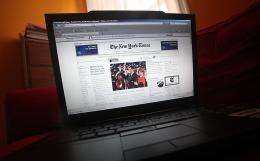
Four years after pulling the plug on an attempt to charge readers on the Web, The New York Times is going to try again.
The US media landscape has changed somewhat since the Times, in September 2007, aborted TimesSelect, its two-year experiment with making readers pay for full access to NYTimes.com.
Print advertising revenue and circulation have continued to slide but newspaper and magazine publishers have latched on to devices like Apple's popular iPad as a potential lifeline.
Apple and Google have also begun offering digital subscription services for news organizations, providing a platform for publishers willing to try to wean Web readers off their accustomed diet of free news.
Few newspapers, however, have followed the lead of Britain's Financial Times and Rupert Murdoch's Wall Street Journal and begun charging online and media analysts and publishers are divided over whether a paid strategy can work.
Rob Grimshaw, managing director of the Financial Times website, FT.com, is firmly in the camp of those who think a paid model can be successful and holds up his newspaper as proof.
FT.com has 210,000 digital subscribers, more than half the newspaper's print circulation, and recorded 50 percent growth in subsciption revenue last year and nearly 50 percent growth in the number of digital subscribers.
"We're very pleased to see another big quality publisher taking the plunge," Grimshaw told AFP of the Times' decision to begin charging for NYTimes.com from March 28.
"We've said for a long time we feel this is an approach and a model that can work very well for quality publishers, not just in terms of niche content like business and finance news, but also for high-quality general news," he said.
"If it's high-quality content, if it's unique, if it's differentiated, then it's valuable to people and if it's valuable people will be prepared to pay."
Gordon Crovitz, former publisher of The Wall Street Journal, is another believer in a paid strategy and a co-founder of Journalism Online, a company which seeks to help news organizations make money on the Web.
Crovitz predicted that charging readers of NYTimes.com could bring in an additional $100 million a year in digital subscription revenue for the Times while not undermining traffic or driving away advertisers.
Another advocate of making online readers pay is News Corp.'s Murdoch, who began charging for Britain's The Times and The Sunday Times online last year and has said he will eventually do the same for all of his newspapers.
Dan Kennedy, a professor of journalism at Boston's Northeastern University, said charging online could well work for the "Gray Lady" but the Times is "not a very good test case for the news business as a whole."
"I really do think there's a huge base of people out there who are willing to pay for the Times and pretty much nothing else," Kennedy said.
"They're probably going to enjoy fairly good success with this and then somebody else says 'OK, we're going to give it a try too' and it fails."
Many US newspaper publishers have been reluctant to erect paywalls around their websites out of fear it will result in a loss of traffic and digital advertising revenue and they will be left out of the online conversation.
Digital advertising revenue has been rising steadily at the Times but at still only accounted for 26 percent of total ad revenue in the last quarter.
One of the reasons the Times killed TimesSelect was because of complaints from its columnists that their opinions were no longer being heard from behind the paywall.
To counter that and remain a visible presence on the Web, the Times is adopting a "metered model," allowing visitors to view 20 articles a month before asking them to pay, and not counting inbound links from Facebook or Twitter as part of the total.
Steve Buttry, director of community engagement at local Washington news website TBD.com, is among the doubters of the Times plan.
"This punishes their most loyal readers for their loyalty: If you really like us and keep on coming back, we'll make you pay," Buttry told Harvard University's Nieman Journalism Lab.
"The hit-and-run Times readers can read for free without ever being bothered," he said. "What the hell kind of business model is that?"
The Financial Times lets registered users see 10 stories a month before asking them to open their wallets.
"We think it's very important that people are able to come into the store and have a look around before we ask them to buy," Grimshaw said.
At the same time, "if you give away too much for free then what you find is that people will take the free sample and not jump over the barrier," he said. "You just have to find the right balance point."
(c) 2011 AFP


