Communicating uncertain climate risks
March 29, 2011

Communicating uncertain climate risks

Enlarge

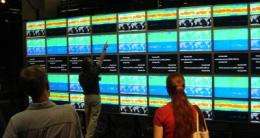
The authors of a recent Perspectives piece in the journal Nature Climate Science say it is not enough to intuit the success of climate communications. They contend the evaluation of climate communication should be met with the same rigor as climate science itself. Here, someone uses the 220 megapixel HiPerWall display at the University of California, San Diego to discuss 10 time varying Intergovernmental Panel on Climate Change simulation runs. Credit: Falko Kuester, California Institute for Telecommunications and Information Technology (Calit2), University of California, San Diego

Despite much research that demonstrates potential dangers from climate change, public concern has not been increasing.

One theory is that this is because the public is not intimately familiar with the nature of the climate uncertainties being discussed.

"A major challenge facing climate scientists is explaining to non-specialists the risks and uncertainties surrounding potential" climate change, says a new Perspectives piece published today in the science journal Nature .

The article attempts to identify communications strategies needed to improve layman understanding of climate science.

"Few citizens or political leaders understand the underlying science well enough to evaluate climate-related proposals and controversies," the authors write, at first appearing to support the idea of specialized knowledge--that only climate scientists can understand .

But, author Baruch Fischhoff quickly dispels the notion. "The goal of science communication should be to help people understand the state of the science," he says, "relevant to the decisions that they face in their private and public lives."

Fischhoff, a social and decision scientist at Carnegie Mellon University in Pittsburgh and Nick Pidgeon, an environmental psychologist at Cardiff University in the United Kingdom wrote the article together, titled, "The role of social and decision sciences in communicating uncertain climate risks."

Fischhoff and Pidgeon argue that should give the public tools that will allow them to understand the uncertainties and disagreements that often underlie scientific discussion. He says that understanding is more likely to happen when people know something about the process that produces the conflicts they hear about in the press.

"Communications about climate science, or any other science, should embrace the same scientific standards as the science that they are communicating," says Fischhoff. He says this is crucial to maintaining people's trust in scientific expertise.

"When people lack expertise, they turn to trusted sources to interpret the evidence for them," Fischhoff says. "When those trusted sources are wrong, then people are misled."

Fischhoff and Pidgeon propose a communications strategy that applies "the best available communications science to convey the best available ." The strategy focuses on identifying, disclosing and when necessary reframing climate risks and uncertainties so the lay public can understand them easily.

"All of our climate-related options have uncertainties, regarding health, economics, ecosystems, and international stability, among other things," says Fischhoff. "It's important to know what gambles we're taking if, for example, we ignore climate issues altogether or create strong incentives for making our lives less energy intensive."

Key to effective communications is what the authors call "strategic organization" and "strategic listening."

Strategic organization involves working in cross-disciplinary teams that include, at a minimum, climate scientists, decision scientists, social and communications specialists and other experts.

Strategic listening encourages scientists, who often have little direct contact with the public, to overcome flawed intuitions of how well they communicate. Strategic listening asks scientists to go beyond intuitive feeling and consider how well they communicate by using systematic feedback and empirical evaluation.

"I think that it is good for scientists to be in contact with the public, so that they can learn about its concerns and see how well, or poorly, they are communicating their knowledge," says Fischhoff. "That way they can do a better job of producing and conveying the science that people need."

Provided by National Science Foundation search and more info website

3.4 /5 (5 votes)  

Filter


Move the slider to adjust rank threshold, so that you can hide some of the comments.


Display comments: newest first

GSwift7
Mar 30, 2011

Rank: not rated yet
You all know I'm a skeptic, but I have no problem with the things this guy is saying.

For example, I particularly like the part where he says that climate spokespersons should take more time to listen to the reactions to what they say. The above statement is a good example of a rational and balanced approach, which makes a person like me more inclined to listen to what the guy is saying.

This is just my opinion, so take it with a grain of salt, but I think people like Jim Hansen and Gavin Schmidt would do well to take this guy's advice. For a person like me, the way they deliver their message takes credibility away from the message. The same goes for the extreme right, where statements by limbaugh and inhofe are no more inspiring than those from the far left.

People just get tired of spin after a while I think.

The obvious catch 22 here is that it only takes a small number of loud idiots to drown out the voices of many smart people.
Rank 3.4 /5 (5 votes)
Relevant PhysicsForums posts

More news stories

SpaceX capsule has 'new car' smell, astronauts say (Update)

SpaceX's Dragon cargo vessel smells like a new car, said astronauts at the International Space Station after opening the hatches Saturday following the spacecraft's landmark mission to the orbiting lab.

Space & Earth / Space Exploration

created 18 hours ago | popularity 4.5 / 5 (20) | comments 0

Astronomers seize last chance in lifetime for Venus Transit

Astronomers are gearing for one the rarest events in the Solar System: an alignment of Earth, Venus and the Sun that will not be seen for another 105 years.

Space & Earth / Astronomy

created 18 hours ago | popularity 5 / 5 (3) | comments 2

Australia hails surprise super-telescope decision

Australia has hailed a surprise decision giving it a role in a radio telescope project aimed at revolutionising astronomy, vowing to draw on its decades of experience in space science.

Space & Earth / Astronomy

created 18 hours ago | popularity 5 / 5 (4) | comments 1

Astronauts enter world's 1st private supply ship

(AP) -- Space station astronauts floated into the Dragon on Saturday, a day after its heralded arrival as the world's first commercial supply ship.

Space & Earth / Space Exploration

created 18 hours ago | popularity 5 / 5 (5) | comments 0

Sophisticated simulations predict future warming

The chances of our planet being hit by a global warming of 3 degrees Celsius by 2050 is as likely as it being hit by an increase of 1.4 degrees, new research shows. Presented in the journal Nature Geoscience, the British study ...

Space & Earth / Earth Sciences

created May 22, 2012 | popularity 4.4 / 5 (9) | comments 51


Scientist: Evolution debate will soon be history

(AP) -- Richard Leakey predicts skepticism over evolution will soon be history. Not that the avowed atheist has any doubts himself.

Dell tablet leak: 10.1-inch display, two-battery choice

(Phys.org) -- Headline after headline talks about vendors’ tablets in the wings as likely number-one contenders for the iPad. Such claims have justifiably been taken with a grain of salt, considering ...

SpotterRF debuts Radar Backpack Kit (w/ Video)

(Phys.org) -- SpotterRF has announced a special radar backpack kit designed to enhance situational awareness for soldiers on the ground. The company says its special radar is designed for warfighters as part ...

Thousands of shellfish found dead in Peru

Thousands of crustaceans were found dead off the coast of Lima following the mystery mass death of dolphins and pelicans, the Peruvian Navy said Friday.

Keep food safety in mind this memorial day weekend

(HealthDay) -- Picnics, parades and cookouts are as much a part of Memorial Day weekend as tributes to the United States' war veterans.

Family history of Alzheimer's affects functional connectivity

(HealthDay) -- Cognitively normal individuals with a family history of late-onset Alzheimer's disease (AD) may display lower resting state functional connectivity in the default mode network (DMN) of the brain, ...