Thermoelectric materials: recycling energy
March 31, 2011 By Agatha Bardoel

Recycling energy

Enlarge

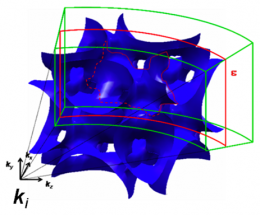
Single-crystal reciprocal space tomography.

(PhysOrg.com) -- For some years now, NASA has been using what are called thermoelectric materials to power its space probes. The probes travel such great distances from our sun that solar panels are no longer an efficient source of power. So NASA imbeds a nuclear material in a radioisotope thermal generator, where it decays, producing heat energy. That energy is then converted by thermoelectric materials into the electricity that powers the space probe. The same technology is now being explored for more earthly applications, for example, to capture heat lost in the exhaust of automobiles to produce electricity for the vehicle.

Thermoelectric materials are a hot new technology that is now being studied intensively by researchers funded by the U.S. Department of Energy's Energy Frontier Research Centers. Oliver Delaire, a Shull fellow at ORNL, is part of such a collaboration, this one led by an EFRC at the Massachusetts Institute of Technology. Delaire uses neutron scattering and computer simulation to investigate the microscopic structure and dynamics of thermoelectric materials so that researchers can make them more efficient for new, energy-saving applications.

Thermoelectrics are adaptable for both heating and for cooling applications. These materials can convert low-grade heat that is wasted in an industrial process, or in the exhaust system of a vehicle, into electricity. Or they can transport heat from an external source of power and manipulate it to cool a surface.

But there are limitations in the materials themselves. "Right now the materials may be on the order of 10 percent efficiency," Delaire said. "If we can make them two or three times better, if we can get 30% efficiency, that would get people very excited, and it would be much more viable economically."

The researchers want to improve their understanding of phonons, the atomic vibrations that transport heat through . "Neutron scattering is unmatched in its ability to probe the atomic vibrations in the crystals," Delaire said. "This is one of the fundamental blocks in the process that we need to understand better."

At ORNL, Delaire and his collaborators are using the Time of Flight spectrometers at SNS-ARCS and CNCS-and the HB-3 Triple-Axis Spectrometer at the High Flux Isotope Reactor.

"The SNS instruments offer more power," Delaire said. "They can sample the whole parameter space very efficiently. They offer a unique opportunity in a single experiment to sample all the types of atomic vibrations, all the phonons inside the solid. And once we have this information, we can reconstruct the microscopic thermoconductivity, which is really the property we are trying to understand."

The single crystals are grown at ORNL. There are two high-temperature materials, PbTe (lead telluride) and La3Te4 (lanthanum telluride) for heat recovery and FeSi (iron silicide) for refrigeration applications. Single crystals offer advantages in neutron science. They can be measured on the TOF instruments at a series of orientations, each orientation giving a comprehensive data set. Combining these sets gives the researchers a complete picture, much like tomography.

"By doing this experiment using the high neutron flux here at SNS we are able to really map out the space, and that is really where the big advance is," Delaire said. "Previously we were only able to look at a few points in the space, and that is like looking with a flashlight. With the flux we have at SNS, we turn on the overhead lights and see the whole room all at once."

Once they have a view of the volume of data, the researchers then use the triple-axis spectrometer at HFIR to zero in and look at pinpoints of phonon vibrations in that region. Next, ab initio computational methods simulate the data that the instruments have generated. These simulations are based on quantum mechanics, which gives the researchers a direct comparison between the neutron science measurements and fundamental theory and theoretical predictions.

In 2010, the researchers uncovered an important coupling between thermal disorder and the electronic structure of FeSi. This type of coupling between thermal disorder and electronic structure at finite temperature could prove to be important in many materials, including thermoelectrics. The research is funded by an Energy Frontier Research Center at MIT and involves a dozen investigators, including Delaire and David Singh, a solid-state theorist in materials science at ORNL. Samples are also contributed by researchers at Boston College. Delaire, Singh and some of the MIT researchers are involved in the computation.

More information: O. Delaire , et al. Phonon softening and metallization of a narrow-gap semiconductor by thermal disorder. Proceedings of the National Academy of Sciences of the United States of America. PNAS March 22, 2011 vol. 108 no. 12 4725-4730

Brian C. Sales, et al. "Thermoelectric properties of FeSi and Related Alloys: Evidence for Strong Electron-Phonon Coupling," PACS: 72.20.Pa, 63.20.Kd. Accepted in Phys. Rev. B.

Provided by Oak Ridge National Laboratory search and more info website

Filter


Move the slider to adjust rank threshold, so that you can hide some of the comments.


Display comments: newest first

Eikka
Mar 31, 2011

Rank: not rated yet
When I was in school, one of the problems presented in the physics class was something like thus:

A ship engineer realized one day that the ocean is typically ten degrees cooler than the air above it, so he had a brilliant idea of lining the bottom of the ship with thermoelectric generators to harness this temperature differential, and save fuel. When he proposed this scheme to his supervisors, he was immediately sacked.

Investigate why.
ereneon
Mar 31, 2011

Rank: not rated yet
Thermoelectric materials are far from "new". The article is a little misleading about that.

@Eikka
Hmmm, interesting. I'll have to think about that.
mattytheory
Mar 31, 2011

Rank: not rated yet
@Eikka:
Because the flow of heat energy is backwards. If the water is cooler than the hull then heat energy is being dissipated into the water instead of being absorbed by the thermoelectric material lining the hull.
Or perhaps the hull will eventually reach an equilibrium temperature with the water so there would be negligible temperature differential. However, doesn't the ship moving through the water still cause friction aka heat?

Just guesses but I am hoping you will repost later with the answer...
Trim
Apr 26, 2011

Rank: not rated yet
I imagine the 'supervisors' had shares in oil companies or the cost of converting the ship to utilise 10 degrees efficiently was way to much. If the sea remained 10 degrees cooler and the hull was insulated it wouldn't matter which direction the ship moved.
Rank 5 /5 (3 votes)
Relevant PhysicsForums posts
  • Writing a book so im learning about things, i have some general questions please read
    created2 hours ago
  • Question about induced E field.
    created3 hours ago
  • Charging a capacitor in a tesla coil
    created3 hours ago
  • Water Rocket
    created6 hours ago
  • why do trucks have bigger brakes?
    created11 hours ago
  • Solar Sail Physics - Do they work on a large scale?
    created12 hours ago
  • More from Physics Forums - General Physics

More news stories

Landmark calculation clears the way to answering how matter is formed

(Phys.org) -- An international collaboration of scientists, including Thomas Blum, associate professor of physics, is reporting in landmark detail the decay process of a subatomic particle called a kaon – ...

Physics / General Physics

created May 25, 2012 | popularity 4.2 / 5 (21) | comments 47 | with audio podcast

Is a classical electrodynamics law incompatible with special relativity?

(Phys.org) -- The laws of classical electromagnetism that were developed in the 19th century are the same laws that scientists use today. They include Maxwell’s four equations along with the Lorentz la ...

Physics / General Physics

created May 24, 2012 | popularity 4.7 / 5 (15) | comments 36 | with audio podcast feature

Lying in wait for WIMPs: Researchers seek to dramatically increase sensitivity of Large Underground Xenon detector

Although it's invisible, dark matter accounts for at least 80 percent of the matter in the universe. No one knows what it is, but most scientists would bet on weakly interacting massive particles, or WIMPs.

Physics / General Physics

created May 23, 2012 | popularity 4 / 5 (7) | comments 15 | with audio podcast

Hall effect at the speed of light: How can you demonstrate relativistic effects with your mobile phone?

The relativistic Hall effect describing objects rotating at speeds comparable with the speed of light has been reported.

Physics / General Physics

created May 21, 2012 | popularity 4.3 / 5 (3) | comments 8

Cloak of invisibility: Engineers use plasmonics to create an invisible photodetector

A team of engineers at Stanford and the University of Pennsylvania has for the first time used "plasmonic cloaking" to create a device that can see without being seen - an invisible machine that detects light. It is the first ...

Physics / General Physics

created May 21, 2012 | popularity 4.8 / 5 (16) | comments 7 | with audio podcast


Scientist: Evolution debate will soon be history

(AP) -- Richard Leakey predicts skepticism over evolution will soon be history. Not that the avowed atheist has any doubts himself.

Dell tablet leak: 10.1-inch display, two-battery choice

(Phys.org) -- Headline after headline talks about vendors’ tablets in the wings as likely number-one contenders for the iPad. Such claims have justifiably been taken with a grain of salt, considering ...

SpotterRF debuts Radar Backpack Kit (w/ Video)

(Phys.org) -- SpotterRF has announced a special radar backpack kit designed to enhance situational awareness for soldiers on the ground. The company says its special radar is designed for warfighters as part ...

SpaceX capsule has 'new car' smell, astronauts say (Update)

SpaceX's Dragon cargo vessel smells like a new car, said astronauts at the International Space Station after opening the hatches Saturday following the spacecraft's landmark mission to the orbiting lab.

Thousands of shellfish found dead in Peru

Thousands of crustaceans were found dead off the coast of Lima following the mystery mass death of dolphins and pelicans, the Peruvian Navy said Friday.

Astronomers seize last chance in lifetime for Venus Transit

Astronomers are gearing for one the rarest events in the Solar System: an alignment of Earth, Venus and the Sun that will not be seen for another 105 years.