Data streaming in from Space Station to OSU lab
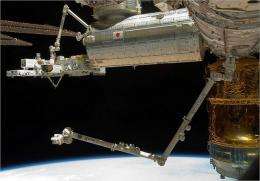
A coastal imaging instrument called the Hyperspectral Imager for the Coastal Ocean, or HICO, is beaming images from the International Space Station to Oregon State University. (photo courtesy of Oregon State University and the Naval Research Laboratory)
A prototype scanner aboard the international space station has been taking new images of Earth's coastal regions during the 16 months since it was launched, providing scientists with a new set of imaging tools that will help them monitor events from oil spills to plankton blooms.
The images and other data are now available to scientists from around the world through an online clearinghouse coordinated by Oregon State University.
Additional details of the project will be announced in a forthcoming issue of the American Geophysical Union journal, EOS, and can be found on an OSU website about the project.
The Hyperspectral Imager for the Coastal Ocean, or HICO, is the first space-borne sensor created specifically for observing the coastal ocean and will allow scientists to better analyze human impacts and climate change effects on the world's coastal regions, according to Curtiss O. Davis, an OSU oceanographer and the project scientist.
"What HICO does that other ocean imaging systems like NASA's MODIS cannot is provide color sensor data down to the human scale," Davis said. "Whereas the normal resolution for an ocean imager is about one kilometer, HICO provides resolution down to 90 meters. And instead of having just nine channels like MODIS, it has 90 channels.
"This allows us to focus the imaging system on a section of the coastline and map the ocean floor in water as deep as 50 to 60 feet," he added. "It gives us the ability to track sediment down the Columbia River, and to distinguish that sediment from phytoplankton blooms in the ocean. It can reveal near-shore eddies, currents, and the influence of coastal streams entering the ocean.
"It is a scientific treasure trove for the coastal oceanographer," he added.
This sophisticated imaging system was developed by the Naval Research Laboratory and installed aboard the space station in 2009. Its development was an experiment to see if engineers could create an "Innovative Naval Prototype" instrument very quickly, at low-cost, and make it work for a year, said Davis, who worked for several years at the laboratory before joining the OSU faculty.
That first goal was achieved last October and now the focus is on the second goal, conducting useful science with this unique data set.
"We've already talked to 40-50 interested scientists and shared some preliminary data," he said, "and they've been excited about the potential. They all want a piece of it."
Some of the images HICO has provided have revealed interesting data:
- Images of the Han River in South Korea outline the dynamic, rapidly shifting shallow mud flats that are covered by the incoming tide, but include sandbars where boats can easily get mired;
- Images from the Straits of Gibraltar, separating Spain from North Africa, reveal where large internal waves propagate hundreds of feet below the surface. These waves, which were used during World War II to hide submarines moving through the channel, can affect fishing and boat navigation.
- Images of the Columbia River, taken during a large storm and after, reveal changing breakwaters and bars that demonstrate the complexity and dynamics of this large system.
The space station orbits Earth about 16 times a day and the researchers are able to get about 5-6 good images daily of targeted locations. Cloud cover and darkness limit the number of possible images, and the transmission of data files is enormous.
Jasmine Nahorniak, a senior research assistant, developed and runs the website through OSU's College of Oceanic and Atmospheric Sciences where HICO images and other data are stored and shared with scientists around the world.
"We have a couple of thousand images and a growing number of scientists who are interested in the data," she said. "It's a work in progress."
More information: The HICO website is at: http://hico.coas.o … onstate.edu/
Provided by
Oregon State University
-
From lemons to lemonade: Reaction uses carbon dioxide to make carbon-based semiconductor,
32 comments
-
Thioridazine kills cancer stem cells in human while avoiding toxic side-effects of conventional cancer treatments,
3 comments
-
SpaceX private rocket blasts off for space station (Update),
42 comments
-
Climate scientists say they have solved riddle of rising sea,
30 comments
-
Research team claims to have found evidence Lake Cheko is impact crater for Tunguska Event,
18 comments
-
Hypothetical desert earth
5 hours ago
-
More human population = greater mass?
May 25, 2012
-
Conversion from aircraft bearing to normal degrees
May 23, 2012
-
Interpretation/Analysis of the Lab results(HEPA filter)
May 22, 2012
-
Has anyone here attended the The Urbino Summer School in Paleoclimatology?
May 22, 2012
-
Earthquakes: Mag 6 N. Italy and Mag 5.6 W. Bulgaria
May 21, 2012
- More from Physics Forums - Earth
More news stories
SpaceX capsule has 'new car' smell, astronauts say (Update)
SpaceX's Dragon cargo vessel smells like a new car, said astronauts at the International Space Station after opening the hatches Saturday following the spacecraft's landmark mission to the orbiting lab.
Space & Earth / Space Exploration
18 hours ago |
4.5 / 5 (20) |
0
Astronomers seize last chance in lifetime for Venus Transit
Astronomers are gearing for one the rarest events in the Solar System: an alignment of Earth, Venus and the Sun that will not be seen for another 105 years.
18 hours ago |
5 / 5 (3) |
2
Australia hails surprise super-telescope decision
Australia has hailed a surprise decision giving it a role in a radio telescope project aimed at revolutionising astronomy, vowing to draw on its decades of experience in space science.
18 hours ago |
5 / 5 (4) |
1
Astronauts enter world's 1st private supply ship
(AP) -- Space station astronauts floated into the Dragon on Saturday, a day after its heralded arrival as the world's first commercial supply ship.
Space & Earth / Space Exploration
18 hours ago |
5 / 5 (5) |
0
Sophisticated simulations predict future warming
The chances of our planet being hit by a global warming of 3 degrees Celsius by 2050 is as likely as it being hit by an increase of 1.4 degrees, new research shows. Presented in the journal Nature Geoscience, the British study ...
Space & Earth / Earth Sciences
May 22, 2012 |
4.4 / 5 (9) |
51
Scientist: Evolution debate will soon be history
(AP) -- Richard Leakey predicts skepticism over evolution will soon be history. Not that the avowed atheist has any doubts himself.
Dell tablet leak: 10.1-inch display, two-battery choice
(Phys.org) -- Headline after headline talks about vendors tablets in the wings as likely number-one contenders for the iPad. Such claims have justifiably been taken with a grain of salt, considering ...
SpotterRF debuts Radar Backpack Kit (w/ Video)
(Phys.org) -- SpotterRF has announced a special radar backpack kit designed to enhance situational awareness for soldiers on the ground. The company says its special radar is designed for warfighters as part ...
Thousands of shellfish found dead in Peru
Thousands of crustaceans were found dead off the coast of Lima following the mystery mass death of dolphins and pelicans, the Peruvian Navy said Friday.
Keep food safety in mind this memorial day weekend
(HealthDay) -- Picnics, parades and cookouts are as much a part of Memorial Day weekend as tributes to the United States' war veterans.
Family history of Alzheimer's affects functional connectivity
(HealthDay) -- Cognitively normal individuals with a family history of late-onset Alzheimer's disease (AD) may display lower resting state functional connectivity in the default mode network (DMN) of the brain, ...
Mar 24, 2011
Rank: not rated yet
http://www.wnd.co...d=278481
Perhaps federal money to OSU shuld be reconsidered until this DeFazio defugalty is resolved.