New shrimp named after scientist
March 4, 2011 By Jennifer Phillips
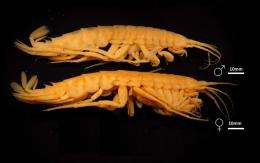
Photo of the male and female Primcaxelia jamiesoni , courtesy of National Institute of Water and Atmospheric research (New Zealand)
Its a new species of shrimp and its been named Princaxelia jamiesoni after the University of Aberdeen scientist who discovered it in trenches at the bottom of the North West Pacific Ocean.
And its almost four decades since the last new member of this shrimp family was discovered.
Dr. Alan Jamieson from the Universitys Oceanlab was on a HADEEP research cruise when the shrimp - or amphipods - were filmed and caught in the Japan Trench in 2008 at 7703m deep and then again in 2009 at the nearby Izu-Bonin Trench at depths of 9316m.
The Research Fellow is Research Manager of the HADEEP Project a collaboration involving the Universities of Aberdeen and Tokyo which is investigating life in the deepest parts of the ocean.
Dr. Jamieson said: We caught lots of the usual animals on both research cruises however in amongst our haul were these long white creatures which no-one knew anything about.
This video is not supported by your browser at this time.
The samples eventually came back to Aberdeen and those unknown species sat under my desk for over two years until our next HADEEP trip took us to New Zealand where I met amphipod taxonomist Dr. Anne-Nina Loerz.I told her about these long white spiky things that we had filmed and caught and was delighted when she said she was an expert in such creatures.
Dr. Jamieson sent the samples to Dr. Loerz who then established that they were a new species.
The taxonomist then named them after Dr. Jamieson saying his dedication to trench research is greatly advancing the scientific knowledge about deep sea biology.
The genus Princaxelia was named after Prince Axel of Denmark (1888-1964) in 1959 after the great Danish Galathea expeditions recovered the first specimens of this kind of shrimp. The last species to be found was in 1977.
This new species, the jamiesoni, is only the fourth species of Princaxelia to be discovered.
Dr. Jamieson, who is originally from Edinburgh, added: It is an extraordinary creature with a long elongated body thought to facilitate swimming over great distances. Yet it is extremely manoeuvrable at short ranges, capable of fast predatory attacks.
It is another example of the extraordinary creatures that inhabit the most extreme depths of the oceans and to have this one named after me is a great honor, both for me, and my family.
Dr. Jamieson and his HADEEP colleagues head off to Japan again tomorrow (March 4) where, among other things, they hope to observe and collect further specimens of Princaxelia jamiesoni.
Meanwhile Dr. Leorzs description of the new shrimphas just been published in the journal Zoologica Baetica and the specimens themselves are currently residing in the National Science Museum of Tokyo.
Provided by
University of Aberdeen
-
From lemons to lemonade: Reaction uses carbon dioxide to make carbon-based semiconductor,
32 comments
-
Thioridazine kills cancer stem cells in human while avoiding toxic side-effects of conventional cancer treatments,
3 comments
-
SpaceX private rocket blasts off for space station (Update),
42 comments
-
Climate scientists say they have solved riddle of rising sea,
30 comments
-
Research team claims to have found evidence Lake Cheko is impact crater for Tunguska Event,
18 comments
-
What would stain as translucent on light-coloured fabric?
8 hours ago
-
How do I identify different bacteria on culture plates?
18 hours ago
-
Why Do Dogs do Strange things...
May 25, 2012
-
What does exophillic and endophillic mean in terms of mosquito and their control?
May 24, 2012
-
Semen stains glows under black lights (uv light)?
May 23, 2012
-
Question on Human Chromosome 2
May 23, 2012
- More from Physics Forums - Biology
More news stories
Scientist: Evolution debate will soon be history
(AP) -- Richard Leakey predicts skepticism over evolution will soon be history. Not that the avowed atheist has any doubts himself.
7 hours ago |
3.4 / 5 (8) |
21
Thousands of shellfish found dead in Peru
Thousands of crustaceans were found dead off the coast of Lima following the mystery mass death of dolphins and pelicans, the Peruvian Navy said Friday.
17 hours ago |
4.8 / 5 (4) |
6
More plant species responding to global warming than previously thought
(Phys.org) -- Far more wild plant species may be responding to global warming than previous large-scale estimates have suggested.
May 22, 2012 |
4.6 / 5 (14) |
18
|
Totally rad: Scientists create rewritable digital data storage in DNA
(Phys.org) -- Scientists from Stanford's Department of Bioengineering have devised a method for repeatedly encoding, storing and erasing digital data within the DNA of living cells.
May 21, 2012 |
4.9 / 5 (17) |
11
|
For monogamous sparrows, it doesn't pay to stray (but they do it anyway)
It's quite common for a female song sparrow to stray from her breeding partner and mate with the male next door, but a new study shows that sleeping around can be costly.
May 22, 2012 |
5 / 5 (1) |
7
|
Dell tablet leak: 10.1-inch display, two-battery choice
(Phys.org) -- Headline after headline talks about vendors tablets in the wings as likely number-one contenders for the iPad. Such claims have justifiably been taken with a grain of salt, considering ...
SpotterRF debuts Radar Backpack Kit (w/ Video)
(Phys.org) -- SpotterRF has announced a special radar backpack kit designed to enhance situational awareness for soldiers on the ground. The company says its special radar is designed for warfighters as part ...
SpaceX capsule has 'new car' smell, astronauts say (Update)
SpaceX's Dragon cargo vessel smells like a new car, said astronauts at the International Space Station after opening the hatches Saturday following the spacecraft's landmark mission to the orbiting lab.
Keep food safety in mind this memorial day weekend
(HealthDay) -- Picnics, parades and cookouts are as much a part of Memorial Day weekend as tributes to the United States' war veterans.
Astronomers seize last chance in lifetime for Venus Transit
Astronomers are gearing for one the rarest events in the Solar System: an alignment of Earth, Venus and the Sun that will not be seen for another 105 years.
Australia hails surprise super-telescope decision
Australia has hailed a surprise decision giving it a role in a radio telescope project aimed at revolutionising astronomy, vowing to draw on its decades of experience in space science.