Scientists study control of invasive tree in western US
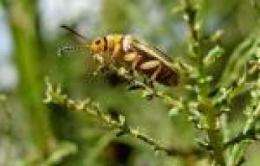
Simply by eating the leaves of an invasive tree that soaks up river water, an Asian beetle may help to slow down water loss in the Southwestern United States.
Two scientists from UC Santa Barbara, working with colleagues from the U.S. Geological Survey and the U.S. Department of Agriculture, have published the first substantive data showing water savings that can result from using Asian beetles for the biological control of tamarisk, an invasive tree of western rivers. The study is now published online and in print in the journal Oecologia.
"Widespread growth of this tree is a critical issue in arid regions facing greater social water demands," said Carla D'Antonio, Schuyler Professor of Environmental Studies at UCSB. "It happens at a time when water supplies may be reduced as a consequence of climate change. Additionally, society is increasingly concerned about wildlife species that depend on these wetland ecosystems."
Tamarisk, also known as saltcedar, is an invasive tree or shrub from Eurasia that occupies over one million acres of riverside habitat in western North America. It displaces native riparian woodlands, reduces habitat quality for wildlife, exacerbates erosion and sedimentation problems, and is flammable, therefore a wildfire hazard. The tree was introduced into North America over 100 years ago, and has overtaken many Western river systems.
The study was conducted in the Great Basin of Nevada as part of a USDA Agricultural Research Service program to develop new methods for invasive plant management. During the first year of large-scale tamarisk defoliation by the tamarisk leaf beetle (Diorhabda carinulata), approximately 2,500 acre-feet of water remained in the ground rather than being lost to the atmosphere. This was in the Humboldt River Basin of northern Nevada in an area of approximately 4,500 acres where tamarisk vegetation dominates.
"This is roughly the same amount of water that would be used to irrigate 1,000 agricultural acres in a year," said Tom Dudley, associate research biologist at UCSB, who cited Pacific Institute figures. "At a value of $185 per acre-foot, or almost a half million dollars, this amount of water could provide for the annual water needs of 5,000 to 10,000 households. It suggests that the biocontrol of weedy tamarisk across the Western U.S. could play an important role in conserving limited water resources."
The researchers pointed out that in warmer desert regions of the U.S. southwest, where water demand by vegetation and by humans is higher, water savings via tamarisk control could be even more important. In some regions the plants that come back following tamarisk control, particularly wetland plants like cottonwoods and willows, also tend to use a large amount of water but they do not get as dense nor cover as much area of the river corridor as tamarisk. So water savings will still accrue, as will benefits to wildlife that depend on these native riparian plants for habitat.
First author Robert Pattison, now an analyst with the U.S. Forest Service PNW Research Station, worked from March through December for two years at field sites along the Humboldt and Walker rivers in western Nevada. Both sites have dense infestations of tamarisk and daily high temperatures of about 100 degrees in mid-summer.
Pattison gave a glimpse of the fieldwork involved in the project. "In addition to the heat and dust, we contended with occasional rattlesnakes. And there were cows and rabbits that developed a taste for the cables on our equipment," said Pattison. "Aside from these challenges, the work was very rewarding –– in part because of interactions with ranchers and other land owners who granted us access to their lands. And it was rewarding because of the dramatic effect the tamarisk leaf beetle had on tamarisk trees. Entire stands were defoliated within a few years of release."
Provided by University of California - Santa Barbara


