Scientists to study effects of shipping containers lost at sea
March 9, 2011

MBARI and Monterey Bay National Marine Sanctuary to study effects of shipping containers lost at sea

Enlarge

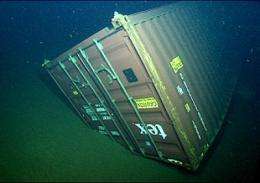
This shipping container was discovered upside down on the seafloor by MBARI researchers in June 2004, four months after it was lost at sea. Researchers will revisit this site during the upcoming cruise. Credit: (c) 2004 MBARI

Each year, an estimated 10,000 shipping containers fall off container ships at sea. Although many of these containers float at the surface for months, most eventually sink to the seafloor. No one knows what happens to these containers once they reach the deep seafloor.

From March 8 to March 10, 2011, a team of researchers from MBARI and the Monterey Bay National Marine Sanctuary (MBNMS) will use a to study the biological impacts of a shipping container resting on the seafloor about 20 kilometers (12 miles) outside of Monterey Bay (but still within the boundaries of the sanctuary).

MBARI researchers first discovered this lost container at a depth of about 1,300 meters (4,200 feet) during a dive in June 2004. Video from MBARI's submersible clearly showed serial numbers on the side of this container. Sanctuary staff sent these numbers to the U.S. customs agency, which was able to identify the ship that had originally carried the container.

The merchant vessel Med Taipei left San Francisco on February 25, 2004, in the middle of a winter storm. As the ship steamed south toward the Port of Los Angeles, it began rolling violently in seven- to nine-meter (23- to 30-foot) swells. In a rush to get his goods to port, the captain continued southward at high speed, despite the rolls. Unbeknownst to the captain and crew, the containers on their ship had been stacked incorrectly, with massive, heavy containers perched on top of lighter ones.

Shortly after midnight on February 26, when the Med Taipei was directly offshore of Monterey Bay, stacks of containers began to break free of their lashings and topple sideways. Fifteen of the 40-foot long containers fell overboard into the churning sea. Yet the ship continued south. By the time the ship reached the Port of Los Angeles, nine more containers had fallen overboard, and another 21 lay crumpled on deck.

You would have thought a disaster like this would have made the national news. But no one was hurt, and there is no legal requirement for shipping companies to report such losses. No government officials knew about this debacle except perhaps a few customs inspectors.

Following up on MBARI's discovery, sanctuary staff investigated the potential for recovering the other missing 14 containers. However, they soon discovered that it was unlikely that the additional containers would ever be located, and the cost and time involved in recovering them would have been prohibitive.

On July 26, 2006, after a significant legal effort, the shipping company agreed to pay the National Oceanic and Atmospheric Administration $3.25 million to settle claims relating to the lost containers. Money from this settlement is being used to fund the upcoming research dives.

Leading the dives are Andrew DeVogelaere, research coordinator at the MBNMS, and James Barry, a senior scientist at MBARI. Using MBARI's research vessel Western Flyer and the remotely operated vehicle Doc Ricketts, the team will take a close look at the container itself, as well as the seafloor around the container.

Marine biologists will count the number of deep-sea animals on and around the container, and collect samples of sediment at various distances from the container for biological and chemical analysis. By comparing animal communities close to and away from the container, the researchers hope to determine what effects (if any) the container has had on life.

According to the U.S. Customs manifest, the container discovered by MBARI holds about 1,159 steel belted tires. Other containers that fell overboard held cyclone fencing, leather chairs, and mattress pads.

This motley list underscores the fact that much of the every-day merchandise we buy in stores has been shipped to the U.S. by container ship. Approximately 90 percent of worldwide non-bulk cargo travels by container ship, and between five and six million containers are in transit at any given moment. To make matters worse, not all container cargo is inert. Perhaps 10 percent of shipping containers carry household and industrial chemicals that could be toxic to marine life.

Over the last five years, the number of containers lost at sea has increased dramatically. This trend is likely to continue as new container ships are being built twice as large as existing ones. Yet tie-down technology and lax monitoring of container weights and stacking procedures have not changed significantly.

The upcoming expedition will provide a snapshot of what is essentially a worldwide problem. When shipping containers are lost at sea, they endanger other craft, cost considerable time and money, and sometimes pose hazards to marine life. According to DeVogelaere, "As these containers drop to the bottom of the sea, they form deep-water stepping stones between ports, highways of debris, if you will. I hope that this cruise will help expand the public's thinking about human impacts in the deep sea."

Provided by Monterey Bay Aquarium Research Institute search and more info website

4.7 /5 (7 votes)  

Filter


Move the slider to adjust rank threshold, so that you can hide some of the comments.


Display comments: newest first

Nik_2213
Mar 09, 2011

Rank: not rated yet
The floaters are also a hazard to navigation-- Ramming one with a yacht would be comparable to a whale-strike...
irjsiq
Mar 10, 2011

Rank: not rated yet
'Flotation Devices' and 'RFID/GPS' transmitters would not add that much to the cost of manufacture . . . placement on Containers is the major obstacle to incorporation of such 'devices'!

10,000 Containers? That is quite a huge investment in the containers alone; add to that the 'contents', and the 'nature of the contents' (both environmentally and economically), and quite large loss figures rapidly accumulate!

Roy J Stewart,
Phoenix AZ
Bob_Kob
Mar 10, 2011

Rank: not rated yet
I don't think gps works at the bottom of the ocean...
dogbert
Mar 10, 2011

Rank: not rated yet
Each year, an estimated 10,000 shipping containers fall off container ships at sea.


That figure is simply mind boggling. You would thing human beings would develop a better method of securing expensive containers.
APB
Mar 10, 2011

Rank: not rated yet
Being in the ocean freight business and also a surfer, this article was quite interesting to me, especially from a statistics standpoint. I had no idea.. I'm a first time visitor to this site as well. Great info!
d_robison
Mar 16, 2011

Rank: not rated yet
Each year, an estimated 10,000 shipping containers fall off container ships at sea.


That figure is simply mind boggling. You would thing human beings would develop a better method of securing expensive containers.


It is a lot, but compared to the number of shipping containers crossing the oceans of the world it is minimal. You would think that they would be able to just prevent the shipping containers from falling off the ship in the first place.

As far as an economic stand point there are so many different companies shipping overseas that one company may be only losing a few containers a year.

And of course there is the environmental side of the problem where we have 10000 containers a year being dropped into the ocean. If they were empty this would be a great way to make artificial reefs (much like they do with some old ships). However, the reality is most of them are probably filled with stuff we don't want soaking in our ocean water.
Rank 4.7 /5 (7 votes)
Relevant PhysicsForums posts

More news stories

SpaceX capsule has 'new car' smell, astronauts say (Update)

SpaceX's Dragon cargo vessel smells like a new car, said astronauts at the International Space Station after opening the hatches Saturday following the spacecraft's landmark mission to the orbiting lab.

Space & Earth / Space Exploration

created 17 hours ago | popularity 4.5 / 5 (20) | comments 0

Astronomers seize last chance in lifetime for Venus Transit

Astronomers are gearing for one the rarest events in the Solar System: an alignment of Earth, Venus and the Sun that will not be seen for another 105 years.

Space & Earth / Astronomy

created 17 hours ago | popularity 5 / 5 (3) | comments 2

Australia hails surprise super-telescope decision

Australia has hailed a surprise decision giving it a role in a radio telescope project aimed at revolutionising astronomy, vowing to draw on its decades of experience in space science.

Space & Earth / Astronomy

created 17 hours ago | popularity 5 / 5 (4) | comments 1

Astronauts enter world's 1st private supply ship

(AP) -- Space station astronauts floated into the Dragon on Saturday, a day after its heralded arrival as the world's first commercial supply ship.

Space & Earth / Space Exploration

created 17 hours ago | popularity 5 / 5 (5) | comments 0

Sophisticated simulations predict future warming

The chances of our planet being hit by a global warming of 3 degrees Celsius by 2050 is as likely as it being hit by an increase of 1.4 degrees, new research shows. Presented in the journal Nature Geoscience, the British study ...

Space & Earth / Earth Sciences

created May 22, 2012 | popularity 4.4 / 5 (9) | comments 51


Scientist: Evolution debate will soon be history

(AP) -- Richard Leakey predicts skepticism over evolution will soon be history. Not that the avowed atheist has any doubts himself.

Dell tablet leak: 10.1-inch display, two-battery choice

(Phys.org) -- Headline after headline talks about vendors’ tablets in the wings as likely number-one contenders for the iPad. Such claims have justifiably been taken with a grain of salt, considering ...

SpotterRF debuts Radar Backpack Kit (w/ Video)

(Phys.org) -- SpotterRF has announced a special radar backpack kit designed to enhance situational awareness for soldiers on the ground. The company says its special radar is designed for warfighters as part ...

Thousands of shellfish found dead in Peru

Thousands of crustaceans were found dead off the coast of Lima following the mystery mass death of dolphins and pelicans, the Peruvian Navy said Friday.

Keep food safety in mind this memorial day weekend

(HealthDay) -- Picnics, parades and cookouts are as much a part of Memorial Day weekend as tributes to the United States' war veterans.

Family history of Alzheimer's affects functional connectivity

(HealthDay) -- Cognitively normal individuals with a family history of late-onset Alzheimer's disease (AD) may display lower resting state functional connectivity in the default mode network (DMN) of the brain, ...