SAGE III - ISS prepped for space station
March 3, 2011 By Michael Finneran
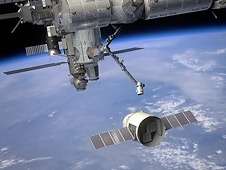
A SpaceX Dragon capsule prepares to dock with the International Space Station. Credit: NASA
After nine years in a clean room, an instrument that studies the Earth's atmosphere and protective ozone layer has been returned to service.
NASA's Stratospheric Aerosol and Gas Experiment III-ISS (SAGE III-ISS) will measure ozone, water vapor and aerosols in the atmosphere when it is attached to the International Space Station (ISS) three years from now.
The instrument is scheduled for launch in 2014 on a SpaceX rocket from NASA's Kennedy Space Center in Florida.
"It will ride in the unpressurized trunk of the rocket, and NASA will use robots to dock the instrument on the ISS - kind of like Transformers," said Michael Cisewski, SAGE III-ISS project manager at NASA Langley Research Center in Hampton, Va. "We're mounting to a piece of the ISS that is going up in the next shuttle launch."
Patience Pays
SAGE III-ISS is a nearly exact replica of SAGE III Meteor-3M, sent into orbit in 2001 on a Russian satellite. SAGE III Meteor-3M went out of service five years ago when the satellite's power supply stopped working.
The new instrument was built in anticipation of being attached to the space station in 2005. A change in ISS design, however, put those plans on hold.
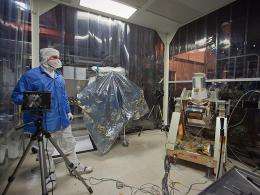
NASA Langley engineer Mark Thornblom helps calibrate SAGE III-ISS for its scan of the moon Feb. 17. The SAGE team arrived at midnight to continue testing the instrument, which will be attached to the space station to measure ozone, water vapor and aerosols in the Earth's atmosphere. Credit: NASA/Sean Smith
The instrument was stored in a Class 100 clean room in a sealed shipping container under a continuous gaseous nitrogen purge. The purge kept clean dry "air" inside the instrument."Now, everything is falling into place," said Cisewski.
SAGE III-ISS underwent initial testing at Langley the week of February 14, 2011, in a clean room set up in a bay with an afternoon view of the sun.
Sunspotting
The instrument was commanded to point to and lock onto the sun as if it were engaging a sunrise event over the horizon. Once locked on, the instrument's scan mirror scanned the full disk of the sun every two seconds. It also was tested at night using the moon as a radiant source.
"It's a matter of testing SAGE III in all its operational modes, solar and lunar, then making some minor modifications," said Patrick McCormick, SAGE principal investigator partnering with NASA through the Center for Atmospheric Sciences at Hampton University in Hampton, Va.
"The nice thing about SAGE III-ISS," McCormick said, "is that being a replica of a proven instrument, the risk for its refurbishment is exceedingly low. SAGE III is a solid, stable instrument."
A Pathfinder
Unique aspects of SAGE III-ISS include:
It will be among the early NASA payloads sent into space on a commercial launch vehicle, the SpaceX F9/Dragon. Started in 2002 by Elon Musk, founder of PayPal and Zip2 Corp., SpaceX has developed two launch vehicles, established a launch manifest and is funded by NASA to demonstrate delivery and return of cargo to the space station.
SAGE III-ISS will be the first instrument to measure the composition of the middle and lower atmosphere from the space station. "ISS is in the perfect orbit to do these sorts of measurements," said Joseph Zawodny, SAGE III-ISS project scientist.
SAGE is one of NASA's longest running Earth-observing programs. That's significant because long-term collection of this data is necessary to understand climate change.
Previous SAGE instruments include SAGE, launched in 1979, followed by SAGE II in 1984. SAGE II gathered data for more than 20 years, and the information it collected was part of the effort that led to a global ban on chlorofluorocarbons in 1987.
Chlorofluorocarbons were used in air-conditioning units and aerosol spray propellants that contributed to the Earth's shrinking layer of protective ozone, which has begun to recover after the chlorofluorocarbon ban.
Ball Aerospace & Technologies Corp. built the SAGE III-ISS instrument in Boulder, Colo. The European Space Agency and Thales Alenia Space, headquartered in France, are providing a hexapod to keep the instrument pointing in the right direction as the ISS maneuvers in space.
Provided by
JPL/NASA
-
From lemons to lemonade: Reaction uses carbon dioxide to make carbon-based semiconductor,
32 comments
-
Thioridazine kills cancer stem cells in human while avoiding toxic side-effects of conventional cancer treatments,
3 comments
-
SpaceX private rocket blasts off for space station (Update),
42 comments
-
Climate scientists say they have solved riddle of rising sea,
30 comments
-
Research team claims to have found evidence Lake Cheko is impact crater for Tunguska Event,
18 comments
-
revamping general concept and cosmological principle
May 25, 2012
-
Transiting Exoplanet Light Curve
May 25, 2012
-
Math behind Theoretical Physics
May 24, 2012
-
Do we know whats at the center of galaxies yet?
May 23, 2012
-
Structure of the Milky Way?
May 20, 2012
-
What would it take to terraform Pluto and Charon?
May 19, 2012
- More from Physics Forums - General Astronomy
More news stories
SpaceX capsule has 'new car' smell, astronauts say (Update)
SpaceX's Dragon cargo vessel smells like a new car, said astronauts at the International Space Station after opening the hatches Saturday following the spacecraft's landmark mission to the orbiting lab.
Space & Earth / Space Exploration
17 hours ago |
4.5 / 5 (20) |
0
Astronomers seize last chance in lifetime for Venus Transit
Astronomers are gearing for one the rarest events in the Solar System: an alignment of Earth, Venus and the Sun that will not be seen for another 105 years.
17 hours ago |
5 / 5 (3) |
2
Australia hails surprise super-telescope decision
Australia has hailed a surprise decision giving it a role in a radio telescope project aimed at revolutionising astronomy, vowing to draw on its decades of experience in space science.
17 hours ago |
5 / 5 (4) |
1
Astronauts enter world's 1st private supply ship
(AP) -- Space station astronauts floated into the Dragon on Saturday, a day after its heralded arrival as the world's first commercial supply ship.
Space & Earth / Space Exploration
17 hours ago |
5 / 5 (5) |
0
Sophisticated simulations predict future warming
The chances of our planet being hit by a global warming of 3 degrees Celsius by 2050 is as likely as it being hit by an increase of 1.4 degrees, new research shows. Presented in the journal Nature Geoscience, the British study ...
Space & Earth / Earth Sciences
May 22, 2012 |
4.4 / 5 (9) |
51
Scientist: Evolution debate will soon be history
(AP) -- Richard Leakey predicts skepticism over evolution will soon be history. Not that the avowed atheist has any doubts himself.
Dell tablet leak: 10.1-inch display, two-battery choice
(Phys.org) -- Headline after headline talks about vendors tablets in the wings as likely number-one contenders for the iPad. Such claims have justifiably been taken with a grain of salt, considering ...
SpotterRF debuts Radar Backpack Kit (w/ Video)
(Phys.org) -- SpotterRF has announced a special radar backpack kit designed to enhance situational awareness for soldiers on the ground. The company says its special radar is designed for warfighters as part ...
Thousands of shellfish found dead in Peru
Thousands of crustaceans were found dead off the coast of Lima following the mystery mass death of dolphins and pelicans, the Peruvian Navy said Friday.
Keep food safety in mind this memorial day weekend
(HealthDay) -- Picnics, parades and cookouts are as much a part of Memorial Day weekend as tributes to the United States' war veterans.
Family history of Alzheimer's affects functional connectivity
(HealthDay) -- Cognitively normal individuals with a family history of late-onset Alzheimer's disease (AD) may display lower resting state functional connectivity in the default mode network (DMN) of the brain, ...
