Using quantum methods to read classical memories offers surprising advantages
Mar 14, 2011 by Lisa Zyga feature
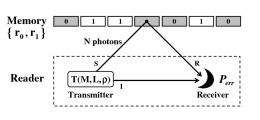
In this basic model of a digital memory, information is stored in memory cells (top row) whose different reflectivities correspond to bit values of 0 or 1. To read the memory, a transmitter shines light directly over a cell. The light is then reflected to a receiver, which measures the value of the bit. Image credit: Stefano Pirandola. ©2011 American Physical Society.

(PhysOrg.com) -- Currently, the data stored in classical digital memories such as CDs, DVDs, and barcodes is read by classical light. But as a new study shows, using quantum light to read these classical memories can bring surprising advantages. Quantum light can read digital data using very few photons, an ability that could lead to faster digital readers and optical memories with larger storage capacities than before.

Quantum physicist Stefano Pirandola from the University of York, UK, has published the study on the quantum readout of classical memories in a recent issue of .

"This is the first demonstration showing that the use of nonclassical light is beneficial for the readout of digital memories, reminiscent of current optical storage devices," Pirandola told PhysOrg.com.

As Pirandola explains in his study, there is an important difference between classical light – the light that is used in practically all of today’s technology applications – and quantum light. In classical light, the states of the electromagnetic field can be decomposed as probabilistic sums of coherent states. In contrast, when this decomposition is not possible, the states of an electromagnetic field are considered to be nonclassical (quantum). Important examples of nonclassical states are those that are entangled, in particular those with Einstein-Podolsky-Rosen (EPR) correlations. When two modes of light are described by these kinds of entangled states, their position and momentum "quadratures" are extremely correlated with each other.

In the proposed method, a classical digital memory consists of many reflective cells, each of which has two possible reflectivities that represent the states 0 and 1 (the two values of a bit). To read the memory, light is irradiated on the cells, and a detector measures the reflected light to determine each cell’s state. Currently, classical light is used for these kinds of memories. However, when its energy is decreased, classical light can only retrieve a limited amount of information from each cell.

Quantum light, on the other hand, doesn’t face the theoretical limits that classical light does. Pirandola’s calculations showed that EPR transmitters (those that use quantum light) can retrieve much more information than classical transmitters in the regime of few photons. He calculates that the enhancement provided by quantum light can be quite large – even up to 1 bit per cell, which corresponds to the extreme situation where only quantum light can retrieve information, and classical light cannot retrieve any information at all.

Since quantum light can read digital information with significantly fewer photons than classical light, it can greatly reduce the reading time of the memory, resulting in higher data transfer rates. For instance, quantum light could increase the rotational speed of a DVD in such a way that only a few photons are irradiated in each data sector. Alternatively, if the reading time is fixed, the quantum light method can offer increased storage capacity compared to reading with classical light.

“The enhancement will be clearer in the future once quantum technology provides more efficient sources of quantum light,” Pirandola said. “Using quantum light, we could read memories using a few photons per bit, while today we use around 1010 photons per bit. This can give an idea of the possible improvement, but I am not able to give good estimates.”

Pirandola also shows that EPR transmitters can be used in error-corrected memory models, in which each bit of information is stored in multiple cells to provide nearly flawless data readout. In contrast, low-energy classical transmitters are basically useless in this situation because they require many more cells for retrieving a single bit of information.

One other possible advantage for reading with quantum light lies in photodegradable organic memories, which contain confidential information. Faint may be able to read this data since it uses so few photons, whereas energetic classical light would destroy these memories.

“The challenging part [of experimentally demonstrating this concept] is clearly in the [light] source which should be fast and efficient,” Pirandola said. “Despite this, a pilot experiment is within the catch of current technology.”

Explore further: Making quantum encryption practical

More information: Stefano Pirandola. “Quantum Reading of a Classical Digital Memory.” Physical Review Letters 106, 090504 (2011). DOI:10.1103/PhysRevLett.106.090504

4.8 /5 (34 votes)

Related Stories

Shining light in quantum computing

Sep 12, 2006

University of Queensland scientist Devon Biggerstaff is investigating ways to manipulate light in a process that will help shape future supercomputers and communication technology.

Quantum memory for communication networks of the future

Nov 08, 2010

Researchers from the Niels Bohr Institute at the University of Copenhagen have succeeded in storing quantum information using two 'entangled' light beams. Quantum memory or information storage is a necessary ...

Better light measurement through quantum cloning

Aug 30, 2010

(PhysOrg.com) -- "One of the things we have been studying is how the world works on a really small scale," Bruno Sanguinetti, a scientist at the University of Geneva in Switzerland tells PhysOrg.com. "At the quantum level, ...

Quantum electronics: Two photons and chips

Jan 20, 2006

Scientists at Toshiba Research Europe Limited (Cambridge, UK) believe they are on to a way of producing entangled twins of photons using a simple semiconductor electronic device. Such a chip-based source of entangled photons ...

Pure mathematics behind the mechanics

Feb 07, 2008

Dutch researcher Peter Hochs has discovered that the same effects can be observed in quantum and classical mechanics, if quantisation is used.

Recommended for you

Making quantum encryption practical

16 hours ago

One of the many promising applications of quantum mechanics in the information sciences is quantum key distribution (QKD), in which the counterintuitive behavior of quantum particles guarantees that no one can eavesdrop on ...

Lab sets a new record for creating heralded photons

May 20, 2013

(Phys.org) —Entanglement, by general consensus of physicists, is the weirdest part of quantum science. To say that two particles, A and B, are entangled means that they are actually two parts of an inseparable ...

Competition in the quantum world

May 20, 2013

Innsbruck physicists led by Rainer Blatt and Peter Zoller experimentally gained a deep insight into the nature of quantum mechanical phase transitions. They are the first scientists that simulated the competition ...

New principle may help explain why nature is quantum

May 14, 2013

Like small children, scientists are always asking the question 'why?'. One question they've yet to answer is why nature picked quantum physics, in all its weird glory, as a sensible way to behave. Researchers ...

User comments : 5

Adjust slider to filter visible comments by rank

Display comments: newest first

holoman
2.3 / 5 (3) Mar 14, 2011
Seems simple huh ?

But I can tell the transmitter, receiver, and bits are all going
to experience things like unrelated thermal expansion of various components at different rates which if not addressed will cause technology failure.
TabulaMentis
5 / 5 (4) Mar 14, 2011
Just imagine where all of this will lead once we can get quantum light to read information down to the sub-nano, pico, femto, zepto, yocto and etc. scales.
marraco
not rated yet Mar 17, 2011
But it is for optical media?

It would be useless for future DVDs, since even small temperature variations would cause deformations making the media unusable.

It may have applications on optical hard disks, maybe.
PaulRadcliff
not rated yet Mar 23, 2011
I can see, twenty years from now, perhaps even sooner- Quantum Artificial Intelligence. Maybe not surpassing an animal ability, but even that may be smart enough to be very useful. If computer chips get married to human neurons and neural networks, effectively making a cyborg brain, what's next? Super-intelligent cyborg mega minds. Will such advancements be corruptible by nefarious power hungry types?
Of course!! Can you imagine a megalomaniac like Gadhaffi souped up with a Quantum Computing Brain Multitasking Implant. Think of the global chaos such a mad man could cause.
Conversely, a super genius scientist could solve lots of nagging medical problems, discover new, super efficient, energy sources or methods for extracting energy from who knows what! Warp Drive anyone? Probably ways around that light speed barrier, if it really proves to exist. Think of the leaps ahead in technological progress, if such brain enhancements were someday possible. Maybe a helmet brain booster. Cool....
Ralph
not rated yet Apr 09, 2011
I am not ready for super-intelligence, but I do want my Google Brain Interface -- and I want it now. Neuromancer-type fantasies are definitely in my line.

More news stories

Making quantum encryption practical

One of the many promising applications of quantum mechanics in the information sciences is quantum key distribution (QKD), in which the counterintuitive behavior of quantum particles guarantees that no one can eavesdrop on ...

Lab sets a new record for creating heralded photons

(Phys.org) —Entanglement, by general consensus of physicists, is the weirdest part of quantum science. To say that two particles, A and B, are entangled means that they are actually two parts of an inseparable ...

Encouraging signs for bee biodiversity

Declines in the biodiversity of pollinating insects and wild plants have slowed in recent years, according to a new study. Researchers led by the University of Leeds and the Naturalis Biodiversity Centre in the Netherlands ...

If you can remember it, you can remember it wrong

(Medical Xpress)—Native peoples in regions where cameras are uncommon sometimes react with caution when their picture is taken. The fear that something must have been stolen from them to create the photo ...

B vitamins could delay dementia

(Medical Xpress)—Despite spending billions of dollars on research and development, drug companies have been unable to come up with effective treatments for dementia and Alzheimer's Disease (AD). Now, A. ...

New method for producing clean hydrogen

Duke University engineers have developed a novel method for producing clean hydrogen, which could prove essential to weaning society off of fossil fuels and their environmental implications.