Oldest objects in solar system indicate a turbulent beginning
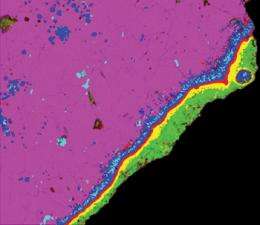
Compositional X-ray image of the rim and margin of a ~4.6 billion year old calcium aluminum refractory inclusion (CAI) from the Allende carbonaceous chondrite. Core extending well beyond the field of view to the upper left consists of melilite, spinel and perovskite. Rim consists of a sequence of mono-mineral layers a few micrometers thick (hibonite, perovskite, spinel, melilite/sodalite, pyroxene, and olivine). A spinel-rich micro-inclusion appears to have been entrapped while the rim was forming.
(PhysOrg.com) -- Scientists have found that calcium, aluminum-rich inclusions (CAIs), some of the oldest objects in the solar system, formed far away from our sun and then later fell back into the mid-plane of the solar system.
The findings may lead to a greater understanding of how our solar system and possibly other solar systems formed and evolved.
CAIs, roughly millimeter- to centimeter in size, are believed to have formed very early in the evolution of the solar system and had contact with nebular gas, either as solid condensates or as molten droplets. Relative to planetary materials, CAIs are enriched with the lightest oxygen isotope and are believed to record the oxygen composition of solar nebular gas where they grew. CAIs, at 4.57 billion years old, are millions of years older than more modern objects in the solar system, such as planets, which formed about 10-50 million years after CAIs.
Using Lawrence Livermore's NanoSIMS (nanometer-scale secondary-ion mass spectrometer) an instrument that can analyze samples with nanometer-scale spatial resolution LLNL scientists in conjunction with NASA Johnson Space Center, University of California, Berkeley and the University of Chicago measured the concentrations of oxygen isotopes found in the CAIs.
In the recent research, the team studied a specific CAI found in a piece of the Allende meteorite. Allende is the largest carbonaceous chondrite meteorite ever found on Earth. It fell to the ground in 1969 over the Mexican state of Chihuahua and is notable for possessing abundant CAIs.
Their findings imply that CAIs formed from several oxygen reservoirs, likely located in distinct regions of the solar nebula. CAIs travelled within the nebula by lofting outward away from the sun and then later falling back into the mid-plane of the solar system or by spiraling through shock waves around the sun.
Through oxygen isotopic analysis, the team found that rims surrounding the CAI show that late in the CAI's evolution, it was in a nebular environment distinct from where it originated and closer in composition to the environment in which the building materials of the terrestrial planets formed.
"Allende is this very unusual meteorite with all these wonderful inclusions (CAIs)," said Ian Hutcheon, one of the LLNL scientists. "The isotopic measurements indicate that this CAI was transported among several different nebular oxygen isotopic reservoirs, arguably as it passed through into various regions of the protoplanetary disk."
A protoplanetary disk is an area of dense gas surrounding a newly formed star. In this case, the CAI formed when our star was quite young.
"It is particularly interesting in understanding the formation and dynamics of our solar system's protoplanetary disk (and protoplanetary disks in general)," said Justin Simon of NASA Johnson Space Center and lead author of a paper appearing in the March 4 issue of the journal Science.
The new observations, "support early and short-lived fluctuations of the environment in which CAIs formed, either due to transport of the CAIs themselves to distinct regions of the solar nebula or because of varying gas composition near the proto-sun", Hutcheon said.
Provided by
Lawrence Livermore National Laboratory
-
From lemons to lemonade: Reaction uses carbon dioxide to make carbon-based semiconductor,
32 comments
-
Thioridazine kills cancer stem cells in human while avoiding toxic side-effects of conventional cancer treatments,
3 comments
-
SpaceX private rocket blasts off for space station (Update),
42 comments
-
Climate scientists say they have solved riddle of rising sea,
30 comments
-
Research team claims to have found evidence Lake Cheko is impact crater for Tunguska Event,
18 comments
-
revamping general concept and cosmological principle
May 25, 2012
-
Transiting Exoplanet Light Curve
May 25, 2012
-
Math behind Theoretical Physics
May 24, 2012
-
Do we know whats at the center of galaxies yet?
May 23, 2012
-
Structure of the Milky Way?
May 20, 2012
-
What would it take to terraform Pluto and Charon?
May 19, 2012
- More from Physics Forums - General Astronomy
More news stories
SpaceX capsule has 'new car' smell, astronauts say (Update)
SpaceX's Dragon cargo vessel smells like a new car, said astronauts at the International Space Station after opening the hatches Saturday following the spacecraft's landmark mission to the orbiting lab.
Space & Earth / Space Exploration
16 hours ago |
4.5 / 5 (19) |
0
Astronomers seize last chance in lifetime for Venus Transit
Astronomers are gearing for one the rarest events in the Solar System: an alignment of Earth, Venus and the Sun that will not be seen for another 105 years.
16 hours ago |
5 / 5 (2) |
2
Australia hails surprise super-telescope decision
Australia has hailed a surprise decision giving it a role in a radio telescope project aimed at revolutionising astronomy, vowing to draw on its decades of experience in space science.
16 hours ago |
5 / 5 (4) |
1
Astronauts enter world's 1st private supply ship
(AP) -- Space station astronauts floated into the Dragon on Saturday, a day after its heralded arrival as the world's first commercial supply ship.
Space & Earth / Space Exploration
16 hours ago |
5 / 5 (5) |
0
Dragon arrives at space station in historic 1st (Update 2)
The privately bankrolled Dragon capsule made a historic arrival at the International Space Station on Friday, triumphantly captured by astronauts wielding a giant robot arm.
Space & Earth / Space Exploration
May 25, 2012 |
5 / 5 (10) |
19
Dell tablet leak: 10.1-inch display, two-battery choice
(Phys.org) -- Headline after headline talks about vendors tablets in the wings as likely number-one contenders for the iPad. Such claims have justifiably been taken with a grain of salt, considering ...
Scientist: Evolution debate will soon be history
(AP) -- Richard Leakey predicts skepticism over evolution will soon be history. Not that the avowed atheist has any doubts himself.
SpotterRF debuts Radar Backpack Kit (w/ Video)
(Phys.org) -- SpotterRF has announced a special radar backpack kit designed to enhance situational awareness for soldiers on the ground. The company says its special radar is designed for warfighters as part ...
Keep food safety in mind this memorial day weekend
(HealthDay) -- Picnics, parades and cookouts are as much a part of Memorial Day weekend as tributes to the United States' war veterans.
Thousands of shellfish found dead in Peru
Thousands of crustaceans were found dead off the coast of Lima following the mystery mass death of dolphins and pelicans, the Peruvian Navy said Friday.
Family history of Alzheimer's affects functional connectivity
(HealthDay) -- Cognitively normal individuals with a family history of late-onset Alzheimer's disease (AD) may display lower resting state functional connectivity in the default mode network (DMN) of the brain, ...
Mar 03, 2011
Rank: 2.1 / 5 (10)
1. "Strange xenon, extinct superheavy elements and the solar neutrino puzzle", Science 195, 208-209 (1977)
omatumr.com/archive/StrangeXenon.pdf
2. "Isotopes of tellurium, xenon and krypton in the Allende meteorite retain record of nucleosynthesis", Nature 277, 615-620 (1979)
nature.com/nature/journal/v277/n5698/abs/277615a0.html
3. "The Sun's origin, composition and source of energy", Abstract 1041 , 32nd Lunar and Planetary Science Conf., Houston, TX, March 12-16, 2001.
lpi.usra.edu/meetings/lpsc2001/pdf/1041.pdf
4. "The Sun is a plasma diffuser that sorts atoms by mass", Physics of Atomic Nuclei 69, number 11, pp. 1847-1856 (2006).
arxiv.org/pdf/astro-ph/0609509
With kind regards,
Oliver K. Manuel
Mar 04, 2011
Rank: 2 / 5 (9)
With kind regards,
K. Margiani
Mar 05, 2011
Rank: 1.9 / 5 (9)
http://www.youtub...vk2wDYwc
to explain how the oldest objects in solar system indicate a turbulent beginning we have to understend on central starfoming regions of the galaxies.
The origin place of the solar system was from the turbulent streams of the precursor (parent) star.
The injection event interrelated to violent nucleo-synthesis reactions in the deep interior of the spots. Each spot is a highly radioactive matter by means of the violent thermonuclear bombardment through the shell. It causes periodic catastrophic concentration of the super heavy matter. The spectral data of the giant protuberances and flares vividly show the demolished super heavy matter, by powerful nuclear reaction. But publications of the spectral data are prohibited. The data contradicts to old view on hydrogen-helium ball
K. margiani
Mar 05, 2011
Rank: 1 / 5 (5)
Three Tier comprehension- Three way mode spread
Science needs to progress
Sun is a dependant Source undergoing cycles. The drive function is somewhere ?. The Balance function is also
not even understood. What one observes is a downlink-CME effects - which are also not categorised in view of
the Earth Planet -loosing its Life Support-balance. Where is science heading without Sensitive Index? Even a Volcano wobbles to catch-up with Schuman frequencies. Search more-Cosmology Vedas interlinks. Space vision needs to go a longway.
Vidyardhi Nanduri
Mar 05, 2011
Rank: 4.3 / 5 (6)
Mar 06, 2011
Rank: 1.5 / 5 (8)
http://www.neutro...s/39.pdf
http://www.neutro...s/42.pdf
There is begun new epoch of the precursor (parent) stars. I want to send congratulations to scientific team for the discovery.
Now Cyclic and Infinite Universe has no alternative.
With kind regards,
K. Margiani
Mar 06, 2011
Rank: 4 / 5 (4)
But Oliver hates it so he fawns on the Arps who are just plain wrong. Cranks of a feather turn gears together. Crushing ceramics as they go.
I bet even the Arps disagree with Oliver.
Ethelred
Mar 06, 2011
Rank: 1.5 / 5 (8)
We can observe lots of merging end injection events of the galaxy-sized matter but NASA did not understand on infinite and cyclic universe still.
False epoch of the BBT is over.
There is begun the truth epoch of the infinite and cyclic universe.
Mar 06, 2011
Rank: 1.2 / 5 (6)
youtube.com/watch?v=AQZe_Qk-q7M
Mar 08, 2011
Rank: 5 / 5 (3)
Behold The Wonder of Neutron Stars that are Smaller than Possible.
See Nonsense passed off as Proof.
Wonder at the Pretty Lake That Has No Relevance.
See Oliver Claim Peter Toth as a Proof the Sun is a Pulsar
Fail to Hear Oliver Admit that Toth Doe Not Support Him.
YouTube the Source of Knowledge and All of It is Perfectly True.
Ethelred
Mar 08, 2011
Rank: 1.5 / 5 (6)
1. "Strange xenon, extinct superheavy elements and the solar neutrino puzzle", Science 195, 208-209 (1977).
2. "Isotopes of tellurium, xenon and krypton in the Allende meteorite retain record of nucleosynthesis", Nature 277, 615-620 (1979).
3. "Neutron Repulsion," The APEIRON Journal in press (2011), 19 pages
arxiv.org/pdf/1102.1499v1
Mar 08, 2011
Rank: 5 / 5 (5)
Up your game, and read something current.
Mar 17, 2011
Rank: 1.8 / 5 (4)
www.lpi.usra.edu/...1033.pdf