NY Times is the new sponsor of a rock-paper-scissors supercomputer
Mar 09, 2011 by Katie Gatto weblog

(PhysOrg.com) -- You probably played at least a few games of Rock-Paper-Scissors as a kid. In this game you pretty much have three options, and each of them has both an item to beat, and an item lose to lose to. Rock beats scissors, scissors cut paper and paper covers rock. All you have to due is choose and see how it falls out. It all seems so simple.

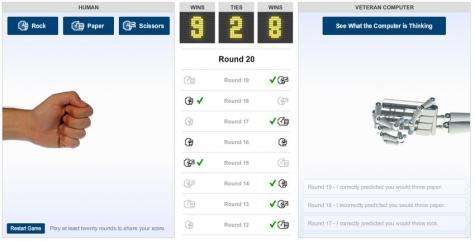
So simple that you need a to win it. The New York Times has created a "You vs. The Computer" game of Rock-Paper-Scissors that pits your ability to play the game versus the supercomputer.

The computer has two different modes: The novice mode and the veteran mode. On the novice mode the system has no access to the data about previously stored games. It simply adapts to your style of play and it makes a set of educated guesses about what you are going to do next. Then it takes its best guess and declares what it thinks will be the winning move. When you play on the the veteran mode, the system has not only your own play style data to work from, but it also has access to data from thousands of games that it has played against other real people. That data is used in a process of recall and comparison to determine what its next move should be. If you want to get an idea of how the system makes these determinations just click on the "See what the computer is thinking" and you will be able to see what the common responses are.

For the record, this reporter beat it first time out, in a set of 20, on the veteran level, and I'll tell you how to do it too. Since the system makes its prediction based on your past moves, and data on other strategy, the best way to beat it is to be unpredictable. Throw strategy out the window and indulge your random side for a while.

Explore further: Google Drive sports new view and scan enhancements

add to favorites email to friend print save as pdf

Related Stories

Game lets geeks compete to build virtual supercomputer

Nov 10, 2008

(PhysOrg.com) -- For those ready to get their geek on, Purdue Unviersity has created the computer game for you. Rack-A-Node is an online video game that lets those über-geeks who love both science and technology ...

Leveling the gaming field

May 13, 2008

A new computer game developed by MIT and Singaporean students makes it possible for visually impaired people to play the game on a level field with their sighted friends.

New Algorithm Ranks Sports Teams like Google's PageRank

Dec 15, 2009

(PhysOrg.com) -- Sports fans may be interested in a new system that ranks NFL and college football teams in a simple, straightforward way, similar to how Google PageRank ranks webpages. The new sports algorithm, ...

Recommended for you

Mobile app to help fight against racism in France

16 hours ago

A French anti-racism association is launching a mobile application it hopes will help eradicate racist graffiti by enabling users to take photos of offensive tags, geo-locate them and get them removed.

Google Drive sports new view and scan enhancements

May 23, 2013

(Phys.org) —Google Drive has a new look and functions. The makeover in Google Drive features scanning and interface enhancements that put the user into "card" mode. The enhancements make it easy for the ...

Model will unlock mysteries of the voice

May 22, 2013

Swedish researchers are leading the development of the world's first comprehensive model of the human voice, which could contribute to better voice care, voice prosthetics, talking robots and teaching opportunities.

Patented system better secures digitally stored data

May 21, 2013

(Phys.org) —Arizona State University computer scientist Gail-Joon Ahn has been granted a U.S. patent for a novel identity management system that helps protect personal identity information stored on digital devices.

UC Davis startup changes listening experience

May 20, 2013

Fifteen years of research at the University of California, Davis, is being turned into commercial products by Dysonics, a startup company based in San Francisco. Since becoming the first "graduate" from the Engineering Translational ...

User comments : 0

More news stories

Radiation leak at Japan lab; small impact expected

An atomic research lab in northern Japan has reported a radiation leak that may have affected about 50 people, though none were hospitalized and no impact was expected outside the facility, the lab's operator ...

Drones may violate international law

(Phys.org) —As President Obama gives a speech on national security—including defending U.S. use of drones to combat terrorism—Leila Sadat, JD, international law expert and professor of law at Washington University in ...

Google eyes emerging markets networks

Google has become deeply involved in a series of projects to build and operate wireless networks in emerging markets including sub-Saharan Africa and Southeast Asia, a report said Friday.

Facial-recognition technology proves its mettle

(Phys.org) —In a study that evaluated some of the latest in automatic facial recognition technology, researchers at Michigan State University were able to quickly identify one of the Boston Marathon bombing ...

The long road to the 2000-watt society

The vision of a society in which each inhabitant of the earth manages to consume only 2000 watts has already been around for 15 years. During this time, there has been a steady increase in environmental awareness ...

Heart failure accelerates male 'menopause'

Heart failure accelerates the aging process and brings on early andropausal syndrome (AS), according to research presented today at the Heart Failure Congress 2013. AS, also referred to as male 'menopause', was four times ...

Galaxies fed by funnels of fuel

(Phys.org) —Computer simulations of galaxies growing over billions of years have revealed a likely scenario for how they feed: a cosmic version of swirly straws.