NASA's successful 'can crush' will aid heavy-lift rocket design
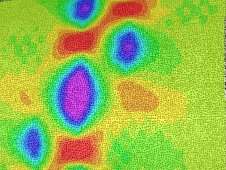
On March 23, NASA put the squeeze on a large rocket test section. Results from this structural strength test at NASA's Marshall Space Flight Center in Huntsville, Ala., will help future heavy-lift launch vehicles weigh less and reduce development costs.
This trailblazing project is examining the safety margins needed in the design of future, large launch vehicle structures. Test results will be used to develop and validate structural analysis models and generate new "shell-buckling knockdown factors" -- complex engineering design standards essential to launch vehicle design.
"This type of research is critical to NASA developing a new heavy-lift vehicle," said NASA Administrator Charlie Bolden. "The Authorization Act of 2010 gave us direction to take the nation beyond low-Earth orbit, but it is the work of our dedicated team of engineers and researchers that will make future NASA exploration missions a reality."
The aerospace industry's shell buckling knockdown factors date back to Apollo-era studies when current materials, manufacturing processes and high-fidelity computer modeling did not exist. These new analyses will update essential design factors and calculations that are a significant performance and safety driver in designing large structures like the main fuel tank of a future heavy-lift launch vehicle.
During the test, a massive 27.5-foot-diameter and 20-foot-tall aluminum-lithium test cylinder received almost one million pounds of force until it failed. More than 800 sensors measured strain and local deformations. In addition, advanced optical measurement techniques were used to monitor tiny deformations over the entire outer surface of the test article.
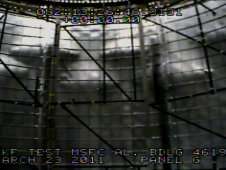
The Shell Buckling Knockdown Factor Project is led by engineers at NASA's Engineering and Safety Center (NESC), and NASA's Langley Research Center in Hampton, Va. NASA's heavy-lift space launch system will be developed and managed at Marshall.
"Launch vehicles are thin walled, cylindrical structures and buckling is one of the primary failure modes," said Mark Hilburger, a senior research engineer in the Structural Mechanics and Concepts Branch at Langley and the principal investigator of the NESC's Shell Buckling Knockdown Factor project. "Only by studying the fundamental physics of buckling through careful testing and analysis can we confidently apply the new knowledge to updated design factors. The outcome will be safer, lighter, more efficient launch vehicles."
Leading up to this full-scale test, the shell buckling team tested four, 8-foot-diameter aluminum-lithium cylinders. Current research suggests applying the new design factors and incorporating new technology could reduce the weight of large heavy-lift launch vehicles by as much as 20 percent.
"Marshall's Structural and Dynamics Engineering Test laboratory is uniquely suited for shell buckling testing," said Mike Roberts, an engineer in Marshall's structural strength test branch and the center lead for this activity. "Originally built to test Saturn rocket stages, the capabilities found here were essential to developing the lightweight space shuttle external tank flying today and for testing International Space Station modules."
For this test, Marshall led all test operations including the engineering, test equipment design and safety assurance. Lockheed Martin Space Systems Company fabricated the test article at Marshall's Advance Weld Process Development Facility using state-of-the-art welding and inspection techniques. Langley engineers led the design and analysis of the test articles, defined the test requirements, and developed new optical displacement measurement standards that enabled highly accurate assessment of the large-scale test article response during the test.
In the future, the shell buckling team will test carbon-fiber composite structures that are 20-30 percent lighter than aluminum and widely used in the automotive and aerospace industries.
Provided by JPL/NASA


