How to keep LISA's laser on target five million km away
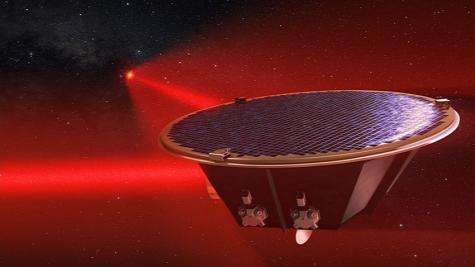
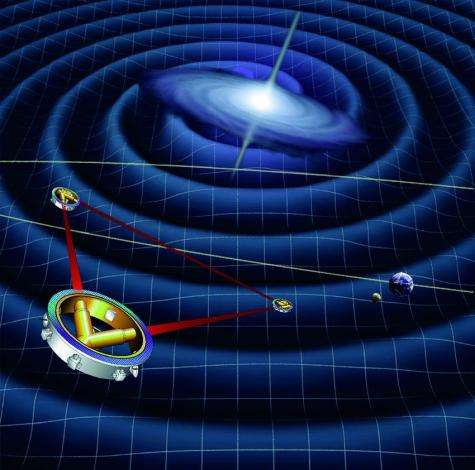
LISA will comprise three satellites, linked by lasers across five million km of space, to track very slight spacetime distortion caused by gravitational waves. Credits: AEI/MildeMarketing/Exozet
(PhysOrg.com) -- A key technical challenge of the joint ESANASA LISA mission has been solved: how to maintain precise pointing of a laser beam across five million km of space.
The next-decade Laser Interferometer Space Antenna (LISA) mission will look for ripples in spacetime their existence predicted by Albert Einstein known as gravitational waves. A trio of identical spacecraft will fly five million km apart in an equilateral triangle formation, linked by laser beams.
A precision-measuring method called interferometry can combine these laser beams to identify the slightest movement between free-floating metallic cubes within each spacecraft.
Motion within a set frequency range will be scrutinised to search out gravitational waves emitted by massive black holes and similarly energetic cosmic objects.
Our research set out to solve one of LISAs most challenging elements, said Lucio Scolamiero, overseeing some of the LISA technology studies for ESA.
How do we maintain the optical pathways between the spacecraft and therefore the measurement chain between them?
LISA will be the first space-based mission to attempt the detection of gravitational waves. These are ripples in space that are emitted by exotic objects such as black holes. Credits: ESA
Owing to the finite speed of light, it will take 16 seconds for each laser beam to cover the five million km to its receiving spacecraft.LISA must steer the laser beam to compensate for the orbital movement of each spacecraft during this time.
In the process, the steering mirror has to remain stable down to the subatomic scale: any motion would be misinterpreted as a gravitational wave.
That this could be achieved at all was by no means certain: to begin with, we didnt even have available means to measure the performance of such a system, Lucio added.
But we received two promising proposals and decided to pursue both of them.
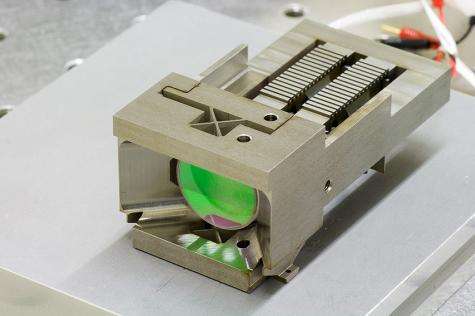
TNO-developed Point Ahead Angle Mechanism prototype for the LISA mission's laser. Credits: TNO
The two designs were developed independently by separate industrial groups: TNO in the Netherlands and RUAG and CSEM in Switzerland.ESA doesnt duplicate technology development but does sometimes pursue complementary approaches, Lucio explained.
If one proves inadequate then we have another as backup.
The two palm-sized designs share some elements. Both use capacitance-based sensors to measure mirror angle errors needing correction. Electrodes are spaced a very short distance apart; any shift in this distance causes a change in the electric charge running between them.
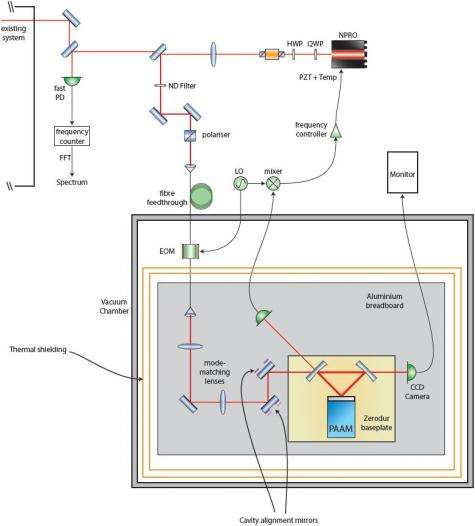
Thermal vacuum chamber and metrology setup for LISA PAAM testing, designed and performed by the Albert Einstein Institute in Hannover. The measurement system uses laser-based interferometry - the same system the LISA mission itself will employ to detect gravitational waves. Credits: Albert Einstein Institute
The motor to make the adjustment is based on piezoelectric ceramics similar to those found in quartz watches, which convert electric signals into movement.These ceramics are sliced up for precision performance. TNOs design uses piezo-stacks while RUAGCSEMs employs a piezo-leg reproducing walking motion.
To steer the mirror, both approaches reject ball-bearing components in favour of flexural hinges. Metallic blades around 0.1 mm thick are carefully shaped using a precision manufacturing technique.
The Albert Einstein Institute in Hannover, Germany, developed an ultra-stable measuring system to validate device performance. They used laser-based interferometry the same technique LISA will rely on with the experiment performed inside a vacuum chamber and mounted on a bench of ZERODUR glass, all-but immune to temperature-driven distortion.
Both developments are fully compliant to our extreme performance requirements, Lucio concluded. A decision on which version to fly will be taken later during LISA's implementation phase.
A single-satellite precursor, LISA Pathfinder, will be launched in 2013 to flight-validate key technologies for the full LISA mission, a large-mission candidate in ESA's Cosmic Vision program.
Provided by
European Space Agency
-
From lemons to lemonade: Reaction uses carbon dioxide to make carbon-based semiconductor,
32 comments
-
Thioridazine kills cancer stem cells in human while avoiding toxic side-effects of conventional cancer treatments,
3 comments
-
SpaceX private rocket blasts off for space station (Update),
42 comments
-
Climate scientists say they have solved riddle of rising sea,
30 comments
-
Research team claims to have found evidence Lake Cheko is impact crater for Tunguska Event,
18 comments
-
revamping general concept and cosmological principle
May 25, 2012
-
Transiting Exoplanet Light Curve
May 25, 2012
-
Math behind Theoretical Physics
May 24, 2012
-
Do we know whats at the center of galaxies yet?
May 23, 2012
-
Structure of the Milky Way?
May 20, 2012
-
What would it take to terraform Pluto and Charon?
May 19, 2012
- More from Physics Forums - General Astronomy
More news stories
SpaceX capsule has 'new car' smell, astronauts say (Update)
SpaceX's Dragon cargo vessel smells like a new car, said astronauts at the International Space Station after opening the hatches Saturday following the spacecraft's landmark mission to the orbiting lab.
Space & Earth / Space Exploration
17 hours ago |
4.5 / 5 (20) |
0
Astronomers seize last chance in lifetime for Venus Transit
Astronomers are gearing for one the rarest events in the Solar System: an alignment of Earth, Venus and the Sun that will not be seen for another 105 years.
17 hours ago |
5 / 5 (3) |
2
Australia hails surprise super-telescope decision
Australia has hailed a surprise decision giving it a role in a radio telescope project aimed at revolutionising astronomy, vowing to draw on its decades of experience in space science.
17 hours ago |
5 / 5 (4) |
1
Astronauts enter world's 1st private supply ship
(AP) -- Space station astronauts floated into the Dragon on Saturday, a day after its heralded arrival as the world's first commercial supply ship.
Space & Earth / Space Exploration
17 hours ago |
5 / 5 (5) |
0
Sophisticated simulations predict future warming
The chances of our planet being hit by a global warming of 3 degrees Celsius by 2050 is as likely as it being hit by an increase of 1.4 degrees, new research shows. Presented in the journal Nature Geoscience, the British study ...
Space & Earth / Earth Sciences
May 22, 2012 |
4.4 / 5 (9) |
51
Scientist: Evolution debate will soon be history
(AP) -- Richard Leakey predicts skepticism over evolution will soon be history. Not that the avowed atheist has any doubts himself.
Dell tablet leak: 10.1-inch display, two-battery choice
(Phys.org) -- Headline after headline talks about vendors tablets in the wings as likely number-one contenders for the iPad. Such claims have justifiably been taken with a grain of salt, considering ...
SpotterRF debuts Radar Backpack Kit (w/ Video)
(Phys.org) -- SpotterRF has announced a special radar backpack kit designed to enhance situational awareness for soldiers on the ground. The company says its special radar is designed for warfighters as part ...
Thousands of shellfish found dead in Peru
Thousands of crustaceans were found dead off the coast of Lima following the mystery mass death of dolphins and pelicans, the Peruvian Navy said Friday.
Keep food safety in mind this memorial day weekend
(HealthDay) -- Picnics, parades and cookouts are as much a part of Memorial Day weekend as tributes to the United States' war veterans.
Family history of Alzheimer's affects functional connectivity
(HealthDay) -- Cognitively normal individuals with a family history of late-onset Alzheimer's disease (AD) may display lower resting state functional connectivity in the default mode network (DMN) of the brain, ...