Host change alters toxic cocktail
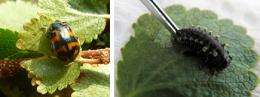
(PhysOrg.com) -- Leaf beetles fascinate us because of their amazing variety of shapes and rich colouring. Their larvae, however, are dangerous plant pests. Larvae of the leaf beetle Chrysomela lapponica attack two different tree species: willow and birch. To fend off predator attacks, the beetle larvae produce toxic butyric acid esters or salicylaldehyde, whose precursors they ingest with their leafy food.
Scientists of the Max Planck Institute for Chemical Ecology in Jena, Germany, now found that a fundamental change in the genome has emerged in beetles that have specialized in birch: The activity of the salicylaldehyde producing enzyme salicyl alcohol oxidase (SAO) is missing in these populations, whereas it is present in willow feeders. For birch beetles, the loss of this enzyme and thereby the loss of salicylaldehyde is advantageous: the enzyme is no longer needed because its substrate salicyl alcohol is only present in willow leaves, but not in birch. Birch beetles can therefore save resources instead of costly producing the enzyme. First and foremost, however, the loss of salicylaldehyde also means that birch feeding populations do not betray themselves to their own enemies anymore, who can trace them because of the odorous substance.
Beetle larvae are part of a food chain. They are attacked by predatory insects and parasites, such as hover flies and bugs, as well as infested by bacteria and fungi. To protect themselves some leaf beetle larvae have developed interesting defence mechanisms, which function externally and metabolically: In case of danger, they emit substances from their defensive glands in form of vesicles. These defensive secretions contain toxins that the larvae sequester from chemical precursors they have ingested with their plant food. The toxin precursors pass the larva’s midgut and reach the defensive glands via a sophisticated molecular transport system. Only a few chemical steps are necessary to produce the actual toxin in the gland.
Dependent on the host plant
Most leaf beetle species only attack one single plant species to feed and reproduce. On the one hand, the uptake of special plant molecules as substrates for toxin-producing enzymes is economical for the beetle larvae; on the other hand, however, the leaf beetles become strongly dependent on the host plant and its specific metabolites. Willows of the Salicaceae family have up to 5 percent glycosylated salicyl alcohol (Salicin) in their leaves, whereas birch trees do not contain these compounds at all. Hence, researchers in the Department of Bioorganic Chemistry of the institute in Jena have investigated how Chrysomela lapponica leaf beetles adapted to both birch and willow as host trees.
First they analyzed in a simple but decisive experiment whether the loss of salicylaldehyde in birch feeders is only due to the fact that the precursor Salicin is not available in birch. To test this they offered willow leaves to hungry leaf beetle larvae they had collected from birch trees. “The beetles were able to ingest Salicin from willow leaves; salicyl alcohol was also detected in their defensive secretions. However, the alcohol was not transformed to an aldehyde; this means that birch feeders lack the enzyme salicyl alcohol oxidase, which is responsible for the oxidation from alcohol to aldehyde,” explains Roy Kirsch, who addresses these topics in his PhD project.
Alternative splicing inactivates enzyme in birch feeders
Biochemical analyses revealed that gland secretions of salicylaldehyde producing willow beetles contain the enzyme salicyl alcohol oxidase in strikingly large amounts. The scientists labelled it SAO-W (W: willow). Using corresponding DNA sequence data they isolated and characterized the SAO-B (B: birch) encoding gene from birch feeders. They found that the amino acid sequences of both enzymes are 97 percent identical. However, SAO-B has become inactive because 27 amino acids at the beginning of the polypeptide chain are missing. This was confirmed after heterologous expression in an insect cell culture and subsequent functional tests.
Further studies on the defensive glands of birch feeders showed that the amount of messenger RNA (mRNA) of the SAO-B gene was reduced by 1000 times compared to willow beetles; the protein and its enzyme activity were below the detection level. The lack of enzyme activity is caused by a mutation in the SAO-B gene located in the area of the second exon/intron junction. The mutation is responsible for changes in mRNA processing, so-called alternative splicing, which leads to the loss of 27 amino acids in the SAO-B enzyme.
The scientists conclude that, originally, Chrysomela lapponica used willows exclusively as host plants and later shifted to birch trees as well. “It is still unclear, whether the gene mutation has enabled the host plant shift from willow to birch or whether it was adapted in the course of evolution after the shift to birch had occurred,” says Wilhelm Boland, the leader of the study. Genetic analysis of further SAO genes from Chrysomela leaf beetle species will allow a better understanding of these processes.
More information: Kirsch, R., et al. Host plant shifts affect a major defense enzyme in Chrysomela lapponica. Proceedings of the National Academy of Sciences USA, Early Edition, DOI 10.1073/pnas.1013846108
Provided by Max-Planck-Gesellschaft


