Honey bee search strategy: Robot swarms to search Mars caves
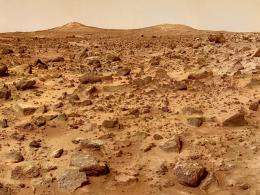
March 22, 2011 by Deborah Braconnier
Mars surface.
(PhysOrg.com) -- In a recent paper published in Acta Astronautica, Aron Kisdi, a University of Southampton engineer, proposes an idea of utilizing a swarm of robots to search large areas of Mars and the caves which current robots have been unable to explore.
The theory behind Kisdis robots incorporates the idea of quorum sensing, similar to that used by honey bees. Quorum sensing is a type of decision-making process used by groups to coordinate behavior and can be seen with honey bees when worker bees scout for new nest areas. Bees will leave the nest, gather information, and determine the best new location.
Kisdis theory works on this same principle. A computer program has been created that functions in a similar way to the honey bees. The robots, called Jollbot, are a rolling and jumping robot.
This video is not supported by your browser at this time.
Jollbot
A Lander would be able to release the swarm of 40 to 60 robots, allowing them to then individually go out and search for pre-programmed information, such as a difference of temperature found in a cave. Once a robot locates this information, it would return to the lander via the shortest route, and upload the information (temperature readings and coordinates).Once the information is uploaded, the robot can then evaluate information shared by previous robots and decide to either start a new search or revisit a previous finding for more information. As information is collected, those sites which the robots decide to be a potential site for more exploration can then be sent to mission control for further exploration by other rovers.
This concept would be cheaper to build than the large rovers and allow for much more initial exploration, leaving the in-depth exploration for the rovers. The other benefit with this idea is that should one of the Jollbots in the swarm be lost or not function, the search process is still able to continue.
In the simulation shown by Kisdi, a swarm of 50 robots would be able to cover a 300 square meter area in around 5 days. With the addition of more robots with a greater search capability, the search area would be able to be increased.
Kisdis next step is to begin developing the hardware required for the robots, but the idea of a swarm of honey bee robots opens up the potential for much more in-depth searches becoming possible on Mars.
More information: Future robotic exploration using honeybee search strategy: Example search for caves on Mars, by Áron Kisdia and Adrian R.L. Tatnall, Acta Astronautica, Article in Press. doi:10.1016/j.actaastro.2011.01.013
© 2010 PhysOrg.com
-
From lemons to lemonade: Reaction uses carbon dioxide to make carbon-based semiconductor,
32 comments
-
Thioridazine kills cancer stem cells in human while avoiding toxic side-effects of conventional cancer treatments,
3 comments
-
SpaceX private rocket blasts off for space station (Update),
42 comments
-
Climate scientists say they have solved riddle of rising sea,
30 comments
-
Research team claims to have found evidence Lake Cheko is impact crater for Tunguska Event,
18 comments
-
revamping general concept and cosmological principle
May 25, 2012
-
Transiting Exoplanet Light Curve
May 25, 2012
-
Math behind Theoretical Physics
May 24, 2012
-
Do we know whats at the center of galaxies yet?
May 23, 2012
-
Structure of the Milky Way?
May 20, 2012
-
What would it take to terraform Pluto and Charon?
May 19, 2012
- More from Physics Forums - General Astronomy
More news stories
SpaceX capsule has 'new car' smell, astronauts say (Update)
SpaceX's Dragon cargo vessel smells like a new car, said astronauts at the International Space Station after opening the hatches Saturday following the spacecraft's landmark mission to the orbiting lab.
Space & Earth / Space Exploration
15 hours ago |
4.5 / 5 (19) |
0
Astronomers seize last chance in lifetime for Venus Transit
Astronomers are gearing for one the rarest events in the Solar System: an alignment of Earth, Venus and the Sun that will not be seen for another 105 years.
15 hours ago |
5 / 5 (2) |
2
Australia hails surprise super-telescope decision
Australia has hailed a surprise decision giving it a role in a radio telescope project aimed at revolutionising astronomy, vowing to draw on its decades of experience in space science.
15 hours ago |
5 / 5 (3) |
1
Astronauts enter world's 1st private supply ship
(AP) -- Space station astronauts floated into the Dragon on Saturday, a day after its heralded arrival as the world's first commercial supply ship.
Space & Earth / Space Exploration
15 hours ago |
5 / 5 (5) |
0
Dragon arrives at space station in historic 1st (Update 2)
The privately bankrolled Dragon capsule made a historic arrival at the International Space Station on Friday, triumphantly captured by astronauts wielding a giant robot arm.
Space & Earth / Space Exploration
May 25, 2012 |
5 / 5 (10) |
19
Dell tablet leak: 10.1-inch display, two-battery choice
(Phys.org) -- Headline after headline talks about vendors tablets in the wings as likely number-one contenders for the iPad. Such claims have justifiably been taken with a grain of salt, considering ...
Scientist: Evolution debate will soon be history
(AP) -- Richard Leakey predicts skepticism over evolution will soon be history. Not that the avowed atheist has any doubts himself.
SpotterRF debuts Radar Backpack Kit (w/ Video)
(Phys.org) -- SpotterRF has announced a special radar backpack kit designed to enhance situational awareness for soldiers on the ground. The company says its special radar is designed for warfighters as part ...
Thousands of shellfish found dead in Peru
Thousands of crustaceans were found dead off the coast of Lima following the mystery mass death of dolphins and pelicans, the Peruvian Navy said Friday.
Keep food safety in mind this memorial day weekend
(HealthDay) -- Picnics, parades and cookouts are as much a part of Memorial Day weekend as tributes to the United States' war veterans.
Family history of Alzheimer's affects functional connectivity
(HealthDay) -- Cognitively normal individuals with a family history of late-onset Alzheimer's disease (AD) may display lower resting state functional connectivity in the default mode network (DMN) of the brain, ...
Mar 22, 2011
Rank: not rated yet
Mar 22, 2011
Rank: not rated yet
Mar 22, 2011
Rank: not rated yet
Mar 22, 2011
Rank: 1 / 5 (1)
Mar 22, 2011
Rank: not rated yet
Mar 22, 2011
Rank: not rated yet
Mar 23, 2011
Rank: 1 / 5 (1)
300 square meters= worthless. less than the size of a large house. Mars landings are precise in the tens of miles range. Do you really think were going to send a rocketship to mars so that some toys can pal around in the middle of the desert bouncing off rocks? even if we can get them delivered right into the mouth of a cave, 300 square meters of exploration isnt any more effective than a laser scan would be. Its a start, but Ill be more excited when theyre capable of exploring an entire deep cave system complete with video.
Mar 23, 2011
Rank: not rated yet
Not quite. The design specs called for each to cover about 600 meters (Note: meters - not kilometers) during its entire mission. Both have outperformed that somewhat. Opportunity has a total travel distance of about 20km behind it. Couldn't find the exact figures for Spirit (should be similar).
That's exactly what the last mission did (and since their track is very narrow they explored much less than 300 square meters thoroughly. Photography is not the same thing as exploration.)
Mar 23, 2011
Rank: not rated yet
Mar 25, 2011
Rank: not rated yet
It says 300 meters in five days not in total.