European team suggests new way to measure scientific relevance by city
March 24, 2011 by Bob Yirka
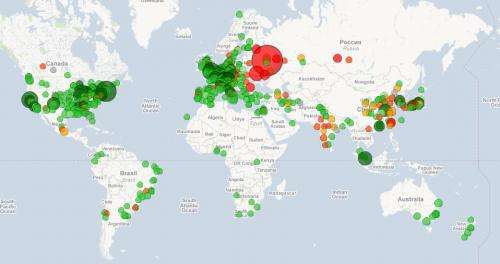
(PhysOrg.com) -- In a move that must have been at least partly aimed at provoking prideful nationalism, Lutz Bornmann of the Max Planck Society in Munich and Loet Leydesdorff from the University of Amsterdam have put together a joint project where they were able to produce what they believe is a graphical representation of the relative importance of the science being done in major cities around the world and have published it on arXiv.org.
They take the basic precept that ten percent of any scientific papers produced in any city, should account for ten percent of citations regarding those papers by others in the field and then mash it onto Google Earth maps with circles representing the relative importance of the science being done there; the bigger the circle, the more work being published; colors are used to denote performance values; red for underachievers, green for over (orange if things come out even, such as is the case with Oxford, England).
The results of their efforts can be seen online and are divided by physics, chemistry and psychology. Because it is a Google Maps/Earth application, users can zoom in and out and when they hover over a circle, the name of the city will be displayed. Also, clicking on a circle shows the statistics that were used to arrive at that circles size and color.
The two authors relied on data obtained from Scopus (circa 2008) for paper publication data, and used citation data up to the beginning of 2011; they focused exclusively on just three of the sciences; physics, chemistry and psychology.
Not surprisingly, their work has received some criticism due to metrics that are not so easily quantified, such as whether the language a paper is published in has any bearing on how often its being cited by others who prefer to cite articles who write in their native tongue. Also, the authors themselves point out in their presentation paper that their methodology doesnt allow for actual institutions of learning to be displayed or the density of science paper writers in a city; such as where one city could for example, have a few prolific writers that get mentioned often, while other cities might have many thousands that are seldom individually mentioned.
In any case, regardless of how the project is perceived, its clear that another step has been taken in the ever ongoing process of measuring the quality of science that is being produced; and that cant be a bad thing.
More information: -- Which cities produce excellent papers worldwide more than can be expected? A new mapping approach--using Google Maps--based on statistical significance testing, Lutz Bornmann, Loet Leydesdorff, arXiv:1103.3216v2 [cs.DL] http://arxiv.org/abs/1103.3216
-- http://www.leydesd … net/topcity/
© 2010 PhysOrg.com
-
From lemons to lemonade: Reaction uses carbon dioxide to make carbon-based semiconductor,
32 comments
-
Thioridazine kills cancer stem cells in human while avoiding toxic side-effects of conventional cancer treatments,
3 comments
-
SpaceX private rocket blasts off for space station (Update),
42 comments
-
Climate scientists say they have solved riddle of rising sea,
30 comments
-
Research team claims to have found evidence Lake Cheko is impact crater for Tunguska Event,
18 comments
-
Limits
13 hours ago
-
Complex numbers: Why is the modulus of z...
14 hours ago
-
A close approximation for square root of 2.
May 25, 2012
-
What are some interesting ways of proving the quadratic formula?
May 25, 2012
-
Punctuation in mathematical writing
May 25, 2012
-
Is there anything wrong with completing the square this way?
May 25, 2012
- More from Physics Forums - General Math
More news stories
Social welfare cuts ultimately come with heavy price, researchers say
(Phys.org) -- Slashing government funding for Medicaid, food stamps and other programs that serve the poor while politically popular with some lawmakers and many conservatives may do more harm ...
Other Sciences / Social Sciences
May 24, 2012 |
4.1 / 5 (14) |
117
Ancient Bethlehem seal unearthed in Jerusalem
Israeli archaeologists have discovered a 2,700-year-old seal that bears the inscription "Bethlehem," the Israel Antiquities Authority announced Wednesday, in what experts believe to be the oldest artifact ...
Other Sciences / Archaeology & Fossils
May 23, 2012 |
3.5 / 5 (14) |
23
Oldest Jewish archaeological evidence on the Iberian Peninsula
German archaeologists of the Friedrich Schiller University Jena found one of the oldest archaeological evidence so far of Jewish Culture on the Iberian Peninsula at an excavation site in the south of Portugal, ...
Other Sciences / Archaeology & Fossils
May 25, 2012 |
4.3 / 5 (4) |
12
Dollars and sense: Why are some people morally against tax?
As the U.S. presidential election campaigns heat up, the economic debate is dominated by bailouts, austerity and, inevitably, taxation. Now a new study published in Symbolic Interaction asks why tax is such an important issue ...
Other Sciences / Social Sciences
May 23, 2012 |
3 / 5 (2) |
12
Oldest art even older
New dates from Geißenklösterle Cave in Southwest Germany document the early arrival of modern humans and early appearance of art and music.
Other Sciences / Archaeology & Fossils
May 24, 2012 |
5 / 5 (2) |
6
Dell tablet leak: 10.1-inch display, two-battery choice
(Phys.org) -- Headline after headline talks about vendors tablets in the wings as likely number-one contenders for the iPad. Such claims have justifiably been taken with a grain of salt, considering ...
Scientist: Evolution debate will soon be history
(AP) -- Richard Leakey predicts skepticism over evolution will soon be history. Not that the avowed atheist has any doubts himself.
SpotterRF debuts Radar Backpack Kit (w/ Video)
(Phys.org) -- SpotterRF has announced a special radar backpack kit designed to enhance situational awareness for soldiers on the ground. The company says its special radar is designed for warfighters as part ...
SpaceX capsule has 'new car' smell, astronauts say (Update)
SpaceX's Dragon cargo vessel smells like a new car, said astronauts at the International Space Station after opening the hatches Saturday following the spacecraft's landmark mission to the orbiting lab.
Thousands of shellfish found dead in Peru
Thousands of crustaceans were found dead off the coast of Lima following the mystery mass death of dolphins and pelicans, the Peruvian Navy said Friday.
Australia hails surprise super-telescope decision
Australia has hailed a surprise decision giving it a role in a radio telescope project aimed at revolutionising astronomy, vowing to draw on its decades of experience in space science.
Mar 24, 2011
Rank: not rated yet
Mar 24, 2011
Rank: not rated yet
Yeah I think the article points out the problems with their assumptions pretty well. I am betting in Moscow they mostly write in Russian, and I doubt that anyone in NewYork is citing Russian language they cannot read.