Europe to turn up heat on climate targets
March 6, 2011 by Christian Spillmann
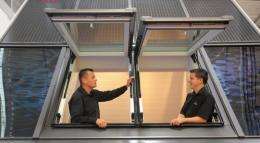
Two men stand at the windows of a solar panel covered rooftop at the Inter Solar trade fair in Munich in June last year. Fresh from the launch of a trillion-euro bid to slash dependency on Middle East oil and Russian gas, Europe sets out this week its most ambitious targets yet to offset climate change.
Fresh from the launch of a trillion-euro bid to slash dependency on Middle East oil and Russian gas, Europe sets out this week its most ambitious targets yet to offset climate change.
The European Union, home to half a billion people and some 20 million companies, is committed to going "green" between now and 2050 as part of passionate moves to save the planet from global warming.
However, making the leap from promise to fulfillment looks sure to be a painful process requiring politically difficult choices by national leaders.
On Tuesday, the European Commission, the powerful EU executive, unveils its roadmap for driving action to mitigate climate change, demanding that the key farming, transport and construction sectors step up the plate.
Denmark's Connie Hedegaard is the woman handed one of the most thankless tasks in Brussels politics -- trying to pilot proposals through a crippling dependency on oil and gas imports, deep social instability in north Africa and potentially the Middle East as well as public suspicion of leaders' number one 'clean energy' preference, nuclear power.
"It's the start of ambitious forward planning -- the stakes are enormous with huge choices to be made in terms of technologies," admits an EU negotiator.
The commission's proposals, to cover the decades between 2020 and 2050, should be taken hand in hand with last month's decision by governments to announce a broad sweep of market reforms, linking national and regional electricity grids and gas pipelines by 2014.
The idea there was to allow power to circulate freely and cheaply, from those who produce it and have surpluses to those who do not but need it -- with energy efficiency a core doctrine.
The other big change was to re-position domestically-produced nuclear energy at the heart of the bloc's long-term supplies.
The attraction of low-emission nuclear generation was clear for leaders who also want to be seen to reduce carbon emissions despite deadlock at a global level on how, where and when to implement the cuts most scientists still say are required.
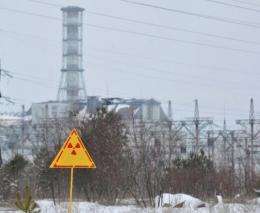
The sarcophagus over destroyed 4th block of Chernobyl power plant, pictured last month ahead of next month's 25th anniversary of the meltdown of reactor number four. Fresh from the launch of a trillion-euro bid to slash dependency on Middle East oil and Russian gas, Europe sets out this week its most ambitious targets yet to offset climate change.
But radical additional measures are also needed if the EU is to deliver, ranging from new rules for transport to a tax on carbon emissions and inefficient 'old' energy consumption.Hedegaard's plans are expected to cost an estimated 270 billion euros (380 billion dollars) per year if the historic switchover is to become a reality -- and the budget can hardly be expected to come down.
The 27-state EU is already commited to reducing greenhouse gas emissions by 80-95 percent of 1999 levels by 2050 in a bid to keep global warming within a two degrees Celsius threshold deemed attainable and safe by governments.
This target must be met "by the EU, in the EU", says the forthright commissioner, one of the EU administration's most engaging figures.
A target of a 20 percent reduction by 2020 has been all-but achieved, due to strict demands placed on heavy industry and electricity producers in particular.
But going further and faster will be an especially delicate task, focused on agriculture, transport and construction.
These key sectors have scarcely been implicated -- beyond voluntary contributions -- in existing moves to cut emissions, and will respectively have to bring about reductions of up to 49, 67 and 91 percent.
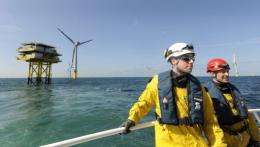
Two technicians from offshore wind power farm "Alpha Ventus" stand on a boat off the northern German Island of Borkum in April last year. Fresh from the launch of a trillion-euro bid to slash dependency on Middle East oil and Russian gas, Europe sets out this week its most ambitious targets yet to offset climate change.
Between them, these areas are responsible for 60 percent of the 4.9 million tonnes of CO2 spewed out currently by the EU each year.The commission wants binding targets imposed in 2013, just as it wants to enforce targeted energy efficiency savings of 20 percent by 2020 -- currently, the level is only half the goal.
Governments are reluctant to make such commitments at a time when the worldwide race for economic recovery means every competitive inch is guarded jealously.
Hence, the re-wording of nuclear as "safe and sustainable low-carbon technologies", at the request of France and strongly backed by Britain.
Germany, Italy and Spain have already cut state aid allocated towards developing renewable energy sources and others can be expected to follow suit.
(c) 2011 AFP
-
From lemons to lemonade: Reaction uses carbon dioxide to make carbon-based semiconductor,
32 comments
-
Thioridazine kills cancer stem cells in human while avoiding toxic side-effects of conventional cancer treatments,
3 comments
-
SpaceX private rocket blasts off for space station (Update),
42 comments
-
Climate scientists say they have solved riddle of rising sea,
30 comments
-
Research team claims to have found evidence Lake Cheko is impact crater for Tunguska Event,
18 comments
-
Hypothetical desert earth
1 hour ago
-
More human population = greater mass?
May 25, 2012
-
Conversion from aircraft bearing to normal degrees
May 23, 2012
-
Interpretation/Analysis of the Lab results(HEPA filter)
May 22, 2012
-
Has anyone here attended the The Urbino Summer School in Paleoclimatology?
May 22, 2012
-
Earthquakes: Mag 6 N. Italy and Mag 5.6 W. Bulgaria
May 21, 2012
- More from Physics Forums - Earth
More news stories
SpaceX capsule has 'new car' smell, astronauts say (Update)
SpaceX's Dragon cargo vessel smells like a new car, said astronauts at the International Space Station after opening the hatches Saturday following the spacecraft's landmark mission to the orbiting lab.
Space & Earth / Space Exploration
15 hours ago |
4.5 / 5 (19) |
0
Australia hails surprise super-telescope decision
Australia has hailed a surprise decision giving it a role in a radio telescope project aimed at revolutionising astronomy, vowing to draw on its decades of experience in space science.
15 hours ago |
5 / 5 (3) |
1
Astronomers seize last chance in lifetime for Venus Transit
Astronomers are gearing for one the rarest events in the Solar System: an alignment of Earth, Venus and the Sun that will not be seen for another 105 years.
15 hours ago |
5 / 5 (1) |
1
Astronauts enter world's 1st private supply ship
(AP) -- Space station astronauts floated into the Dragon on Saturday, a day after its heralded arrival as the world's first commercial supply ship.
Space & Earth / Space Exploration
15 hours ago |
5 / 5 (5) |
0
Dragon arrives at space station in historic 1st (Update 2)
The privately bankrolled Dragon capsule made a historic arrival at the International Space Station on Friday, triumphantly captured by astronauts wielding a giant robot arm.
Space & Earth / Space Exploration
May 25, 2012 |
5 / 5 (10) |
19
Dell tablet leak: 10.1-inch display, two-battery choice
(Phys.org) -- Headline after headline talks about vendors tablets in the wings as likely number-one contenders for the iPad. Such claims have justifiably been taken with a grain of salt, considering ...
Scientist: Evolution debate will soon be history
(AP) -- Richard Leakey predicts skepticism over evolution will soon be history. Not that the avowed atheist has any doubts himself.
SpotterRF debuts Radar Backpack Kit (w/ Video)
(Phys.org) -- SpotterRF has announced a special radar backpack kit designed to enhance situational awareness for soldiers on the ground. The company says its special radar is designed for warfighters as part ...
Thousands of shellfish found dead in Peru
Thousands of crustaceans were found dead off the coast of Lima following the mystery mass death of dolphins and pelicans, the Peruvian Navy said Friday.
Keep food safety in mind this memorial day weekend
(HealthDay) -- Picnics, parades and cookouts are as much a part of Memorial Day weekend as tributes to the United States' war veterans.
Family history of Alzheimer's affects functional connectivity
(HealthDay) -- Cognitively normal individuals with a family history of late-onset Alzheimer's disease (AD) may display lower resting state functional connectivity in the default mode network (DMN) of the brain, ...


Mar 06, 2011
Rank: 1.9 / 5 (13)
Meanwhile, environmentalists really shot themselves in the foot by focusing on CO2. The science was never really there, but they saw an opportunity to rework all of society into the form of their green dreams and took it, and discredited themselves in the process. Now we can hopefully get back to more legitimate environmental threats like development-induced habitat loss.
Mar 06, 2011
Rank: 2.3 / 5 (12)
Mar 07, 2011
Rank: 1 / 5 (5)
Great article, thanks so much!
Mar 07, 2011
Rank: 2.6 / 5 (5)
Mar 07, 2011
Rank: 2 / 5 (8)
The pain, of course, will be inflicted upon the populace, who will have little to no say in the matter.
"from each according to ability, to each according to need"
This is capital-C Communism scarcely disguised, and it is true that "going green" = "going red".
You know what freedom is? Having my consumption governed only by what I choose to buy. My choice. If too many buy "too much", the price goes up. It is self-correcting. But when governments try to control markets, they harm or destroy them, and spread only misery. "A run of bad luck, it's called..."
Mar 07, 2011
Rank: 2 / 5 (2)
With that kind of money they could build a good transportaion system so that the people didn't need that many cars.
More research on batteries technology and space based solar farms.
If NASA is giving money to explore the possibility of creating an elevator to go into space, then i'm sure they can find the will to make a cable to bring solar power to earth.
And don't talk about efficiency. That's retard talking. Solar or wind power doesn't have to be efficient. The solar/wind energy is free and renewable so if we can convert even 1% of it, it's better than non at all.
Efficiency is all about profit. The formula is something like that. If we have 20% efficiency during 10 years the profit will be 200%, if it's 10% we only get 100% profit. That isn't good enough. We need the 200% so that the profits can be divided between the shareholders.... That is capitalism...
Mar 09, 2011
Rank: 1 / 5 (1)
Mar 10, 2011
Rank: 1 / 5 (2)
And sadly, there will never be a space elevator, and it isn't a matter of "finding the will" to make a cable to bring solar power to earth. "They" could probably make such a cable - strengthwise. The problem is that strength isn't the sole issue - the real problem lies in the power itself. The Earth functions as a leaky capacitor, and the ionosphere and magnetosphere can be considered as "double layers" in electrified plasma. Double layers form in electrified plasmas to protect areas of dissimilar charge. But if you penetrate those layers with a cable, you've laid a conductor across the poles of a planet-sized charged capacitor. ZZZAP!!! One big bolt of mega-lightning later and you're left with no cable. And probably a big hole in the ground too.