Earth from Space: 'Black hole'
Mar 25, 2011
Earth from Space: 'Black hole'
Credits: KARI

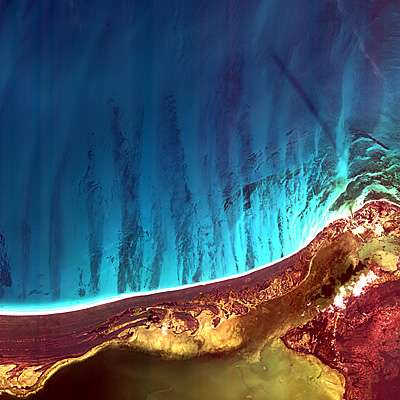
(PhysOrg.com) -- Holbox Island and the Yalahau Lagoon on the northeast corner of Mexico?s Yucatan Peninsula are featured in this satellite image.

Holbox is a 42-km-long island running along the peninsula’s coast that is separated from the mainland by Yalahau Lagoon.
One of the world’s most important ecosystems, Holbox and its surrounding waters are part of the Yum Balam Biosphere Reserve.

Its unspoiled beaches of fine white coralline sands are important for turtle nesting, and over 500 bird species can be found here.

Caboe Catoche, the cape at the eastern tip of the island (right), is where the Gulf of and the Caribbean Sea meet. Their mingling waters create a kaleidoscope of turquoise and emerald hues.

Located where the currents of the Gulf, Caribbean and the Atlantic Ocean mix to create nutrient-rich waters, this area supports an abundant and diverse array of marine life.

In addition to dolphins, manta rays and several shark species, the plankton-rich waters support the world’s largest known congregation of whale sharks – our planet’s largest fish – for five months of the year.

The freshwater lagoon has a deep rocky hole that surrounds the island, making the water appear black. It is thought that Holbox, which in Mayan translates as ‘black hole’, was named after the dark lagoon water.

The Korea Multi-purpose Satellite (Kompsat-2) of the Korea Aerospace Research Institute acquired this image on 12 March. Launched in 2006, it was developed to ensure continuity with its predecessor, Kompsat-1.

ESA supports the Kompsat series as a Third Party Mission, meaning it uses its ground infrastructure and expertise to acquire, process and distribute data to users.

Explore further: Source of life running out: water scientists

add to favorites email to friend print save as pdf

Related Stories

Ghostly, Ethereal Island as seen from space

Feb 22, 2011

Looking rather otherworldly, this haunting view of Shikotan-to island shows ghostly swirls of sea ice surrounding the snow-covered volcanic island. Also known as Ostrov Shikotan, this island is at the southern ...

Millenium atoll: A pristine ecosystem

Jun 07, 2010

A series of surveys were carried out to characterize the physical and biological parameters of the Millennium Atoll lagoon during a research expedition in April of 2009. Millennium is a remote coral atoll in the Central Pacific ...

Scientists conduct shark survey off US East Coast

Aug 13, 2009

Sandbar, dusky and tiger sharks are among dozens of shark species living in the coastal waters off the U.S. East Coast. Little is known about many of the species, but a survey begun nearly 25 years ago is helping scientists ...

Researchers make hurricane predictions more accurate

May 24, 2006

The hurricane forecasting model developed by University of Rhode Island and NOAA scientists – the most accurate model used by the National Hurricane Center over the last three years – has been improved ...

Recommended for you

Source of life running out: water scientists

18 hours ago

The majority of people on Earth people will face severe water shortages within a generation or two if pollution and waste continues unabated, scientists warned at a conference in Bonn Friday.

Century-old science helps confirm global warming

May 23, 2013

(Phys.org) —Ocean measurements taken more than 135 years ago during the scientific expedition of HMS Challenger have provided further confirmation of human-produced global warming over the past century.

User comments : 0

More news stories

Galaxies fed by funnels of fuel

(Phys.org) —Computer simulations of galaxies growing over billions of years have revealed a likely scenario for how they feed: a cosmic version of swirly straws.

Source of life running out: water scientists

The majority of people on Earth people will face severe water shortages within a generation or two if pollution and waste continues unabated, scientists warned at a conference in Bonn Friday.

Dark, massive asteroid to fly by Earth on May 31

It's 1.7 miles long. Its surface is covered in a sticky black substance similar to the gunk at the bottom of a barbecue. If it impacted Earth it would probably result in global extinction. Good thing it is ...