Going to Earth's core for climate insights
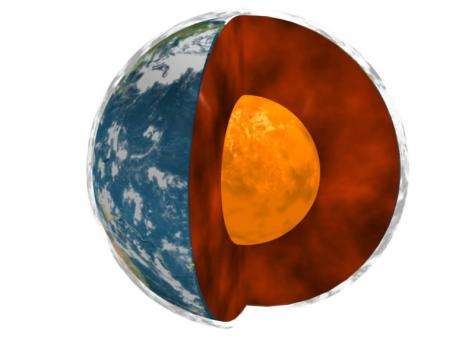
A NASA/university study of data on Earth's rotation, movements in Earth's molten core and global surface air temperatures has uncovered interesting correlations. Credit: NASA/JPL-Université Paris Diderot - Institut de Physique du Globe de Paris
(PhysOrg.com) -- The latest evidence of the dominant role humans play in changing Earth's climate comes not from observations of Earth's ocean, atmosphere or land surface, but from deep within its molten core.
Scientists have long known that the length of an Earth day - the time it takes for Earth to make one full rotation - fluctuates around a 24-hour average. Over the course of a year, the length of a day varies by about 1 millisecond, getting longer in the winter and shorter in the summer. These seasonal changes in Earth's length of day are driven by exchanges of energy between the solid Earth and fluid motions of Earth's atmosphere (blowing winds and changes in atmospheric pressure) and its ocean. Scientists can measure these small changes in Earth's rotation using astronomical observations and very precise geodetic techniques.
But the length of an Earth day also fluctuates over much longer timescales, such as interannual (two to 10 years), decadal (approximately 10 years), or those lasting multiple decades or even longer. A dominant longer timescale mode that ranges from 65 to 80 years was observed to change the length of day by approximately 4 milliseconds at the beginning of the 20th century.
These longer fluctuations are too large to be explained by the motions of Earth's atmosphere and ocean. Instead, they're due to the flow of liquid iron within Earth's outer core, where Earth's magnetic field originates. This fluid interacts with Earth's mantle to affect Earth's rotation. While scientists cannot observe these flows directly, they can deduce their movements by observing Earth's magnetic field at the surface. Previous studies have shown that this flow of liquid iron in Earth's outer core oscillates, in waves of motion that last for decades with timescales that correspond closely to long-duration variations in Earth's length of day.
Still other studies have observed a link between the long-duration variations in Earth's length of day and fluctuations of up to 0.2 degrees Celsius (0.4 degree Fahrenheit) in Earth's long-term global average surface air temperature.
So how might all three of these variables - Earth's rotation, movements in Earth's core (formally known as the core angular momentum) and global surface air temperature - be related? That's what researchers Jean Dickey and Steven Marcus of NASA's Jet Propulsion Laboratory, Pasadena, Calif., and colleague Olivier de Viron of the Universite Paris Diderot and Institut de Physique du Globe de Paris in France, set out to discover in a first-of-its-kind study.
The scientists mapped existing data from a model of fluid movements within Earth's core and data on yearly averaged length-of-day observations against two time series of observed annual global average surface temperature: one from NASA's Goddard Institute of Space Studies in New York that extends back to 1880, and another from the United Kingdom's Met Office that extends back to 1860. Since total air temperature is composed of two components - temperature changes that occur naturally and those caused by human activities - the researchers used results from computer climate models of Earth's atmosphere and ocean to account for temperature changes due to human activities. These human-produced temperature changes were then subtracted from the total observed temperature records to generate corrected temperature records.
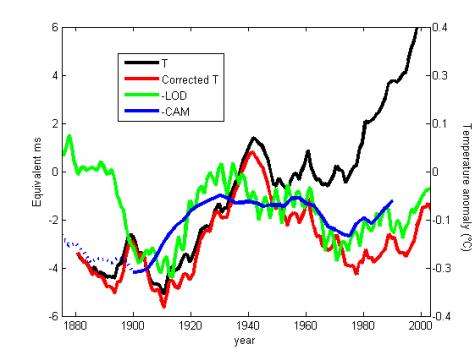
Time series of Earth's surface air temperature (black line) and time series corrected for the influence of human activities (red line), Earth's length of day (green line) and Earth's core angular momentum (blue line). Credit: NASA/JPL-Université Paris Diderot - Institut de Physique du Globe de Paris
The researchers found that the uncorrected temperature data correlated strongly with data on movements of Earth's core and Earth's length of day until about 1930. They then began to diverge substantially: that is, global surface air temperatures continued to increase, but without corresponding changes in Earth's length of day or movements of Earth's core. This divergence corresponds with a well-documented, robust global warming trend that has been widely attributed to increased levels of human-produced greenhouse gases.But an examination of the corrected temperature record yielded a different result: the corrected temperature record remained strongly correlated with both Earth's length of day and movements of Earth's core throughout the entire temperature data series. The researchers performed robust tests to confirm the statistical significance of their results.
"Our research demonstrates that, for the past 160 years, decadal and longer-period changes in atmospheric temperature correspond to changes in Earth's length of day if we remove the very significant effect of atmospheric warming attributed to the buildup of greenhouse gases due to mankind's enterprise," said Dickey. "Our study implies that human influences on climate during the past 80 years mask the natural balance that exists among Earth's rotation, the core angular momentum and the temperature at Earth's surface."
So what mechanism is driving these correlations? Dickey said scientists aren't sure yet, but she offered some hypotheses.
Since scientists know air temperature can't affect movements of Earth's core or Earth's length of day to the extent observed, one possibility is the movements of Earth's core might disturb Earth's magnetic shielding of charged-particle (i.e., cosmic ray) fluxes that have been hypothesized to affect the formation of clouds. This could affect how much of the sun's energy is reflected back to space and how much is absorbed by our planet. Other possibilities are that some other core process could be having a more indirect effect on climate, or that an external (e.g. solar) process affects the core and climate simultaneously.
Regardless of the eventual connections to be established between the solid Earth and climate, Dickey said the solid Earth's impacts on climate are still dwarfed by the much larger effects of human-produced greenhouse gases. "The solid Earth plays a role, but the ultimate solution to addressing climate change remains in our hands," she concluded.
More information: Study results were published recently in the Journal of Climate.
Provided by
JPL/NASA
-
From lemons to lemonade: Reaction uses carbon dioxide to make carbon-based semiconductor,
32 comments
-
Thioridazine kills cancer stem cells in human while avoiding toxic side-effects of conventional cancer treatments,
3 comments
-
SpaceX private rocket blasts off for space station (Update),
42 comments
-
Climate scientists say they have solved riddle of rising sea,
30 comments
-
Research team claims to have found evidence Lake Cheko is impact crater for Tunguska Event,
18 comments
-
Hypothetical desert earth
1 hour ago
-
More human population = greater mass?
May 25, 2012
-
Conversion from aircraft bearing to normal degrees
May 23, 2012
-
Interpretation/Analysis of the Lab results(HEPA filter)
May 22, 2012
-
Has anyone here attended the The Urbino Summer School in Paleoclimatology?
May 22, 2012
-
Earthquakes: Mag 6 N. Italy and Mag 5.6 W. Bulgaria
May 21, 2012
- More from Physics Forums - Earth
More news stories
SpaceX capsule has 'new car' smell, astronauts say (Update)
SpaceX's Dragon cargo vessel smells like a new car, said astronauts at the International Space Station after opening the hatches Saturday following the spacecraft's landmark mission to the orbiting lab.
Space & Earth / Space Exploration
15 hours ago |
4.5 / 5 (19) |
0
Australia hails surprise super-telescope decision
Australia has hailed a surprise decision giving it a role in a radio telescope project aimed at revolutionising astronomy, vowing to draw on its decades of experience in space science.
15 hours ago |
5 / 5 (3) |
1
Astronomers seize last chance in lifetime for Venus Transit
Astronomers are gearing for one the rarest events in the Solar System: an alignment of Earth, Venus and the Sun that will not be seen for another 105 years.
15 hours ago |
5 / 5 (1) |
1
Astronauts enter world's 1st private supply ship
(AP) -- Space station astronauts floated into the Dragon on Saturday, a day after its heralded arrival as the world's first commercial supply ship.
Space & Earth / Space Exploration
15 hours ago |
5 / 5 (5) |
0
Dragon arrives at space station in historic 1st (Update 2)
The privately bankrolled Dragon capsule made a historic arrival at the International Space Station on Friday, triumphantly captured by astronauts wielding a giant robot arm.
Space & Earth / Space Exploration
May 25, 2012 |
5 / 5 (10) |
19
Dell tablet leak: 10.1-inch display, two-battery choice
(Phys.org) -- Headline after headline talks about vendors tablets in the wings as likely number-one contenders for the iPad. Such claims have justifiably been taken with a grain of salt, considering ...
Scientist: Evolution debate will soon be history
(AP) -- Richard Leakey predicts skepticism over evolution will soon be history. Not that the avowed atheist has any doubts himself.
SpotterRF debuts Radar Backpack Kit (w/ Video)
(Phys.org) -- SpotterRF has announced a special radar backpack kit designed to enhance situational awareness for soldiers on the ground. The company says its special radar is designed for warfighters as part ...
Thousands of shellfish found dead in Peru
Thousands of crustaceans were found dead off the coast of Lima following the mystery mass death of dolphins and pelicans, the Peruvian Navy said Friday.
Keep food safety in mind this memorial day weekend
(HealthDay) -- Picnics, parades and cookouts are as much a part of Memorial Day weekend as tributes to the United States' war veterans.
Family history of Alzheimer's affects functional connectivity
(HealthDay) -- Cognitively normal individuals with a family history of late-onset Alzheimer's disease (AD) may display lower resting state functional connectivity in the default mode network (DMN) of the brain, ...

Mar 10, 2011
Rank: 5 / 5 (3)
Mar 10, 2011
Rank: 5 / 5 (4)
Mar 10, 2011
Rank: 1.9 / 5 (7)
Could this be due to the fact that the earth is closer to the sun during the northern winter? Time runs slower in a stronger gravity field.
Mar 10, 2011
Rank: 4.1 / 5 (9)
Mar 10, 2011
Rank: 1.7 / 5 (6)
Mar 10, 2011
Rank: 2.3 / 5 (6)
Mar 10, 2011
Rank: 1 / 5 (1)
Mar 10, 2011
Rank: 1.5 / 5 (16)
anhonestclimatedebate.wordpress.com/2011/03/10/hide-the-decline-explained/
The root of the problem seems to be in Washington, DC where the US National Academy of Sciences reviews budgets of research agencies for Congress and allocates funds to organizations that report evidence for "CO2-induced global warming" in exchange for government funds, as former President Eisenhower warned might happen on day in his 1961 farewell address:
youtube.com/watch?v=GOLld5PR4ts
With kind regards,
Oliver K. Manuel
Mar 11, 2011
Rank: 5 / 5 (5)
Question, that's unnecessary. There is no objective measure of time. If you are a clock counting time and time slows down, you slow down too. Regardless of how accurate you are, you will not notice the change in the flow of time because you are a party to that change and not an objective referential observer.
Mar 11, 2011
Rank: not rated yet
Mar 11, 2011
Rank: 4 / 5 (4)
The LoD measurements are made relative to astronomical observations, so a change in the local flow of time must be accounted for if it is significant. I have read that the GPS navigation system would not function well if local deviations in the flow of time were not continuously accounted for.
Mar 11, 2011
Rank: 1 / 5 (1)
Mar 11, 2011
Rank: 5 / 5 (2)
Yes and that isn't due purely to gravity, that also has to do with referential frame and speed. The faster you go, the slower time passes for your reference frame.
Mar 11, 2011
Rank: not rated yet
IIRC, observations of fast pulsars situated orthogonally may be used to correct for gravitational effects...
Mar 12, 2011
Rank: 3 / 5 (4)
(Just kidding guys).
Mar 14, 2011
Rank: 5 / 5 (1)
yes, exactly. For instance, the GPS satellites on the sunward side of the earth compared to the ones farthest from the sun at any given time have a significant difference in relative velocity, since one is moving against the earth's orbit and the other is moving in the same direction as the earth. When you're talking about miliseconds or small dopler effect changes, it's a significant effect. According to a book I read once, if you tried to fly to the moon and you didn't account for the change in the rate of the flow of time due to leaving Earth's gravity well, you would miss the moon. I don't remember what book that was though. Maybe A Brief History of Time? I don't know. Question, if you haven't read that one, you might enjoy it. It's a little outdated but still good.
Mar 14, 2011
Rank: 1 / 5 (3)
Mar 15, 2011
Rank: 5 / 5 (5)
Iron, wait for it.
Where did that come from? The Sun's core is hydrogen and helium. And there is rather a lot more of each between the Sun's core and the surface and another 93 million miles between the Sun and the Earth.
Yes. Core A is not equal to Core b.
Did your post have a purpose? If so what was it?
And then continues on up. And it ISN'T a head and shoulders. If you MUST misuse a stock market analogy its series of rising tops and bottoms and YOU are not ever going to be my Stock Market Elf if you can't tell Tops and Bottoms from Head and Shoulders.
Ethelred
Mar 15, 2011
Rank: 4.3 / 5 (6)
This sounds like a job for Plasma Cosmology and-or Neutron Repulsion. They're both light years ahead of current theory(pun intended). :^)