How dogs make sense of size
March 4, 2011

How dogs make sense of size

Enlarge

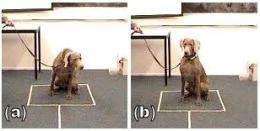
Images show differing reactions of subject dog to stuffed models as growl sounds played back.

(PhysOrg.com) -- University of Sussex psychologists have demonstrated an ability in domestic dogs to match acoustic and visual cues - a cognitive ability once thought to be found in primates only -when assessing size in other dogs.

Researchers Dr Anna Taylor, Dr David Reby and Karen McComb filmed the reactions of 40 different volunteer when presented with two other dogs (a stuffed Jack Russell and a stuffed German shepherd dog) of different size and a variety of manipulated growl recordings.

The playback recordings represented a variety of large and small dogs of different age, breed and sex. Each dog was introduced to the two stuffed models and then heard two "large dog" growls and two "small dog" growls. While each growl was played, the experimenters recorded which stuffed model the dog looked at first, which model the dog looked at longest, and how long the dog looked at each model.

It was found that the amount of attention paid to either the small dog or large dog by each subject was significantly greater when the sound played matched correctly with either model (known as "preferential looking").

The findings are now available in a research paper - Cross Modal Perception of body Size in Domestic Dogs (Canis familiaris) - published in the online open access journal .

Body size in animals is used to assess potential mates, or the relative strength and dominance of competitors. Animals therefore use visual cues to make decisions on whether to engage in potential social or sexual interaction with other individuals.

In nature many animals have developed the ability to make themselves look bigger than they actually are to ward off enemies or attract mates, meaning that visual clues alone are not entirely reliable indicators of size.

The findings of the Taylor experiment show that domestic dogs have the cognitive ability to match visual cues to size (by looking at the other dog) with acoustic cues to size (by listening to the growling sound made), enabling them to build a more accurate picture of the other animal's status.

The researchers believe that this relatively sophisticated cognitive ability, integrating information on size from different sensory channels, is not restricted to domestic dogs.

Dr Taylor says: "This ability is likely to be crucial to intra-specific interactions between , especially in group situations. The ability to categorically relate information from different sources is particularly relevant to animals when they make social decisions. Future experiments should investigate whether other types of information can be similarly conceptualised."

Dr Reby, from the University's Mammal Vocal Communication and Cognition Research Group in the School of Psychology says: "This study also suggests that the ability to estimate body from vocal signals, a crucial property of human speech perception, is in fact present across mammalian species. Studying animal vocal communication informs our understanding of the origins of speech production and perception."

More information: Anna M. Taylor, David Reby, & Karen McComb (2011). Cross Modal Perception of Body Size in Domestic Dogs (Canis familiaris) PLoS ONE, 6 (2). http://www.plosone … pone.0017069

Provided by University of Sussex search and more info website

4.8 /5 (4 votes)  

Filter


Move the slider to adjust rank threshold, so that you can hide some of the comments.


Display comments: newest first

rgwalther
Mar 04, 2011

Rank: not rated yet
The only way my dog would respond to 'recorded' dog growls/sounds is if the playback device was very large and you were able to sneak up unnoticed and drop the device on him.(he's getting older but he would not allow either of these actions to happen).
I doubt you could get him to pay any attention to a stuffed animal toy unless it bounced after you threw it.
Rank 4.8 /5 (4 votes)
Relevant PhysicsForums posts

More news stories

Scientist: Evolution debate will soon be history

(AP) -- Richard Leakey predicts skepticism over evolution will soon be history. Not that the avowed atheist has any doubts himself.

Biology / Evolution

created 4 hours ago | popularity 2.8 / 5 (6) | comments 14

Thousands of shellfish found dead in Peru

Thousands of crustaceans were found dead off the coast of Lima following the mystery mass death of dolphins and pelicans, the Peruvian Navy said Friday.

Biology / Ecology

created 14 hours ago | popularity 4.8 / 5 (4) | comments 5

More plant species responding to global warming than previously thought

(Phys.org) -- Far more wild plant species may be responding to global warming than previous large-scale estimates have suggested.

Biology / Ecology

created May 22, 2012 | popularity 4.6 / 5 (14) | comments 18 | with audio podcast

Totally rad: Scientists create rewritable digital data storage in DNA

(Phys.org) -- Scientists from Stanford's Department of Bioengineering have devised a method for repeatedly encoding, storing and erasing digital data within the DNA of living cells.

Biology / Biotechnology

created May 21, 2012 | popularity 4.9 / 5 (17) | comments 11 | with audio podcast

For monogamous sparrows, it doesn't pay to stray (but they do it anyway)

It's quite common for a female song sparrow to stray from her breeding partner and mate with the male next door, but a new study shows that sleeping around can be costly.

Biology / Plants & Animals

created May 22, 2012 | popularity 5 / 5 (1) | comments 7 | with audio podcast


Dell tablet leak: 10.1-inch display, two-battery choice

(Phys.org) -- Headline after headline talks about vendors’ tablets in the wings as likely number-one contenders for the iPad. Such claims have justifiably been taken with a grain of salt, considering ...

SpotterRF debuts Radar Backpack Kit (w/ Video)

(Phys.org) -- SpotterRF has announced a special radar backpack kit designed to enhance situational awareness for soldiers on the ground. The company says its special radar is designed for warfighters as part ...

SpaceX capsule has 'new car' smell, astronauts say (Update)

SpaceX's Dragon cargo vessel smells like a new car, said astronauts at the International Space Station after opening the hatches Saturday following the spacecraft's landmark mission to the orbiting lab.

Australia hails surprise super-telescope decision

Australia has hailed a surprise decision giving it a role in a radio telescope project aimed at revolutionising astronomy, vowing to draw on its decades of experience in space science.

Keep food safety in mind this memorial day weekend

(HealthDay) -- Picnics, parades and cookouts are as much a part of Memorial Day weekend as tributes to the United States' war veterans.

Astronomers seize last chance in lifetime for Venus Transit

Astronomers are gearing for one the rarest events in the Solar System: an alignment of Earth, Venus and the Sun that will not be seen for another 105 years.