Deal to combine AT&T, T-Mobile raises questions
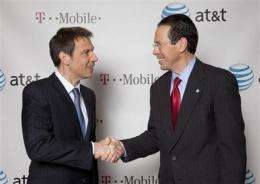
(AP) -- AT&T's surprise announcement that it plans to acquire T-Mobile USA will force federal regulators to confront a difficult antitrust question: Can American consumers get good wireless service at a fair price if they must choose between just two national companies?
That debate will be at the center of the government review of the $39 billion cash-and-stock deal announced Sunday. If approved, the purchase would catapult AT&T past Verizon Wireless to become the nation's largest cellphone service provider.
The deal would combine AT&T Inc., the nation's second-largest wireless carrier, with T-Mobile USA, the fourth-largest, which is now owned by Germany's Deutsche Telekom AG. And it could pave the way for Verizon to go after Sprint Nextel Corp., which would be a distant No. 3 and the only remaining national provider.
None of the smaller U.S. carriers, including Leap Wireless, Metro PCS and U.S. Cellular, has complete nationwide coverage.
Officials at the Justice Department and the Federal Communications Commission could spend a year or more scrutinizing the deal before deciding whether to block it or allow it to proceed with substantial conditions attached.
"I am not convinced that this deal is unthinkable," said Jeffrey Silva, an analyst with Global Medley Advisors. "But it's a very, very heavy lift."
Regulators will conduct a thorough market-by-market analysis to determine how many wireless choices consumers would have in communities across the country. And even if they allow the deal to go through, government officials would probably require the combined company to sell off assets - including wireless spectrum, cell towers and customers - in particular markets that are too concentrated.
The bigger question facing federal officials is whether the enormous cost of building a nationwide wireless network means that a market dominated by only two companies is the best they can hope for.
And if that's the case, what kinds of merger conditions should the government impose on AT&T to prevent it from abusing its power?
"This marketplace doesn't work even before this merger," said Mark Cooper, director of research for the Consumer Federation of America. "I want policymakers to confront the fiction that competition in this market is sufficient to protect consumers."
Cooper, for one, would like to see federal regulators bar AT&T from engaging in common industry practices such as charging consumers large fees for text messaging and for ending contracts before they expire.
He would also like to see government officials impose stronger "network neutrality" rules on AT&T's wireless system to ensure that subscribers can access apps and other online applications without carrier interference.
Net neutrality rules adopted by the FCC late last year prohibit broadband providers from discriminating against online traffic, but they give wireless companies a considerable amount of flexibility to manage traffic on their systems.
Analyst Rebecca Arbogast of the firm Stifel Nicolaus believes government regulators will also consider conditions intended to help smaller wireless providers compete.
Those could include data-roaming obligations, which would require AT&T to let smaller regional wireless companies use its network to send data traffic in places where they do not offer their own service. The FCC is currently considering adopting industry-wide data roaming rules.
Government officials could also impose "special access" obligations, which would guarantee rival wireless companies access to vital lines owned by AT&T that they rely on to connect their towers to broader telecommunications networks and the Internet.
Smaller carriers - most notably Sprint - argue that they pay excessive prices for that access because much of the critical network infrastructure is owned by the big landline telephone companies, AT&T and Verizon, which compete with them in the wireless arena.
If government officials do eventually sign off on AT&T's proposed acquisition of T-Mobile, they will likely require the combined company to sell off wireless spectrum in certain markets. The hope would be that these airwaves - which are in scarce supply - would wind up in the hands of smaller players such as Sprint and Leap, possibly restoring some competition.
Wireless companies are clamoring for more airwaves to keep up with the explosive growth of online apps, mobile video and other bandwidth-hungry wireless applications. Indeed, AT&T has said that one key benefit of the T-Mobile transaction is that it would provide both carriers with access to more spectrum, although AT&T already has an ample supply of spectrum it is not planning to use for several years.
Both the FCC and the Obama administration are exploring ways to free up more spectrum for wireless broadband.
T-Mobile's own unsuccessful struggles to get more wireless spectrum may have helped push it into the arms of AT&T. The company had been aggressively lobbying Congress and the FCC to auction off a prime slice of airwaves freed up in the 2009 transition from analog to digital TV signals.
T-Mobile had hoped to bid on that spectrum and appeared to make a convincing case with the FCC, which had proposed auctioning off the airwaves last year.
But in a major setback for T-Mobile, the agency later backed away from that plan after running into substantial opposition from public safety officials - and their backers in Congress - who want to use the spectrum to build a nationwide wireless network for police officers, firefighters and other emergency workers.
For its part, AT&T rejects the notion that the wireless industry is too concentrated.
James Cicconi, senior executive vice president for external and legislative affairs, noted that consumers will still have a choice of multiple wireless providers - including Leap, Metro PCS and U.S. Cellular - in many markets even if the deal is approved.
He added that the merger will produce significant benefits for the public, as AT&T has promised to blanket 95 percent of the U.S. population with high-speed, fourth-generation wireless Internet access, also known as 4G. That goes to the heart of a top telecom policy goal for both the FCC and the Obama administration, which have pledged to bring high-speed Internet access to all Americans. They see wireless as critical to meeting that goal, particularly in rural areas where it does not make economic sense to build landline networks.
Other factors that could help AT&T sell the deal to the government include its promise to invest more than $8 billion in its 4G network over the next seven years and the fact that the company's workforce is unionized. T-Mobile's workers do not have bargaining rights.
At this point, it's too soon to know whether the merger will be approved. But what is clear, Silva said, is that "there will be a rich mix of very important policy and political considerations."
©2010 The Associated Press. All rights reserved. This material may not be published, broadcast, rewritten or redistributed.


