Black holes: a model for superconductors?
March 2, 2011

black hole

Enlarge

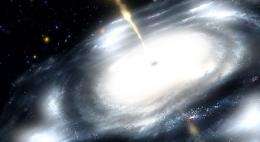
This artist's concept shows a galaxy with a supermassive black hole at its core. The black hole is shooting out jets of radio waves. Image credit: NASA/JPL-Caltech

Black holes are some of the heaviest objects in the universe. Electrons are some of the lightest. Now physicists at the University of Illinois at Urbana-Champaign have shown how charged black holes can be used to model the behavior of interacting electrons in unconventional superconductors.

"The context of this problem is high-temperature superconductivity," said Phillips. "One of the great unsolved problems in physics is the origin of superconductivity (a conducting state with ) in the ceramics discovered in 1986." The results of research by Phillips and his colleagues Robert G. Leigh, Mohammad Edalati, and Ka Wai Lo were published online in Physical Review Letters on March 1 and in Physical Review D on February 25.

Unlike the old superconductors, which were all metals, the new superconductors start off their lives as insulators. In the insulating state of the copper-oxide materials, there are plenty of places for the electrons to hop but nonetheless—no current flows. Such a state of matter, known as a Mott insulator after the pioneering work of Sir Neville Mott, arises from the strong repulsions between the electrons. Although this much is agreed upon, much of the physics of Mott insulators remains unsolved, because there is no exact solution to the Mott problem that is directly applicable to the copper-oxide materials.

Enter string theory—an evolving theoretical effort that seeks to describe the known fundamental forces of nature, including gravity, and their interactions with matter in a single, mathematically complete system.

Fourteen years ago, a string theorist, Juan Maldacena, conjectured that some strongly interacting quantum mechanical systems could be modeled by classical gravity in a spacetime having constant negative curvature. The charges in the quantum system are replaced by a charged black hole in the curved spacetime, thereby wedding the geometry of spacetime with quantum mechanics.

Since the Mott problem is an example of strongly interacting particles, Phillips and colleagues asked the question: "Is it possible to devise a theory of gravity that mimics a Mott insulator?" Indeed it is, as they have shown.

The researchers built on Maldacena's mapping and devised a model for electrons moving in a curved spacetime in the presence of a charged black hole that captures two of the striking features of the normal state of high-temperature superconductors: 1) the presence of a barrier for electron motion in the Mott state, and 2) the strange regime in which the electrical resistivity scales as a linear function of temperature, as opposed to the quadratic dependence exhibited by standard metals.

The treatment advanced in the paper published in shows surprisingly that the boundary of the spacetime consisting of a charged black hole and weakly interacting electrons exhibits a barrier for moving in that region, just as in the Mott state. This work represents the first time the Mott problem has been solved (essentially exactly) in a two-dimensional system, the relevant dimension for the high-temperature superconductors.

"The next big question that we must address," said Phillips, "is how does superconductivity emerge from the gravity theory of a Mott insulator?"

Provided by University of Illinois College of Engineering

4.3 /5 (18 votes)  

Filter


Move the slider to adjust rank threshold, so that you can hide some of the comments.


Display comments: newest first

Waterdog
Mar 02, 2011

Rank: 3.3 / 5 (3)
The fundamental question for me is "what is charge?". I know what it does. I can describe it. It can be quantified, but what is it? It seems to me to be a elementary unit of the universe. It seems to be conserved even in nuclear reactions. This article seems to be implying that if you were to bombard a black hole with electrons that the charge would not be consumed by the black hole. What else can you say that for?
Alburton
Mar 02, 2011

Rank: 2.8 / 5 (5)
Science does scarcely confront the question of the fundamental what. The universe is a mistery so deep we dont know "what" is anything,do we?
What are you?
Kant would say we cannot know the object for itself,but only the object for me.
Doom1974
Mar 02, 2011

Rank: not rated yet
In string theory, black holes appear to be described as elementary particles, therefore within that mathematical framework, they appear to be able to marry gravity with quantum mechanics.
natetuvkok
Mar 02, 2011

Rank: not rated yet
Within an energy band, energy levels form a near continuum. First, the separation between energy levels in a solid is comparable with the energy that electrons constantly exchange with phonons (atomic vibrations). Second, it is comparable with the energy uncertainty due to the Heisenberg uncertainty principle, for reasonably long intervals of time. As a result, the separation between energy levels is of no consequence.
Caliban
Mar 02, 2011

Rank: not rated yet
All well and good, except that an empirically real phenomenon is being extrapolated, or, mapped upon another that is yet to be quantified empirically. How do you go about proving that a BH is weakly negatively charged?
Skeptic_Heretic
Mar 02, 2011

Rank: 5 / 5 (3)
Not negatively charged, comprised of a slight negative balance of energy. Big difference, but your question stands.
Anthony_Milner
Mar 02, 2011

Rank: 1 / 5 (2)
Finally someones looking in the right direction. Relativity of inverse vortices and angular vectors at an event horizon in my view literally hold the key to the unknown Universe.
Shelgeyr
Mar 03, 2011

Rank: 3.6 / 5 (10)
...The charges in the quantum system are replaced by a charged black hole in the curved spacetime, thereby wedding the geometry of spacetime with quantum mechanics.


I conjecture that paragraph containing the above is truly, truly meaningless.

This work represents the first time the Mott problem has been solved (essentially exactly)...


This isn't science. This is mathematical navel-gazing.

First prove that there is such a creature as a "charged black hole", a strictly theoretical entity (and good luck with that), then that we know anything at all about its real-world behavior (we don't) which could then be related to superconductors (a real-world phenomena).

As it is, the solution presented here is "two handfuls of magic pixie dust" to solve one physics problem.

I'm not a troll. But sometimes these articles make it hard not to sound like a PRO-SCIENCE troll...
ZephirAWT
Mar 03, 2011

Rank: 1.7 / 5 (6)
Superconductivity is conceptually simple. High temperature superconductors contain so-called hole stripes, i.e. the lines of positively charged atoms. Movable electrons are attracted to them like hens to chicken feeder. Because they're all negatively charged, their repulsive forces overlap and compensate mutually. As the result, the electrons are moving freely along the hole stripes, because the geometric constrains for their motion are merely removed.

What the black hole has with it? In modern theories the black holes are very dense stars rather than singularities, their particles are heavily compressed and they're forming superfluid in similar way, like the electrons inside of superconductors.
ZephirAWT
Mar 03, 2011

Rank: 1 / 5 (5)
What the Mott insulating state has with it? Well, when electrons aren't compressed enough, their repulsive forces dictate them to arrange into hexagonal regular lattice, so-called the Wigner's crystal. Within such lattice the electrons are virtually unmovable, so that the material is forming an insulator, although it's full of movable electrons. The so-called topological insulators are (non)conducting in similar way.

The process of transition of Mott insulator state into chaotic superconductive state can be modelled quite easily with computer simulation, at least conceptually. A substantially more difficult is to include the environmental parameters into such ad-hoced simulation to predict real numbers. A third level is to derive formal model for it, which enables to predict the temperature of superconductive transition from material constants of superconductor. The important thing is, these calculations aren't necessary for qualitative understanding of superconductor function.
antialias
Mar 03, 2011

Rank: 5 / 5 (4)
This isn't science. This is mathematical navel-gazing.

The point is IF superconductors can be described by thei method then it can be used to predict other (better?) superconductors.
So the theory is testable - something that should be high on the agenda of the people involved.

As always in science: Theory first. Then comes the test.
ZephirAWT
Mar 03, 2011

Rank: 1 / 5 (4)
As always in science: Theory first. Then comes the test.
Always? Such rule doesn't exist in science. After all, just both the low temperature superconductors, both high temperature superconductors were revealed accidentally. So far we are talking about empirical physics, as we have no reliable theory of HT superconductors at all.
ZephirAWT
Mar 03, 2011

Rank: 2 / 5 (4)
As always in science: Theory first. Then comes the test.
Always? Such rule doesn't exist in science. After all, just both the low temperature superconductors, both high temperature superconductors were revealed accidentally. So far we are talking about empirical physics, as we have no reliable theory of HT superconductors at all.
..The point is IF superconductors can be described by their method then it can be used to predict other (better?) superconductors...
This is really a big IF. The finding of perfect theory of SC doesn't mean, we would know, how to produce theoretically proposed structures at feasible scale. And vice-versa: we can propose the fundamentally new superconductors even with quite qualitative models with no math at all - after all, this is how the best superconductors were prepared so far. It's merely an art, rather than the science.
antialias
Mar 03, 2011

Rank: 5 / 5 (5)
This method will certainly predict other superconductors or other superconductor-behavior than the standard method. So we can test it and move away from this 'trial and error' based mucking around (or 'art' as you call it) of searching for new superconductors.

Science requires theories, because science is about finding rules with which you can predict future behavior of as yet unrecorded phenomena. Everything else is just data acquisition.

No doubt, data acquisition is a valuable part of science - much like making theories - but only together they make up the scientific method.

Definition taken from wikipdeia, 'scientific method':
scientific method is: ...systematic observation, measurement, and experiment, and the formulation, testing, and modification of hypotheses
Nik_2213
Mar 03, 2011

Rank: 1 / 5 (2)
Truly weird science...
I won't even pretend to understand more than scraps of this article, it's so abstruse: Uh, IIRC, a black hole will *eventually* neutralise itself via Hawking radiation. What bugs me is that an electron has 'unity' charge, but quarks carry 'fractional' charges...
Shelgeyr
Mar 03, 2011

Rank: 2.6 / 5 (5)
If this leads to a testable theory of high-temp superconductors, then I assume it will only be due to a happy accident since we can't test black holes. Nonetheless, if it DOES lead to a testable theory, great! In that event I'll happily withdraw my "mathematical navel-gazing" snark.
ZephirAWT
Mar 03, 2011

Rank: 1 / 5 (6)
This method will certainly predict other superconductors or other superconductor-behaviour than the standard method.
You're not even wrong. You're just naive. Do you know about some mechanism, how to avoid the paying the useless nonsensical research? If not, then you have no feedback about it.
antialias
Mar 03, 2011

Rank: 5 / 5 (7)
If it doesn't make predictions other than the standard method then it is equivalent to the standard method. in that case - depending on whether it can be formulated in a more conscise way than the standard method - it may be more or less useful.

But since it postulates a fundamentally different mechanism some discrepancy should occur: and there is where you set up the test.

This research doesn't say that black holes are involved. it just uses the mathematical methods involved in describing them (string theory) on another subject. Nothing wrong with that. Mathematical _methods_ are independent of the physical subjects they are applied to. the article postulates that a gravity equivalent can be formulated to an electrodynamic problem (and vice versa). The research to verify (or falsify) this costs next to nothing.
GSwift7
Mar 03, 2011

Rank: 4 / 5 (3)
Black holes are some of the heaviest objects in the universe. Electrons are some of the lightest.


Kinda way off topic and also kinda philosophical, but for some reason I can't help but criticize the above comment. First, I'm not sure I would call a black hole an object in the traditional sense. Second, an electron is actually quite dense in terms of the total mass/energy contained in an electron compared to its size. Third, using the word 'heavy' is a bit odd.

Oh, and one more thing:

This artist's concept shows a galaxy with a supermassive black hole at its core. The black hole is shooting out jets of radio waves


I think it's actually shooting out jets of white paint or chalk. :)
Pyle
Mar 03, 2011

Rank: 5 / 5 (1)
You're not even wrong. You're just naive. Do you know about some mechanism, how to avoid the paying the useless nonsensical research? If not, then you have no feedback about it.

How many billions of dollars would a room temperature superconductor be worth? Maybe a trillion? More?
Research is a risk/reward system. I would even agree that oversight can always be improved. Maybe even pegging more public money in investment portfolio style selection methods might be a step forward. But your negativity comes across as reaction to a past slight more than an objective argument.

I say flush it all down the LHC!!! Who knows? Maybe it will find your aether.
GSwift7
Mar 03, 2011

Rank: 1 / 5 (2)
How many billions of dollars would a room temperature superconductor be worth? Maybe a trillion? More?


Let's pretend you have one. It's a good one, but a year later I come up with a better one. How much is yours worth? :P

I agree with your post, I just like to play devil's advocate for the purpose of discussion sometimes.
Pyle
Mar 03, 2011

Rank: 5 / 5 (4)
I wasn't really thinking along marketing lines. I was thinking more along value to humanity lines.
To your point though, yeah. That is why funding for bleeding edge research is usually government sponsored. Companies don't want to take that initial risk. They much prefer to focus their energies on technologies that can be secured for profit after the government does the dirty work.

Back to the superconductors, the potential benefits in power transmission alone make this worthy pursuit. Who cares if the comparison in this research is likely to an impossible mathematical artifact resulting from a broken limit within GR/string theories?
beelize54
Mar 03, 2011

Rank: 1.5 / 5 (8)
How many billions of dollars would a room temperature superconductor be worth? Maybe a trillion? More?
Research is a risk/reward system.
This is actually the core of the problem. It's not risk/reward, because J.F.Prins prepared such superconductor before ten years already. We have these solid phase superconductors already and we don't need theorists for it. We understand this mechanism and we could even make artificial superconductive phase from carriers attracted to nonconductive surfaces with electrostatic field. But physicists are still developing dummy models instead of testing of these results. These results never appear at physorg-like news servers, because superconductor "re-search" is an industry and too many people would lose their safe jobs.

http://www.superc...276K.htm

http://iopscience...18/3/319
Pyle
Mar 03, 2011

Rank: 4.8 / 5 (4)
Give it up man! You and your conspiracies. Prins didn't demonstrate ANYTHING. Mere speculation and inconclusive experimental results. Haven't we all been down this road multiple times? It's not like nobody is trying to use diamonds to make superconductors. Give it a rest. And... Nobody but snake oil salesmen continue to sell cold fusion, despite their efforts to recreate it.

Sorry everyone else. Having a bad day.
beelize54
Mar 04, 2011

Rank: 1 / 5 (7)
..Prins didn't demonstrate ANYTHING. Mere speculation and inconclusive experimental results...
LOL, you can't simply tell this, because nobody bothered to analyze it and replicate it in peer-reviewed press. You're just like the opponents of Galileo, who refused to have look through his telescope to face the evidence. We all know, cold fusion is real, room temperature superconductivity is real and mainstream physicists are taking money whole years for research of irrelevant nonsense like alchemists of modern era - because they simply can. In contemporary science no one is responsible for ignorance of existing results. So you don't believe, it's possible? Lets face the reality.
frajo
Mar 04, 2011

Rank: 5 / 5 (5)
Lets face the reality.
Reality is that beelize54
prepared such superconductor before ten years
and ZephirAWT
the cooling speed measurement for determination of neutron star viscosity has been proposed before fifty years already
are two accounts of one person.
Some people are unable to learn.
Pyle
Mar 04, 2011

Rank: 5 / 5 (2)
Zephir, you really think that a company that could distribute energy with zero resistance and make BILLIONS upon BILLIONS of dollars in profit would be curbed by some egg heads at universities that want to keep their research money?

You really think that China would pass up the chance to use this technology to catapult itself past the western world?

I know I am asking a lot, but be reasonable. Some conspiracies are plausible and believed by people who are skeptical of the "official version". Some are believed only by nutjobs. Just because you keep repeating a conspiracy doesn't make you one of the former. We know you are reasonably intelligent. Your math skills and knowledge of science are well above the average person. Try to analyze your beliefs a little bit and reflect on your posting. Unless it is all just for a laugh, in which case, you are funny but it is getting tired.
Skeptic_Heretic
Mar 05, 2011

Rank: 5 / 5 (3)
The reason why large secret conspiracies don't exist is because people are not good at keeping their mouths shut.

If one person happened on superconductivity, they most assuredly had assistants and associates working on the project. The larger a project, the larger the secret society would have to be. The larger the society of secret conspirators, the greater the possibility of a leak. Then of course there's always the fact that if it was discovered or leaked you'd need to bring those people into the fold, resulting in an even larger conspiracy, with more people, and bigger leaks, resulting in more people picking up the research and discovering HTSC, resulting in .........

This is why people like you make me laugh, Zephir.
ab3a
Mar 05, 2011

Rank: 5 / 5 (4)
As always in science: Theory first. Then comes the test.


Usually the hypotheses are the result of attempting to explain experimental results and observations. If it is tested and confirmed to be reasonably accurate, we call it a theory. It is rare that an hypothesis come about strictly from a mathematical perspective. And then for that hypothesis to have no readily testable aspects to it?

That's no theory. I'm not even sure one could call it an hypothesis. Until it can be tested, it is a lot of mathematical doodling.

THAT is why there are so many physicists who express doubts.
beelize54
Mar 05, 2011

Rank: 2 / 5 (4)
@Pyle: Show me some attempt for replication of J.F.Prins experiments published in peer-reviewed article (a link). Without it your comments are pure conspiratorial speculations.
CrossMan
Mar 24, 2011

Rank: not rated yet
To those you are bothered by the fact that charged black holes need not exist, let me say that this is no obstacle to what this work accomplishes. The Maldacena mapping is used to map a difficult problem onto an (presumably) equivalent problem, but one described by different mathematics, and which is hopefully easier to understand. It doesn't matter if the new math describes something real, since the math itself can be studied directly.

As an analogy, consider many masses connected to each other by springs and making them oscillate. The resulting motions are very complicated to describe because the behavior of any one mass depends on its neighbors -- the system is highly coupled. But, you can transform the problem to an equivalent uncoupled system (which need not exist in reality), which is very easy to solve because the solutions are independent of each other. Those solutions are mapped back to the original problem, and we learn something about coupled oscillation.
Rank 4.3 /5 (18 votes)
Relevant PhysicsForums posts
  • Question about induced E field.
    created1 hour ago
  • Charging a capacitor in a tesla coil
    created1 hour ago
  • Water Rocket
    created4 hours ago
  • why do trucks have bigger brakes?
    created9 hours ago
  • Solar Sail Physics - Do they work on a large scale?
    created10 hours ago
  • How should I switch an air conditioner off?
    created10 hours ago
  • More from Physics Forums - General Physics

More news stories

Landmark calculation clears the way to answering how matter is formed

(Phys.org) -- An international collaboration of scientists, including Thomas Blum, associate professor of physics, is reporting in landmark detail the decay process of a subatomic particle called a kaon – ...

Physics / General Physics

created May 25, 2012 | popularity 4.4 / 5 (20) | comments 47 | with audio podcast

Is a classical electrodynamics law incompatible with special relativity?

(Phys.org) -- The laws of classical electromagnetism that were developed in the 19th century are the same laws that scientists use today. They include Maxwell’s four equations along with the Lorentz la ...

Physics / General Physics

created May 24, 2012 | popularity 4.7 / 5 (15) | comments 36 | with audio podcast feature

Lying in wait for WIMPs: Researchers seek to dramatically increase sensitivity of Large Underground Xenon detector

Although it's invisible, dark matter accounts for at least 80 percent of the matter in the universe. No one knows what it is, but most scientists would bet on weakly interacting massive particles, or WIMPs.

Physics / General Physics

created May 23, 2012 | popularity 4 / 5 (7) | comments 15 | with audio podcast

Hall effect at the speed of light: How can you demonstrate relativistic effects with your mobile phone?

The relativistic Hall effect describing objects rotating at speeds comparable with the speed of light has been reported.

Physics / General Physics

created May 21, 2012 | popularity 4.3 / 5 (3) | comments 8

Cloak of invisibility: Engineers use plasmonics to create an invisible photodetector

A team of engineers at Stanford and the University of Pennsylvania has for the first time used "plasmonic cloaking" to create a device that can see without being seen - an invisible machine that detects light. It is the first ...

Physics / General Physics

created May 21, 2012 | popularity 4.8 / 5 (16) | comments 7 | with audio podcast


Dell tablet leak: 10.1-inch display, two-battery choice

(Phys.org) -- Headline after headline talks about vendors’ tablets in the wings as likely number-one contenders for the iPad. Such claims have justifiably been taken with a grain of salt, considering ...

Scientist: Evolution debate will soon be history

(AP) -- Richard Leakey predicts skepticism over evolution will soon be history. Not that the avowed atheist has any doubts himself.

SpotterRF debuts Radar Backpack Kit (w/ Video)

(Phys.org) -- SpotterRF has announced a special radar backpack kit designed to enhance situational awareness for soldiers on the ground. The company says its special radar is designed for warfighters as part ...

SpaceX capsule has 'new car' smell, astronauts say (Update)

SpaceX's Dragon cargo vessel smells like a new car, said astronauts at the International Space Station after opening the hatches Saturday following the spacecraft's landmark mission to the orbiting lab.

Thousands of shellfish found dead in Peru

Thousands of crustaceans were found dead off the coast of Lima following the mystery mass death of dolphins and pelicans, the Peruvian Navy said Friday.

Keep food safety in mind this memorial day weekend

(HealthDay) -- Picnics, parades and cookouts are as much a part of Memorial Day weekend as tributes to the United States' war veterans.