Turning bacteria into butanol biofuel factories
March 2, 2011 By Robert Sanders

Turning bacteria into butanol biofuel factories

Enlarge

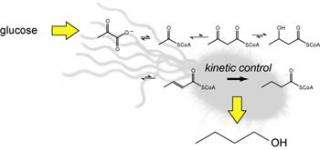
The enzyme pathway by which glucose is turned into n-butanol is set against the silhouette of an E. coli bacterium. The pathway, taken from Clostridium bacteria and inserted into E. coli, consists of five enzymes that convert acetyl-CoA, a product of glucose metabolism, into n-butanol (C4H9OH).

(PhysOrg.com) -- While ethanol is today's major biofuel, researchers aim to produce fuels more like gasoline. Butanol is the primary candidate, now produced primarily by Clostridium bacteria. UC Berkeley chemist Michelle Chang has transplanted the enzyme pathway from Clostridium into E. coli and gotten the bacteria to churn out 10 times more n-butanol than competing microbes, close to the level needed for industrial scale production.

University of California, Berkeley, chemists have engineered bacteria to churn out a gasoline-like biofuel at about 10 times the rate of competing , a breakthrough that could soon provide an affordable and “green” transportation fuel.

The advance is reported in this week’s issue of the journal Nature Chemical Biology by Michelle C. Y. Chang, assistant professor of chemistry at UC Berkeley, graduate student Brooks B. Bond-Watts and recent UC Berkeley graduate Robert J. Bellerose.

Various species of the naturally produce a chemical called n-butanol (normal butanol) that has been proposed as a substitute for diesel oil and . While most researchers, including a few biofuel companies, have genetically altered Clostridium to boost its ability to produce n-butanol, others have plucked enzymes from the bacteria and inserted them into other microbes, such as yeast, to turn them into n-butanol factories. Yeast and E. coli, one of the main bacteria in the human gut, are considered to be easier to grow on an industrial scale.

While these techniques have produced promising genetically altered E. coli bacteria and yeast, n-butanol production has been limited to little more than half a gram per liter, far below the amounts needed for affordable production.

Chang and her colleagues stuck the same enzyme pathway into E. coli, but replaced two of the five enzymes with look-alikes from other organisms that avoided one of the problems other researchers have had: n-butanol being converted back into its chemical precursors by the same enzymes that produce it.

The new genetically altered E. coli produced nearly five grams of n-buranol per liter, about the same as the native Clostridium and one-third the production of the best genetically altered Clostridium, but about 10 times better than current industrial microbe systems.

“We are in a host that is easier to work with, and we have a chance to make it even better,” Chang said. “We are reaching yields where, if we could make two to three times more, we could probably start to think about designing an industrial process around it.”

“We were excited to break through the multi-gram barrier, which was challenging,” she added.
Turning bacteria into butanol biofuel factories

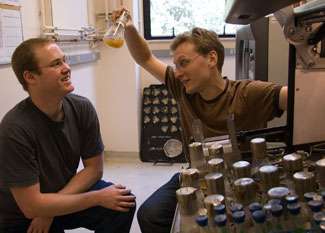
Graduate student Brooks Bond-Watts and post-doctoral fellow Jeff Hanson examine cultured E. coli used to produce the biofuel n-butanol. (Photo by Michael Barnes)

Among the reasons for engineering microbes to make fuels is to avoid the toxic byproducts of conventional fossil fuel refining, and, ultimately, to replace fossil fuels with more environmentally friendly biofuels produced from plants. If microbes can be engineered to turn nearly every carbon atom they eat into recoverable fuel, they could help the world achieve a more carbon-neutral transportation fuel that would reduce the pollution now contributing to global climate change. Chang is a member of UC Berkeley’s year-old Center for Green Chemistry.

The basic steps evolved by Clostridium to make butanol involve five enzymes that convert a common molecule, acetyl-CoA, into n-butanol. Other researchers who have engineered yeast or E. coli to produce n-butanol have taken the entire enzyme pathway and transplanted it into these microbes. However, n-butanol is not produced rapidly in these systems because the native enzymes can work in reverse to convert butanol back into its starting precursors.

Chang avoided this problem by searching for organisms that have similar enzymes, but that work so slowly in reverse that little n-butanol is lost through a backward reaction.

“Depending on the specific way an enzyme catalyzes a reaction, you can force it in the forward direction by reducing the speed at which the back reaction occurs,” she said. “If the back reaction is slow enough, then the transformation becomes effectively irreversible, allowing us to accumulate more of the final product.”

Chang found two new enzyme versions in published sequences of microbial genomes, and based on her understanding of the enzyme pathway, substituted the new versions at critical points that would not interfere with the hundreds of other chemical reactions going on in a living E. coli cell. In all, she installed genes from three separate organisms – Clostridium acetobutylicum, Treponema denticola and Ralstonia eutrophus — into the E. coli.

Chang is optimistic that by improving enzyme activity at a few other bottlenecks in the n-butanol synthesis pathway, and by optimizing the host microbe for production of n-butanol, she can boost production two to three times, enough to justify considering scaling up to an industrial process. She also is at work adapting the new synthetic pathway to work in yeast, a workhorse for industrial production of many chemicals and pharmaceuticals.

Provided by University of California - Berkeley search and more info website

4.5 /5 (4 votes)  

Filter


Move the slider to adjust rank threshold, so that you can hide some of the comments.


Display comments: newest first

bugmenot23
Mar 02, 2011

Rank: not rated yet
isnt the picture propanol?
pauljpease
Mar 02, 2011

Rank: not rated yet
isnt the picture propanol?


No, propanol has three carbons. The stick figure they show has four carbons (each vertex of line segments represents one carbon atom).
dnatwork
Mar 02, 2011

Rank: not rated yet
It seems to me they could cut out a few steps if they inserted those genes into plants instead. Then, rather than feeding sugar from industrially-farmed plants to industrially-processed microbes, you'd just have the plants produce the butanol from sunlight and the carbon dioxide in the air. Double whammy on global warming right there. Tap the plants like maple trees, use solar heating to boil the sap down into "syrup."
Caliban
Mar 02, 2011

Rank: not rated yet
What safeguards do they have in place to prevent these gut-bacteria from escaping into the wild? What sort of havoc could these microbes wreak in even a small-scale outbreak?

I don't know this for a fact, but I would guess that butanol being produced in situ(and in quantity) in the human or other animal gut would be fatal.

Rank 4.5 /5 (4 votes)
Relevant PhysicsForums posts
  • Schwartz reagent-- NMR/MS/IR
    created10 hours ago
  • Inversion temp
    created15 hours ago
  • High school chemistry EEI
    created22 hours ago
  • oxidation of I- by KMnO4
    createdMay 25, 2012
  • Invesion temp
    createdMay 25, 2012
  • Hybridization of SnCl3 -
    createdMay 25, 2012
  • More from Physics Forums - Chemistry

More news stories

From lemons to lemonade: Reaction uses carbon dioxide to make carbon-based semiconductor

(Phys.org) -- A materials scientist at Michigan Technological University has discovered a chemical reaction that not only eats up the greenhouse gas carbon dioxide, it also creates something useful. And, by ...

Chemistry / Materials Science

created May 21, 2012 | popularity 4.7 / 5 (88) | comments 30 | with audio podcast

New CO2-removing catalyst can take the heat

(Phys.org) -- The current method of removing the greenhouse gas carbon dioxide (CO2) from the flues of coal-fired power plants uses so much energy that no one bothers to use it. So says Roger Aines, principal ...

Chemistry / Materials Science

created May 24, 2012 | popularity 5 / 5 (7) | comments 7 | with audio podcast

High-speed method to aid search for solar energy storage catalysts

Eons ago, nature solved the problem of converting solar energy to fuels by inventing the process of photosynthesis.

Chemistry / Materials Science

created May 25, 2012 | popularity 5 / 5 (3) | comments 4 | with audio podcast

Researchers demonstrate possible primitive mechanism of chemical info self-replication

(Phys.org) -- When scientists think about the replication of information in chemistry, they usually have in mind something akin to what happens in living organisms when DNA gets copied: a double-stranded molecule ...

Chemistry / Materials Science

created May 25, 2012 | popularity 5 / 5 (4) | comments 2 | with audio podcast

Castor oil: Action mechanism of one of the oldest drugs known to man elucidated

Castor oil is known primarily as an effective laxative; however, it was also used in ancient times with pregnant women to induce labour. Only now have scientists at the Max Planck Institute for Heart and Lung ...

Chemistry / Biochemistry

created May 21, 2012 | popularity 3 / 5 (2) | comments 3 | with audio podcast


Dell tablet leak: 10.1-inch display, two-battery choice

(Phys.org) -- Headline after headline talks about vendors’ tablets in the wings as likely number-one contenders for the iPad. Such claims have justifiably been taken with a grain of salt, considering ...

Scientist: Evolution debate will soon be history

(AP) -- Richard Leakey predicts skepticism over evolution will soon be history. Not that the avowed atheist has any doubts himself.

Keep food safety in mind this memorial day weekend

(HealthDay) -- Picnics, parades and cookouts are as much a part of Memorial Day weekend as tributes to the United States' war veterans.

SpaceX capsule has 'new car' smell, astronauts say (Update)

SpaceX's Dragon cargo vessel smells like a new car, said astronauts at the International Space Station after opening the hatches Saturday following the spacecraft's landmark mission to the orbiting lab.

SpotterRF debuts Radar Backpack Kit (w/ Video)

(Phys.org) -- SpotterRF has announced a special radar backpack kit designed to enhance situational awareness for soldiers on the ground. The company says its special radar is designed for warfighters as part ...

Australia hails surprise super-telescope decision

Australia has hailed a surprise decision giving it a role in a radio telescope project aimed at revolutionising astronomy, vowing to draw on its decades of experience in space science.