Tuning the collective properties of artificial nanoparticle supercrystals
February 16, 2011

Tuning the collective properties of artificial nanoparticle supercrystals

Enlarge

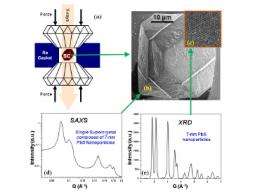
(a) Schematic illustration of the high-pressure experiment in a diamond anvil cell. High-resolution scanning electrom microscopy images of faceted 3-D supercrystals (b) self-assembled from colloidal 7.0-nm spherical PbS nanocrystals (c) and corresponded small-angle x-ray scattering (d) and micro x-ray diffraction patterns (e)

Precise ordering in two-dimensional (2-D) and three-dimensional (3-D) superlattices formed by the self-assembly of individual nanocrystals (NCs) allows for control of the magnetic, optical, and electronic coupling between the individual NCs. This control can lead to useful collective properties such as vibrational coherence, reversible metal-to-insulator transitions, enhanced conductivity, spin-dependent electron transport, enhanced ferro- and ferrimagnetism, tunable magnetotransport, and efficient charge transport. These properties have many potential applications in solar cells, field-effect transistors, light-emitting devices, photodetectors, and photoconductors.

Due to precise positioning of the NCs within a 3-D superlattice, such systems are frequently referred to as “supercrystals” (SCs) in analogy to crystals built of atoms. But unlike the atomic crystals, SCs offer the flexibility of tuning the interparticle distance due to presence of the “soft” shell of organic ligands that can be used to control collective properties in such structures. Structural stability and compressibility are fundamental characteristics of any 3-D system.

A team of researchers from the Argonne National Laboratory Center for Nanoscale Materials, the X-ray Science Division at the Argonne Advanced Photon Source (APS), University of Chicago’s GeoSoilEnviroCARS, which operates Sector 13 at the APS, and Northwestern University have reported on the first combined quasi-hydrostatic, high-pressure, small-angle x-ray scattering (SAXS) and micro x-ray diffraction (XRD) studies on individual faceted, 3-D supercrystals self-assembled from colloidal 7.0-nm PbS nanocrystals. Combining the SAXS and XRD techniques allowed for precise evaluation of the interparticle spacing during the pressure cycling since the volume change of the individual NCs was taken into account. Neon was used as a pressure transmitting media to avoid the possibility of the leaching of organic ligands from the surface of the NCs and losing the structural integrity of the SCs due to sintering. Diamond anvil cell (DAC) SAXS experiments in the pressure range from ambient to 12.5 GPa, performed at X-ray Science Division x-ray beamline 12-ID-C at the APS, revealed nearly perfect structural stability of the SCs, with fcc organization of the NCs. The XRD experiments, which were carried out at GeoSoilEnviroCARS x-ray beamline 13-ID-D at the APS, demonstrated that NCs have strong preferential orientation of individual NCs in SCs up to ~55 GPa that is preserved during pressure cycling.

The mechanical properties of the individual NCs, their SCs, and the ligand matrix were analyzed using the equation of states derived from the compression data produced by SAXS and XRD. Ambient pressure bulk modulus of the SCs was calculated to be ~5 GPa during compression and ~14.5 GPa during the release cycle, respectively. NCs were found to undergo first-order phase transition above 8 GPa, and the transformation proceeds through a single nucleation event (within a pressure range of 8.1-9.2 GPa) during the first transition, and heterogeneous nucleation during the second transformation from the intermediate phase (that is not yet identified) to CsCl structure. A bulk modulus for the ligand matrix of ~2.2-2.95 GPa is an order of magnitude greater than that observed from nanoindentation study.

The high structural stability of the SCs and the ability to tune the interparticle spacing seem to offer the promise of further manipulation of the collective properties of self-organized artificial solids including the structures that consisted of NCs transformed at high pressures into a different phase. Combining high-pressure XRD and SAXS provides unique opportunities to obtain direct information about the mechanical properties of individual building blocks and their hierarchical architectures.

More information: Paul Podsiadlo, et al. “High-Pressure Structural Stability and Elasticity of Supercrystals Self-Assembled from Nanocrystals,” Nanolett. Article ASAP, published online ahead of print, December 22, 2010

Provided by Argonne National Laboratory search and more info website


Rank 5 /5 (3 votes)
Relevant PhysicsForums posts
  • Water Rocket
    created1 hour ago
  • why do trucks have bigger brakes?
    created5 hours ago
  • Solar Sail Physics - Do they work on a large scale?
    created6 hours ago
  • How should I switch an air conditioner off?
    created7 hours ago
  • Question about current decay in R-L circuit
    created7 hours ago
  • Elementary time - how does it work?
    created10 hours ago
  • More from Physics Forums - General Physics

More news stories

Dopant gives graphene solar cells highest efficiency yet

(Phys.org) -- By taking advantage of graphene’s favorable electrical and optical properties, and then adding an organic dopant, researchers have achieved the highest power conversion efficiency yet for ...

Nanotechnology / Nanophysics

created May 21, 2012 | popularity 5 / 5 (10) | comments 14 | with audio podcast feature

Nanomedicine: Quantum dots appear safe in pioneering study on primates

A pioneering study to gauge the toxicity of quantum dots in primates has found the tiny crystals to be safe over a one-year period, a hopeful outcome for doctors and scientists seeking new ways to battle diseases ...

Nanotechnology / Bio & Medicine

created May 20, 2012 | popularity 4.3 / 5 (3) | comments 8 | with audio podcast

In nanorod crystal growth, nanoparticles seen as artificial atoms

In the growth of crystals, do nanoparticles act as "artificial atoms" forming molecular-type building blocks that can assemble into complex structures? This is the contention of a major but controversial theory ...

Nanotechnology / Nanophysics

created May 24, 2012 | popularity 4.8 / 5 (6) | comments 0 | with audio podcast

First direct observation of oriented attachment in nanocrystal growth

Berkeley Lab researchers have reported the first direct observation of nanoparticles undergoing oriented attachment, the critical step in biomineralization and the growth of nanocrystals. A better understanding ...

Nanotechnology / Nanophysics

created May 24, 2012 | popularity 4.7 / 5 (3) | comments 0 | with audio podcast

Synthetic nano-waste does not disappear

(Phys.org) -- Tiny particles of cerium oxide do not burn or change in the heat of a waste incineration plant. They remain intact on combustion residues or in the incineration system, as a new study by Swiss ...

Nanotechnology / Bio & Medicine

created May 25, 2012 | popularity 5 / 5 (2) | comments 1 | with audio podcast


Dell tablet leak: 10.1-inch display, two-battery choice

(Phys.org) -- Headline after headline talks about vendors’ tablets in the wings as likely number-one contenders for the iPad. Such claims have justifiably been taken with a grain of salt, considering ...

Scientist: Evolution debate will soon be history

(AP) -- Richard Leakey predicts skepticism over evolution will soon be history. Not that the avowed atheist has any doubts himself.

SpaceX capsule has 'new car' smell, astronauts say (Update)

SpaceX's Dragon cargo vessel smells like a new car, said astronauts at the International Space Station after opening the hatches Saturday following the spacecraft's landmark mission to the orbiting lab.

SpotterRF debuts Radar Backpack Kit (w/ Video)

(Phys.org) -- SpotterRF has announced a special radar backpack kit designed to enhance situational awareness for soldiers on the ground. The company says its special radar is designed for warfighters as part ...

Keep food safety in mind this memorial day weekend

(HealthDay) -- Picnics, parades and cookouts are as much a part of Memorial Day weekend as tributes to the United States' war veterans.

Thousands of shellfish found dead in Peru

Thousands of crustaceans were found dead off the coast of Lima following the mystery mass death of dolphins and pelicans, the Peruvian Navy said Friday.