Solar Dynamics Observatory sundog mystery
Feb 14, 2011 By Dr. Tony Phillips
SDO sundog mystery
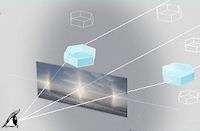
How ice crystals make sundogs.

]NASA's Solar Dynamics Observatory (SDO), best known for cutting-edge images of the sun, has made a discovery right here on Earth.

"It's a new form of ice halo," says atmospheric optics expert Les Cowley of England. "We saw it for the first time at the launch of SDO--and it is teaching us new things about how shock waves interact with clouds."
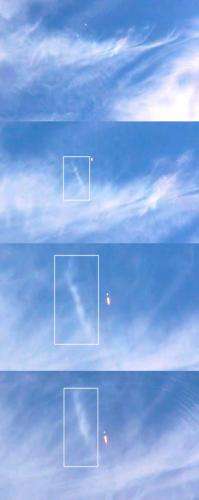
A luminous column of white light follows SDO into the sky.

Ice halos are rings and arcs of light that appear in the when sunlight shines through ice crystals in the air. A familiar example is the sundog—a rainbow-colored splash often seen to the left or right of the morning sun. Sundogs are formed by plate-shaped ice crystals drifting down from the sky like leaves fluttering from trees.
Last year, SDO destroyed a sundog—and that's how the new halo was discovered.

SDO lifted off from Cape Canaveral on Feb. 11, 2010—one year ago today. It was a beautiful morning with only a handful of wispy cirrus crisscrossing the wintry-blue sky. As the countdown timer ticked to zero, a sundog formed over the launch pad.

This video is not supported by your browser at this time.
SDO has a close encounter with a sundog. "The shock waves were amazing, fantastical!" says high school student Amelia Phillips who watched the event alongside friend and photographer Anna Herbst of Bishop, California. "We were shouting and jumping up and down when SDO destroyed the sundog." Movie credit: Anna Herbst.

"When the rocket penetrated the cirrus, shock waves rippled through the cloud and destroyed the alignment of the ice crystals," explains Cowley. "This extinguished the sundog."

The sundog's destruction was understood. The events that followed, however, were not.

"A luminous column of white light appeared next to the Atlas V and followed the rocket up into the sky," says Cowley. "We'd never seen anything like it."

Cowley and colleague Robert Greenler set to work figuring out what the mystery-column was. Somehow, shock waves from the rocket must have scrambled the ice crystals to produce the 'rocket halo.' But how? Computer models of shining through ice crystals tilted in every possible direction failed to explain the SDO event.

[PIC=53471:leftThen came the epiphany: The crystals weren't randomly scrambled, Cowley and Greenler realized. On the contrary, the plate-shaped hexagons were organized by the shock waves as a dancing army of microscopic spinning tops.

Cowley explains their successful model: "The crystals are tilted between 8 and 12 degrees. Then they gyrate so that the main crystal axis describes a conical motion. Toy tops and gyroscopes do it. The earth does it once every 26000 years. The motion is ordered and precise."

Bottom line: Blasting a rocket through a cirrus cloud can produce a surprising degree of order. "This could be the start of a new research field—halo dynamics," he adds.

The simulations show that the white column beside SDO was only a fraction of a larger oval that would have appeared if the crystals and had been more wide-ranging. A picture of the hypothetical complete halo may be found here.

"We'd love to see it again and more completely," says Cowley.

"If you ever get a once-in-a-lifetime opportunity to be at a rocket launch," he advises with a laugh, "forget about the rocket! Look out instead for halos."

Explore further: NASA head views progress on asteroid lasso mission

Related Stories

Cool Movie: SDO Destroys a Sundog (w/ Video)

Feb 19, 2010

Last week, on Feb. 11th, the Solar Dynamics Observatory (SDO) lifted off from Cape Canaveral on a five-year mission to study the sun. Researchers have called the advanced spacecraft the "crown jewel" of NASA's ...

NASA Successfully Launches a New Eye on the Sun

Feb 11, 2010

(PhysOrg.com) -- NASA's Solar Dynamics Observatory, or SDO, lifted off Thursday from Cape Canaveral Air Force Station's Launch Complex 41 on a first-of-a-kind mission to reveal the sun's inner workings in ...

Cloud formation affected by human activity, study says

Sep 12, 2006

University of Toronto researchers and their collaborators have discovered that solid ammonium sulphate aerosol – an airborne particle more prevalent in continental areas - can act as a catalyst to the formation of ice clouds, ...

Solar Dynamics Observatory Set to Launch Feb. 9

Feb 02, 2010

(PhysOrg.com) -- The Solar Dynamics Observatory, or SDO, is set to launch from Florida no earlier than 10:30 a.m. EST on Feb. 9, on an unprecedented mission to study the sun and its dynamic behavior. Onboard ...

Recommended for you

NASA head views progress on asteroid lasso mission

6 hours ago

Surrounded by engineers, NASA chief Charles Bolden inspected a prototype spacecraft engine that could power an audacious mission to lasso an asteroid and tow it closer to Earth for astronauts to explore.

Ecuador satellite collides with Russian space junk

6 hours ago

A small Ecuadoran satellite collided in orbit with the remains of a Russian rocket, but it is too soon to know how much damage it might have sustained, Quito's space agency said Thursday.

Forecast for Titan: Wild weather could be ahead

May 22, 2013

(Phys.org) —Saturn's moon Titan might be in for some wild weather as it heads into its spring and summer, if two new models are correct. Scientists think that as the seasons change in Titan's northern hemisphere, ...

SDO observes mid-level solar flare

May 22, 2013

UPDATE 16:30 p.m. EDT: The M7-class flare was also associated with a coronal mass ejection or CME, another solar phenomenon that can send billions of tons of particles into space. While this CME was not Ea ...

User comments : 1

Adjust slider to filter visible comments by rank

Display comments: newest first

CSharpner
not rated yet Feb 14, 2011
I had to look up Sundog I have never heard of it and never saw one, even in the video I had to watch it a couple of times to know what I was supposed to be looked at I just thought it was lens flare.
I've seen'em a million times, but also never heard of the term "Sundog" either.

More news stories

Hubble reveals the ring nebula's true shape

(Phys.org) —The Ring Nebula's distinctive shape makes it a popular illustration for astronomy books. But new observations by NASA's Hubble Space Telescope of the glowing gas shroud around an old, dying, ...

A hidden population of exotic neutron stars

(Phys.org) —Magnetars – the dense remains of dead stars that erupt sporadically with bursts of high-energy radiation - are some of the most extreme objects known in the Universe. A major campaign using ...

NASA head views progress on asteroid lasso mission

Surrounded by engineers, NASA chief Charles Bolden inspected a prototype spacecraft engine that could power an audacious mission to lasso an asteroid and tow it closer to Earth for astronauts to explore.

Controlling mood through the motions of mitochondria

(Medical Xpress)—Regulating the distribution of power in neurons is done by a system that makes the national electric grid look simple by comparison. Each neuron has several thousand mitochondria confined ...

A quantum simulator for magnetic materials

Physicists understand perfectly well why a fridge magnet sticks to certain metallic surfaces. But there are more exotic forms of magnetism whose properties remain unclear, despite decades of intense research. ...