Back to the roots of the solar system
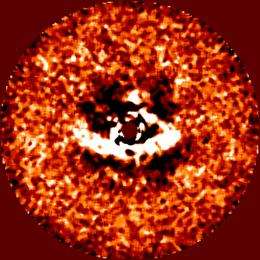
This image taken with the HiCIAO planet-hunter camera on Subaru Telescope shows a bright arc of scattered light (white) from the protoplanetary disk around the young star LkCa 15 (centre, masked out with a dark circle). The arc’s sharp inner edge traces the outline of a wide gap in the disk. The gap is decidedly lopsided - it is markedly wider on the left side - and has most likely been carved out of the disk by one or more newborn planets that orbit the star. © MPIA (Christian Thalmann) & NAOJ
(PhysOrg.com) -- Planets form in disks of dust and gas that surround young stars. A look at the birth places means a journey into the past of the earth and its siblings. Now, astronomers have been able to obtain detailed images of the protoplanetary disks of two stars using the Subaru telescope in Hawaii. This is the first time that disk structures comparable in size to our own solar system have been resolved this clearly, revealing features such as rings and gaps that are associated with the formation of giant planets. The observations are part of a systematic survey to search for planets and disks around young stars using a state-of-the-art high-contrast camera designed specifically for this purpose.
Planetary systems like our own share a humble origin as mere by-products of star formation. A newborn star's gravity gathers leftover gas and dust in a dense, flattened disk of matter orbiting the star. Clumps in the disk sweep up more and more material, until their own gravity becomes sufficiently strong to compress them into the dense bodies we know as planets. Recent years have seen substantial advances both in observations (mostly indirect) and in theoretical modelling of such protoplanetary disks. The two new observations have added intriguing new details, revealing some structures that had never before been seen directly.
One of the two studies targeted the star LkCa 15, which is located around 450 light-years from Earth in the constellation Taurus. At an age of a few million years, LkCa 15 is a young star the Sun is a thousand times older. From previous observations of its infrared spectrum and its millimetre emissions, scientists had deduced the presence of a large gap in the centre of its protoplanetary disk. The new images show starlight gleaming off the disk surface, clearly outlining the sharp edge of the gap for the first time. Most interestingly, the elliptical shape of the gap is not centred on the star, but appears lopsided.
The most likely explanation for LkCa 15's disk gap, and in particular its asymmetry, is that one or more planets, freshly born from the disk material, have swept up the gas and dust along their orbits, says Christian Thalmann, who led the study while on staff at the Max Planck Institute for Astronomy (MPIA). Intriguingly, the disk gap is sufficiently large to accommodate the orbits of all the planets in our own Solar System. It is therefore tempting to speculate that LkCa 15 might be in the process of forming an entire planetary system much like our own. We haven't detected the planets themselves yet", adds Thalmann. "But that may change soon.
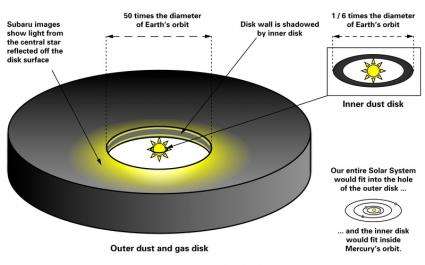
A sketch of the three-dimensional shape of the protoplanetary disk around the star LkCa 15. Only the light reflected from the outer disk (shown in yellow) is seen on the HiCIAO images. The other structural features have been inferred from previous indirect observations of the system. The large gap between the inner and the outer disk has most likely been carved out by one or more newborn planets that orbit the star. The planets themselves have not been detected - yet. © MPIA / Christian Thalmann
The second observation, led by Jun Hashimoto (National Observatory of Japan), targeted the star AB Aur in the constellation Auriga, at a distance of 470 light-years from Earth. This star is even younger, with an age of a mere one million years. The observations were the first to show details down to length scales comparable to the size of our own solar system for comparison: At a distance of 470 light-years, the solar system has the same apparent size as a 1 Euro coin viewed at a distance of more than 10 km. They show nested rings of material that are tilted with respect to the disk's equatorial plane, and whose material, intriguingly, is not distributed symmetrically around the star irregular features that indicate the presence of at least one very massive planet.Both observations where made with the HiCIAO instrument at the 8.2 metre Subaru Telescope. Imaging a disk or planet close to a star is an enormous challenge, as it is very difficult to discern the light emitted by those objects in the star's intense glare. HiCIAO meets this challenge by correcting for the distorting influence of the Earth's atmosphere and by physically blocking out most of the star's light.
The observations are part of the SEEDS project, short for Strategic Explorations of Exoplanets and Disks with Subaru. MPIA's managing director, Thomas Henning, one of the project's co-investigators, explains: SEEDS is a five-year systematic search for exoplanets and protoplanetary disks. We are thrilled about the images the Subaru telescope has produced as part of this project. Detailed observations like these are the key to understanding how planetary systems, including our own solar system, came into being. SEEDS involves more than 100 researchers from 25 astronomical institutions in Asia (NAOJ and others), Europe (MPIA and others), and the US (Princeton University and others).
More information: Thalmann, C. et al. Imaging of a Transitional Disk Gap in Reflected Light: Indications of Planet Formation Around the Young Solar Analog LkCa 15. Astrophysical Journal Letters 718, S. L87-L91
Provided by
Max-Planck-Gesellschaft
-
From lemons to lemonade: Reaction uses carbon dioxide to make carbon-based semiconductor,
30 comments
-
Thioridazine kills cancer stem cells in human while avoiding toxic side-effects of conventional cancer treatments,
3 comments
-
SpaceX private rocket blasts off for space station (Update),
42 comments
-
Climate scientists say they have solved riddle of rising sea,
30 comments
-
Research team claims to have found evidence Lake Cheko is impact crater for Tunguska Event,
18 comments
-
revamping general concept and cosmological principle
May 25, 2012
-
Transiting Exoplanet Light Curve
May 25, 2012
-
Math behind Theoretical Physics
May 24, 2012
-
Do we know whats at the center of galaxies yet?
May 23, 2012
-
Structure of the Milky Way?
May 20, 2012
-
What would it take to terraform Pluto and Charon?
May 19, 2012
- More from Physics Forums - General Astronomy
More news stories
SpaceX capsule has 'new car' smell, astronauts say (Update)
SpaceX's Dragon cargo vessel smells like a new car, said astronauts at the International Space Station after opening the hatches Saturday following the spacecraft's landmark mission to the orbiting lab.
Space & Earth / Space Exploration
12 hours ago |
4.6 / 5 (18) |
0
Australia hails surprise super-telescope decision
Australia has hailed a surprise decision giving it a role in a radio telescope project aimed at revolutionising astronomy, vowing to draw on its decades of experience in space science.
12 hours ago |
5 / 5 (2) |
0
Astronomers seize last chance in lifetime for Venus Transit
Astronomers are gearing for one the rarest events in the Solar System: an alignment of Earth, Venus and the Sun that will not be seen for another 105 years.
12 hours ago |
5 / 5 (1) |
0
Astronauts enter world's 1st private supply ship
(AP) -- Space station astronauts floated into the Dragon on Saturday, a day after its heralded arrival as the world's first commercial supply ship.
Space & Earth / Space Exploration
12 hours ago |
5 / 5 (5) |
0
Dragon arrives at space station in historic 1st (Update 2)
The privately bankrolled Dragon capsule made a historic arrival at the International Space Station on Friday, triumphantly captured by astronauts wielding a giant robot arm.
Space & Earth / Space Exploration
May 25, 2012 |
5 / 5 (10) |
19
Dell tablet leak: 10.1-inch display, two-battery choice
(Phys.org) -- Headline after headline talks about vendors tablets in the wings as likely number-one contenders for the iPad. Such claims have justifiably been taken with a grain of salt, considering ...
Scientist: Evolution debate will soon be history
(AP) -- Richard Leakey predicts skepticism over evolution will soon be history. Not that the avowed atheist has any doubts himself.
SpotterRF debuts Radar Backpack Kit (w/ Video)
(Phys.org) -- SpotterRF has announced a special radar backpack kit designed to enhance situational awareness for soldiers on the ground. The company says its special radar is designed for warfighters as part ...
Keep food safety in mind this memorial day weekend
(HealthDay) -- Picnics, parades and cookouts are as much a part of Memorial Day weekend as tributes to the United States' war veterans.
Thousands of shellfish found dead in Peru
Thousands of crustaceans were found dead off the coast of Lima following the mystery mass death of dolphins and pelicans, the Peruvian Navy said Friday.
Family history of Alzheimer's affects functional connectivity
(HealthDay) -- Cognitively normal individuals with a family history of late-onset Alzheimer's disease (AD) may display lower resting state functional connectivity in the default mode network (DMN) of the brain, ...

Feb 17, 2011
Rank: 3.9 / 5 (7)
Feb 17, 2011
Rank: 4.3 / 5 (6)
Feb 17, 2011
Rank: 2.1 / 5 (7)
Yes, planets "form in disks of dust and gas that surround young stars."
That disk was supernova debris orbiting a pulsar in the first planetary system found outside the solar system [Wolszczan, A., Frail, D. (1992). "A planetary system around the millisecond pulsar PSR1257 + 12". Nature 355: 145–147].
That was also the way our solar system formed ["Strange xenon, extinct superheavy elements and the solar neutrino puzzle", Science 195, 208-209 (1977); Isotopes of tellurium, xenon and krypton in the Allende meteorite retain record of nucleosynthesis", Nature 277, 615-620 (1979); "Heterogeneity of isotopic and elemental compositions in meteorites: Evidence of local synthesis of the elements ", Geokhimiya (12) 1776-1801 (1981)].
We still don't know if all planetary system form in that manner.
With kind regards,
Oliver K. Manuel
Feb 17, 2011
Rank: 1.8 / 5 (5)
youtube.com/my_videos_insight?v=AQZe_Qk-q7M
Feb 18, 2011
Rank: 1.8 / 5 (5)