Presence of insect pest discovered in Indonesia
(PhysOrg.com) -- Scientists with a Virginia Tech-led program have discovered the presence of the giant whitefly in western Java, the first known infestation of this pest in Asia. The scientists fear an infestation could cause widespread destruction of crops in southeastern and South Asia.
Rangaswamy Muniappan, entomologist and director of a multimillion dollar U.S. Agency for International Development-funded program at Virginia Tech, noticed the insect on a poinsettia plant along a roadside in Cipanas, Indonesia. Taxonomists soon confirmed whitefly’s presence.
Muniappan was in Indonesia with partner scientists from Clemson University and Bogor Agricultural University in Bogor, Indonesia, inspecting program progress when he noticed telltale signs of the whitefly: a sooty black mold that covers the surface of infected leaves, making photosynthesis impossible.
The giant whitefly, Aleurodicus dugesii, is a polyphagous species of Central American origin that prefers woody flowering hosts, including fruit trees and hibiscus plants. The cultivation of these ornamentals is what Indonesia’s ministry of agriculture is looking to foster as a way to create jobs in rural areas.
“Our concern is that the giant whitefly may spread to the rest of the islands in Indonesia and also to other neighboring countries in southeastern Asia and South Asia,” says Muniappan, who leads the Integrated Pest Management Collaborative Research Support Program.
Infestation could cause widespread destruction of crops, as happened with the cassava mealybug in equatorial Africa in the 1980s. That disaster caused billions of dollars worth of crop damage and almost led to widespread starvation, according to Muniappan.
When Muniappan discovered the insect, he collected leaves with the whitefly on them and dropped them into alcohol vials he carries. He then sent these for identification to a specialist in whitefly taxonomy at the California Department of Agriculture, who confirmed the identification as the giant whitefly.
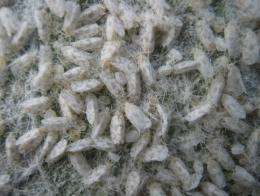
The giant whitefly, a pest of over 50 common ornamental plants, works by sucking sap from plants. In the process, it exudes a honeydew rich in sugars. This honeydew develops into a sooty mold, a black coating on the leaf that reduces the photosynthetic surface, eventually killing the plant. Giant whitefly nymphs compound the insult by emerging from eggs laid on the underside of leaves and producing waxy material that is visible from a distance.
Muniappan believes that the solution to this menace lies in classical biological control: introducing a species’ natural enemies. Two such enemies already exist in the United States, the parasitic wasps Idioporus affinis and Encarsiella noyesii. Muniappan says he is hopeful that using these will be a relatively easy way to manage the population of giant whiteflies.
With its tropical climate, Indonesia provides ideal conditions for the growth of ornamental plants such as the poinsettia, which are an important part of the island nation’s economy. The plants are grown for domestic consumption as well as for export. Ornamentals are big business in other Asian countries as well.
Muniappan hopes that by alerting agriculture officials, a disaster can be averted. “Scientists in countries to which the giant whitefly has not yet spread should be taking preventive measures such as informing the public and alerting quarantine officials to avoid serious economic damage,” he says.
While the Integrated Pest Management Collaborative Research Support Program led by Virginia Tech does not specifically work with ornamentals, the agricultural research being conducted under its support affects a range of crops. The project in Indonesia is one of 11 around the world managed by the program. The goal of the U.S. Agency for International Development-funded program is to develop approaches to agriculture that minimize crop losses, increase farmer income, and decrease pesticide use.
Provided by Virginia Polytechnic Institute and State University


