Planck Surveyor: 15,000 New Celestial Objects
February 3, 2011

Planck Surveyor: 15,000 New Celestial Objects

Enlarge

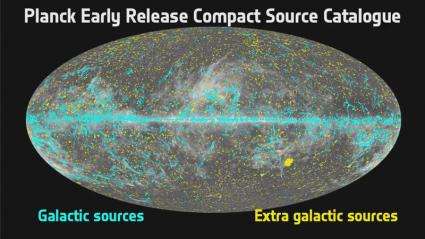
The 15 000 objects in the “Early Release Compact Source Catalogue”, where galactic objects - mainly compact dust clouds - are shown in green, and extragalactic objects - mainly radio galaxies and galaxies with a large thermal emission from dust - are shown in yellow. The larger yellow blob to the lower right is the Large Magellanic Cloud, a dwarf galaxy orbiting the Milky Way. © ESA / Planck Collaboration

(PhysOrg.com) -- Scientists of the "Planck" satellite mission present first results in a conference in Paris.

In its first year in operation, the "Planck Surveyor" satellite has achieved impressive results: a catalogue with 15000 celestial objects such as galaxy clusters, quasars, radio galaxies, nearby galaxies and galactic dust clouds, 25 scientific papers, as well as the most precise measurement of the far infrared background to date, which reveals in the . The Max Planck Institute for developed important software components for Planck and is heavily involved in the scientific interpretation of the mission data.

So far, Planck has produced three complete scans of the whole sky, thus fulfilling its primary objective. However, as it continues to function perfectly, the satellite will probably stay in operation until the start of 2012 and continue to provide data. The results gained from the first year of Planck data were first presented on 11 January 2011, where many of these results are based on the “Early Release Compact Source Catalogue” with some 15 000 new celestial objects. The early release of this data enables scientists to arrange for detailed follow-up observations with other telescopes such as the Herschel space telescope with operates at similar wavelengths.
Planck Surveyor: 15,000 New Celestial Objects
Enlarge

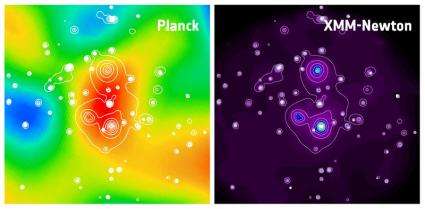
A galaxy super cluster discovered by Planck due to the Sunyaev-Zeldovich effect (left) and its confirmation due to the X-ray emission of the hot gas in the galaxy cluster with the XMM-Newton X-ray telescope (right). © ESA / Planck Collaboration

At the same time as the catalogue, 25 scientific papers are published with topics covering many orders of magnitude and objects and ranging from studies of individual objects in the catalogue and analyses of galactic emission to the first cosmological results on galaxy clusters and the light of early galaxies. Highlights of these papers include:

• confirmation of the anomalous microwave radiation emitted by galactic dust and probably due to the fast rotation of small, electrically charged dust particles;

• a map of a dark gaseous component in our galaxy, only visible in microwaves;

• the precise measurement of 189 galaxy clusters and the discovery of 20 new galaxy clusters with the Suyaev-Zeldovich effect, arising from the interaction of the cosmic background radiation with the hot gas (up to 100 million degrees) in the atmosphere of galaxy clusters;

• the first measurement of the theoretically predicted Suyaev-Zeldovich effect also in smaller , which now makes possible a nearly complete inventory of the previously invisible gas in the universe;

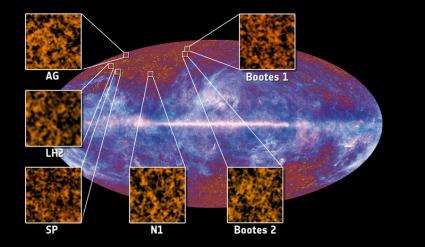
• a detailed measurement of the far infrared emission of all star forming galaxies in the universe. The scientists can now observe the history of galaxy formation, looking back to an epoch when the universe was only 2 billion years old, just one sevenths of its present age.
Planck Surveyor: 15,000 New Celestial Objects
Enlarge

The first six regions in which the cosmic far infrared background was studied, as the galactic foreground emission there is relatively weak. Each small image shows the grainy emission due to myriad contributing galaxies. In part this emission is from epochs when the universe was only 2 billion years old, its present age is about 14 billion years. © ESA / Planck Collaboration

The results presented at this Planck conference mainly cover the astrophysical by-products of the Planck mission. The data related to Planck’s primary goal, the cosmic microwave background, the resulting conclusions regarding the age, structure and composition of the universe as well as insights into its origins will probably be published in 2013.

Until then, the noise signal from space but also from the instruments has to be understood in more detail. The team at the Max Planck Institute for Astrophysics will contribute to this effort – their software for simulating and processing the data will continue to be in daily use. The software development at the Institute received financial support from the Max Planck Society and Germany's national research centre for aeronautics and space (DLR).

Provided by Max-Planck-Gesellschaft search and more info website

Filter


Move the slider to adjust rank threshold, so that you can hide some of the comments.


Display comments: newest first

omatumr
Feb 03, 2011

Rank: 3 / 5 (1)
Congratulations!

We are on the verge of a quantum leap in our understanding of the beautiful universe.

With kind regards,
Oliver K. Manuel
Former NASA Principal
Investigator for Apollo
Rank 5 /5 (10 votes)
Relevant PhysicsForums posts
  • revamping general concept and cosmological principle
    createdMay 25, 2012
  • Transiting Exoplanet Light Curve
    createdMay 25, 2012
  • Math behind Theoretical Physics
    createdMay 24, 2012
  • Do we know whats at the center of galaxies yet?
    createdMay 23, 2012
  • Structure of the Milky Way?
    createdMay 20, 2012
  • What would it take to terraform Pluto and Charon?
    createdMay 19, 2012
  • More from Physics Forums - General Astronomy

More news stories

SpaceX capsule has 'new car' smell, astronauts say (Update)

SpaceX's Dragon cargo vessel smells like a new car, said astronauts at the International Space Station after opening the hatches Saturday following the spacecraft's landmark mission to the orbiting lab.

Space & Earth / Space Exploration

created 14 hours ago | popularity 4.5 / 5 (19) | comments 0

Australia hails surprise super-telescope decision

Australia has hailed a surprise decision giving it a role in a radio telescope project aimed at revolutionising astronomy, vowing to draw on its decades of experience in space science.

Space & Earth / Astronomy

created 14 hours ago | popularity 5 / 5 (3) | comments 1

Astronomers seize last chance in lifetime for Venus Transit

Astronomers are gearing for one the rarest events in the Solar System: an alignment of Earth, Venus and the Sun that will not be seen for another 105 years.

Space & Earth / Astronomy

created 14 hours ago | popularity 5 / 5 (1) | comments 0

Astronauts enter world's 1st private supply ship

(AP) -- Space station astronauts floated into the Dragon on Saturday, a day after its heralded arrival as the world's first commercial supply ship.

Space & Earth / Space Exploration

created 14 hours ago | popularity 5 / 5 (5) | comments 0

Dragon arrives at space station in historic 1st (Update 2)

The privately bankrolled Dragon capsule made a historic arrival at the International Space Station on Friday, triumphantly captured by astronauts wielding a giant robot arm.

Space & Earth / Space Exploration

created May 25, 2012 | popularity 5 / 5 (10) | comments 19


Dell tablet leak: 10.1-inch display, two-battery choice

(Phys.org) -- Headline after headline talks about vendors’ tablets in the wings as likely number-one contenders for the iPad. Such claims have justifiably been taken with a grain of salt, considering ...

Scientist: Evolution debate will soon be history

(AP) -- Richard Leakey predicts skepticism over evolution will soon be history. Not that the avowed atheist has any doubts himself.

SpotterRF debuts Radar Backpack Kit (w/ Video)

(Phys.org) -- SpotterRF has announced a special radar backpack kit designed to enhance situational awareness for soldiers on the ground. The company says its special radar is designed for warfighters as part ...

Thousands of shellfish found dead in Peru

Thousands of crustaceans were found dead off the coast of Lima following the mystery mass death of dolphins and pelicans, the Peruvian Navy said Friday.

Keep food safety in mind this memorial day weekend

(HealthDay) -- Picnics, parades and cookouts are as much a part of Memorial Day weekend as tributes to the United States' war veterans.

Family history of Alzheimer's affects functional connectivity

(HealthDay) -- Cognitively normal individuals with a family history of late-onset Alzheimer's disease (AD) may display lower resting state functional connectivity in the default mode network (DMN) of the brain, ...