US pandas hold yearly romantic romp
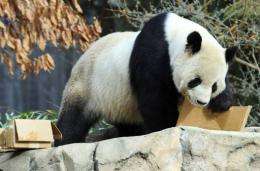
The doors to the outside world were closed, the lights dimmed. Video cameras angled down from multiple locations, and a couple dozen onlookers watched intently.
The two giant pandas at the National Zoo were about to have their first date in a year.
And since the female, Mei Xiang, is only fertile for a couple of days annually, their mating ritual was closely monitored in the hopes that she and longtime mate Tian Tian would produce a cub come spring.
"That is the beauty of the panda breeding season. Everything happens in two or three days but it is always extremely intense," said Pierre Comizzoli, a reproductive physiologist at the National Zoo in the US capital, Washington.
Mei Xiang began making sounds that zoo keepers recognized as fertility calls about two weeks ago, indicating that the time was near.
An expert from China, Tang Chunxiang from the China Conservation and Research Center for the Giant Panda in Wolong, flew in to consult with the US-based team in late January.
Finally, over the weekend, the two bears who spend nearly every other day of the year in separate spaces were allowed to get close to each other.
Scientists monitored Mei Xian's hormone levels, veterinarians were at the ready in case the sexual tension turned violent, and behavior specialists watched for signs that "something is happening naturally," said Comizzoli.
The pandas have been a longtime couple, monogamous since 2000. They produced one cub, Tai Shan, in 2005, though he was conceived through artificial insemination.
Ahead of this year's breeding season, zoo keepers enrolled the bears in workout sessions to boost their stamina and build their muscles.
Tian Tian's regime focused on training him to stand tall on his hind legs, while Mei Xiang was coaxed into lying across a large log in her cabin to improve her positioning.
"We wanted them to be well-rested and in the best possible shape physically to breed naturally," said curator Brandie Smith. "And if there was anything we could do to enhance that success, then we did our best to apply it."
Comizzoli said Tang was helpful because the Wolong center hosts around 90 pandas, compared to Washington which only has a pair, and so he had seen plenty of panda behaviors.
"The main problem we've had with our male and female so far is that they were really not good at conceiving naturally, so the natural mating was not really good," said Comizzoli.
Tang was "definitely able to detect exactly what was wrong with the positioning of the male and the female" that was preventing natural impregnation, he said.
But since Tian Tian, 13, gets few chances to improve on his technique, zoo experts were forgiving of his foibles.
"Basically it is a lack of practice and a lack of confidence," said Comizzoli.
In the end, lots of efforts were made but zoo experts still were not sure if the female had been able to conceive, so like in China, they performed artificial insemination anyway, once on January 29 and once on January 30.
"Due in part to the bears' rigorous attempts at natural mating, efforts to retrieve semen from Tian Tian were not successful. The team decided to thaw high-quality semen of Tian Tian collected and frozen in 2005," the zoo said in a statement.
And now, the real mystery begins.
Zoo keepers will not know for months if Mei Xiang, who is 12 years old, was able to become pregnant. A panda's gestation can last 90-185 days. Hormone levels do not reveal anything early, and ultrasounds are difficult.
"What is really frustrating with those bears is they are really huge, really fat and they have a really thick fur," explained Comizzoli.
"And they have a really tiny uterus and the cub inside is a really tiny cub so in comparison with other mammals it is really difficult to see something. If you do see something it is really toward the end of the pregnancy."
Pandas are considered an endangered species. Scientists believe about 1,600 of them exist in the wild, mainly in China, and there are about 300 in zoos around the world.
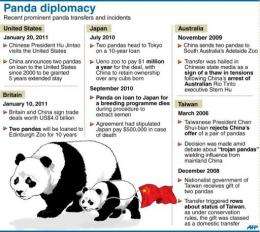
Mei Xiang and Tian Tian belong to China but came to the US National Zoo in 2000 for 10 years of research. Their stay was recently extended by a five-year deal but if they don't produce a cub soon, they may be exchanged for a younger couple.
(c) 2011 AFP


