Neutron analysis reveals '2 doors down' superconductivity link
February 7, 2011

Neutron analysis reveals '2 doors down' superconductivity link

Enlarge

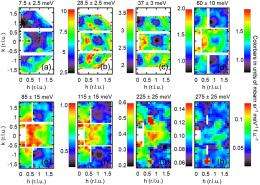
This visual representation of neutron data from ORNL's Spallation Neutron Source shows the evolution of spin waves as a function of increasing energy for the iron chalcogenide FeTe. Experiments indicate high-temperature superconductivity in different materials may share a common magnetic origin.

Neutron scattering analysis of two families of iron-based materials suggests that the magnetic interactions thought responsible for high-temperature superconductivity may lie "two doors down": The key magnetic exchange pairings occur in a next-nearest-neighbor ordering of atoms, rather than adjacent atoms.

Researchers at the Department of Energy's Oak Ridge National Laboratory and the University of Tennessee, using the Spallation Neutron Source's ARCS Wide Angular Range Chopper , performed spin-wave studies of magnetically ordered iron chalcogenides. They based their conclusions on comparisons with previous spin-wave data on magnetically ordered pnictides, another class of iron-based superconductors.

"As we analyze the spectra, we find that even though the nearest neighbor exchange couplings between chalcogenide and pnictide atoms are different, the next nearest neighbor exchange couplings are closely similar," said Pengcheng Dai, who has a joint appointment with ORNL's Neutron Sciences Directorate and the University of Tennessee.

Dai referred to theories that have suggested second-nearest-neighbor couplings could be responsible for the widely acclaimed but poorly understood properties of .

"There are theories suggesting that it's the second nearest neighbor that drives the superconductivity," he said. "Our discovery of similar next-nearest-neighbor couplings in these two iron-based systems suggests that superconductivity shares a common magnetic origin."

Oliver Lipscombe of the University of Tennessee, Dai and ORNL's Doug Abernathy used the ARCS time-of-flight instrument on the SNS to study spin waves of the chalcogenide iron-tellurium superconductor and compared these with iron pnictide superconductors.

Scientists have been studying the iron-based superconductors since their discovery in 2008 to see if the dynamics behind their high-temperature superconducting properties -- in which electricity flows without resistance at temperatures well above absolute zero -- could help explain what was until recently thought to be exclusive to copper-oxide-based superconductors.

"Finding commonalities is always a good step when you're looking for a very basic understanding of a phenomenon like high-temperature superconductivity," said Abernathy, who is lead instrument scientist for the ARCS instrument.

The team's neutron scattering analysis of the materials was made possible by the high intensity of the neutron beams provided by the SNS, which is the world's most powerful pulsed source. Neutrons, which carry no electric charge but can act as subatomic magnets, are well suited for studying atom-scale spin characteristics.

"Since the interactions in the high-temperature superconductors are so strong, measurement of these materials' spin waves requires beams of energetic neutrons that were unavailable to the research community at this intensity before the SNS," Abernathy said.

The work, which was funded by the DOE Office of Science, is published in Physical Review Letters.

Provided by Oak Ridge National Laboratory search and more info website

4.6 /5 (13 votes)  

Filter


Move the slider to adjust rank threshold, so that you can hide some of the comments.


Display comments: newest first

Parsec
Feb 07, 2011

Rank: 3.3 / 5 (7)
It scares the hell out of me knowing that the scientifically illiterate Republican's are now in charge of the funding for this and other projects. I have no doubt that the relatively small amount of funding for this type of research will go begging, while the real deficit drivers are untouched.

This type of research has real effects for future advances in superconductivity, which has a long timeline basis for producing effects on society. However the effects will be undoubtedly profound.

Crudo's to the researchers.
apex01
Feb 07, 2011

Rank: 5 / 5 (1)
yeah, those pesky evil Republicans......
lexington
Feb 07, 2011

Rank: 5 / 5 (1)
Curse them and their evil!
Code_Warrior
Feb 07, 2011

Rank: 1.8 / 5 (5)
Yeah Parsec, as opposed to those scientifically illiterate Democrats that were in charge before that. Speaking of illiteracy, "kudos" works better than "crudo's". I can't say you fat fingered it, because the "C" and the "K" are on opposite sides of the keyboard and it would take some awfully fat fingers to screw that up, not to mention the "r" that you added for good measure.

Perhaps your research grant applications were rejected due to spelling errors.
Caliban
Feb 08, 2011

Rank: 3.9 / 5 (7)
Sorry, but I gotta (mostly) agree with parsec. I think mostly it is Conservative thought, as expressed, typically, by Republicans, and even more, now, by Teaists, as well as the NGOs, Lobbyists and Interest groups(anyone ever heard of the Koch brothers, and their "grassroots organizations?) that do seem to be waging a war against Science.

And by that, I don't just mean AGW, there is also the Theory of Evolution, Vaccine therapy, GMOs, Public Education, Higher Education, and their actions against science-based government agencies, including the EPA, USDA, FDA....

You get the picture -whether it's a media campaign, a political campaign, or a legislative campaign, there seems to be an abundance of Conservative effort and resources going to the purpose of stifling scientific input into policy, education, individual/institutional thought, and even national discourse.

Parsec
Feb 08, 2011

Rank: 3.9 / 5 (7)
Yeah Parsec, as opposed to those scientifically illiterate Democrats that were in charge before that. Speaking of illiteracy, "kudos" works better than "crudo's". I can't say you fat fingered it, because the "C" and the "K" are on opposite sides of the keyboard and it would take some awfully fat fingers to screw that up, not to mention the "r" that you added for good measure.

Perhaps your research grant applications were rejected due to spelling errors.

I am in fact the worlds worst speller. I am one of those who bless the day spell checkers were invented.

I am really talking about the current environment this year. It looks like the NSF will be in for HUGE cuts, while the 'pigs' eating our lunch will not be addressed at all.

Luckily the validity of my observations don't depend on my spelling.
Occupodies
Feb 08, 2011

Rank: 3.7 / 5 (3)
Yeah, but acquiring a research grant does. If you don't take the time to revise your papers well enough to leave out most errors or obvious ones at the least then why should they expect you to have the same patience and meticulous efforts required for detailed research. In any case and in my experience, the public awareness of how poorly funded some programs are or aren't is far too low. You think research on High TC superconductors is really going to suffer?? Hahahaha, the real reason there's not a huge revolutionary research done on SC's is because of all the huge names working on it. These huge labs (corporate and government funded) force university professors out of the field. If you're a professor at a university doing research on this material the best you can hope for is a collab. with someone at a national lab.
NotAsleep
Feb 08, 2011

Rank: 5 / 5 (3)
Are you really having a discussion of politics over an article discussing superconductors? Please find another forum for that
wiyosaya
Feb 08, 2011

Rank: 5 / 5 (1)
Hahahaha, the real reason there's not a huge revolutionary research done on SC's is because of all the huge names working on it. These huge labs (corporate and government funded) force university professors out of the field.

Don't forget the guy in the basement. In Darwin's day, that was at least one source from whence scientific advancement came. Now the guy in the basement has little chance of contributing.
Code_Warrior
Feb 09, 2011

Rank: 5 / 5 (2)
Sorry, but I gotta (mostly) agree with parsec. I think mostly it is Conservative thought, as expressed, typically, by Republicans, and even more, now, by Teaists, as well as the NGOs, Lobbyists and Interest groups(anyone ever heard of the Koch brothers, and their "grassroots organizations?) that do seem to be waging a war against Science.

I think the war is being waged between the factions who politicize science in order to further their agendas and science gets caught in the crossfire. Those who get power stifle research that is contrary to their agenda. People conveniently ignore that behavior when their research is favored, but cry foul when their research gets the shaft. If you want fairness, then you have to speak out against those tactics regardless of who is in power. If you don't oppose it when its done to your opponent, then don't cry foul when your opponents do the same to you.
Rank 4.6 /5 (13 votes)
Relevant PhysicsForums posts
  • Water Rocket
    created2 hours ago
  • why do trucks have bigger brakes?
    created6 hours ago
  • Solar Sail Physics - Do they work on a large scale?
    created7 hours ago
  • How should I switch an air conditioner off?
    created8 hours ago
  • Question about current decay in R-L circuit
    created8 hours ago
  • Elementary time - how does it work?
    created11 hours ago
  • More from Physics Forums - General Physics

More news stories

Landmark calculation clears the way to answering how matter is formed

(Phys.org) -- An international collaboration of scientists, including Thomas Blum, associate professor of physics, is reporting in landmark detail the decay process of a subatomic particle called a kaon – ...

Physics / General Physics

created May 25, 2012 | popularity 4.4 / 5 (20) | comments 46 | with audio podcast

Is a classical electrodynamics law incompatible with special relativity?

(Phys.org) -- The laws of classical electromagnetism that were developed in the 19th century are the same laws that scientists use today. They include Maxwell’s four equations along with the Lorentz la ...

Physics / General Physics

created May 24, 2012 | popularity 4.7 / 5 (15) | comments 35 | with audio podcast feature

Lying in wait for WIMPs: Researchers seek to dramatically increase sensitivity of Large Underground Xenon detector

Although it's invisible, dark matter accounts for at least 80 percent of the matter in the universe. No one knows what it is, but most scientists would bet on weakly interacting massive particles, or WIMPs.

Physics / General Physics

created May 23, 2012 | popularity 4 / 5 (7) | comments 15 | with audio podcast

Hall effect at the speed of light: How can you demonstrate relativistic effects with your mobile phone?

The relativistic Hall effect describing objects rotating at speeds comparable with the speed of light has been reported.

Physics / General Physics

created May 21, 2012 | popularity 4.3 / 5 (3) | comments 8

Cloak of invisibility: Engineers use plasmonics to create an invisible photodetector

A team of engineers at Stanford and the University of Pennsylvania has for the first time used "plasmonic cloaking" to create a device that can see without being seen - an invisible machine that detects light. It is the first ...

Physics / General Physics

created May 21, 2012 | popularity 4.8 / 5 (16) | comments 7 | with audio podcast


Dell tablet leak: 10.1-inch display, two-battery choice

(Phys.org) -- Headline after headline talks about vendors’ tablets in the wings as likely number-one contenders for the iPad. Such claims have justifiably been taken with a grain of salt, considering ...

Scientist: Evolution debate will soon be history

(AP) -- Richard Leakey predicts skepticism over evolution will soon be history. Not that the avowed atheist has any doubts himself.

SpotterRF debuts Radar Backpack Kit (w/ Video)

(Phys.org) -- SpotterRF has announced a special radar backpack kit designed to enhance situational awareness for soldiers on the ground. The company says its special radar is designed for warfighters as part ...

SpaceX capsule has 'new car' smell, astronauts say (Update)

SpaceX's Dragon cargo vessel smells like a new car, said astronauts at the International Space Station after opening the hatches Saturday following the spacecraft's landmark mission to the orbiting lab.

Thousands of shellfish found dead in Peru

Thousands of crustaceans were found dead off the coast of Lima following the mystery mass death of dolphins and pelicans, the Peruvian Navy said Friday.

Australia hails surprise super-telescope decision

Australia has hailed a surprise decision giving it a role in a radio telescope project aimed at revolutionising astronomy, vowing to draw on its decades of experience in space science.