Insect hearing inspires new approach to small antennas
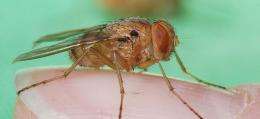
(PhysOrg.com) -- Ormia ochracea is a small parasitic fly best known for its strong sense of directional hearing. A female fly tracks a male cricket by its chirps and then deposits her eggs on the unfortunate host. The larvae subsequently eat the cricket.
Though it doesn't work out well for male crickets, such acute hearing in a tiny body has inspired a University of Wisconsin-Madison researcher as he studies new designs for very small, powerful antennas.
Nader Behdad, an assistant professor of electrical and computer engineering, has received a 2011 Faculty Early Career Development Award (CAREER) award and grant from the National Science Foundation to pursue a novel approach to a challenge that has thwarted electromagnetic researchers for more than a half century.
For a structure like an antenna to effectively transmit or receive an electromagnetic wave at a given frequency, the size must be comparable to the wavelength at that frequency. Making the structure's aperture size physically smaller than a wavelength becomes a critical performance issue. These small antennas aren't as efficient and don't work well beyond a narrow band of frequencies. Additionally, many applications, such as satellite TV and radar systems, require antennas that can distinguish signals from specific directions, and current small antennas don't have these precise directional capabilities.
"Designing small, directional antennas is one of those things we tell students can't happen," Behdad says. "But the question is, what if it can be done?"
Behdad decided to address the challenge through a new lens, one not often used in his field. He is looking to nature for some design guidance, an approach known as biomimetics or biomimicry.
He started by exploring the human auditory system. Humans are equipped with a fairly good sense of directional hearing, thanks to two ears separated by a head large enough to attenuate sound. Humans also have a brain complex enough to calculate the time difference between sound arriving in each ear and the intensity of the sound to determine its origin. "We're like a large antenna," Behdad says.
His research gradually led to smaller creatures, such as mice and insects, and eventually, Behdad came across the Ormia ochracea. "Some insects can hear in the same manner we can. But their body size is small, so the time difference of the sound arrival is significantly smaller," he says.
Usually, an insect's "ears" are not even located on the head, but instead are close together on its thorax or elsewhere, depending on the animal. Yet despite the small time and intensity differences, some insects have directional hearing capabilities surpassing those of humans. The parasitic fly, which appears to be among the smallest with superb directional hearing, can detect the direction of a chirping cricket with an accuracy of one to two degrees.
"These are small antennas that actually work better than large antennas," says Behdad, who took this knowledge and began designing circuits that could mimic an insect's auditory system.
"There hasn't been any work done to design antennas that mimic the hearing mechanism of different insects," he says. "We've designed a basic proof-of-concept antenna and have some preliminary results. But at this point, we still need to understand what the physics are."
Behdad's designs are for a type of antenna known as super resolving, which is capable of distinguishing signals coming from different directions. If he can create very small, efficient super-resolving antennas, the technology could result in significantly more wireless bandwidth, better cell phone reception and other applications in the consumer electronics industry, as well as new radar and imaging systems.
Behdad also is interested in eventually using his CAREER research to explore small super-directive antennas, a class of antennas that could capture a lot of power coming from one direction. Though this type of antenna is still far from reality, the result could be a tiny antenna with the capabilities of a giant one.
Provided by University of Wisconsin-Madison


