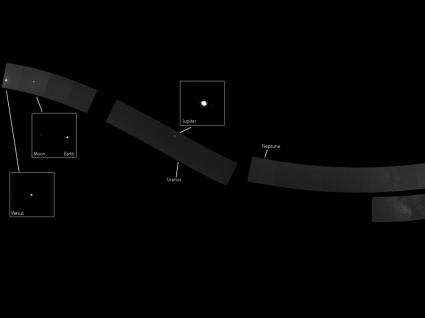
Image: A solar system family portrait, from the inside out
Feb 21, 2011
Image Credit: NASA, Johns Hopkins University Applied Physics Laboratory, Carnegie Institution of Washington

NASA's MESSENGER spacecraft has constructed the first portrait of our solar system by combining 34 images taken by the spacecraft’s Wide Angle Camera on Nov. 3 and 16, 2010.

The mosaic, pieced together over a period of a few weeks, comprises all of the planets except for Uranus and Neptune, which were too faint to detect.

On March 17, 2011, MESSENGER may become the first probe ever to orbit Mercury. Scientists hope orbital observations will provide new answers to how Earth-like planets, like Mercury, are assembled and evolve.

Explore further: Curiosity Mars rover drills second rock target

add to favorites email to friend print save as pdf

Related Stories

NASA rescheduled MESSENGER start to Mercury to August 3

Aug 02, 2004

Today's launch of the MESSENGER spacecraft has been canceled due to weather constraints. The launch team will try again tomorrow, August 3, at 2:15:56 a.m. MESSENGER is a scientific investigation of the planet ...

MESSENGER On Its Way

Aug 04, 2004

The MESSENGER spacecraft lifted off on-time aboard a Boeing Delta II rocket from pad 17-B at Cape Canaveral Air Force Station, Fla., at 2:15:56.537 a.m. EDT. MESSENGER has successfully begun its mission to u ...

MESSENGER Returns Images from Oct. 6 Mercury Fly-By

Oct 07, 2008

MESSENGER is the first mission sent to orbit the planet closest to the sun. On Oct. 6, 2008, at roughly 4:40 a.m. ET, MESSENGER flew by Mercury for the second time this year. During the encounter, the probe ...

MESSENGER Spacecraft Flies by Mercury

Sep 30, 2009

Shortly before 5:55 p.m. EDT, MESSENGER skimmed 228 kilometers (141 miles) above the surface of Mercury in its third and final flyby of the planet.

Messenger spacecraft on way to Mercury

Aug 03, 2005

NASA's Messenger spacecraft swung by Earth for a Tuesday gravity assist that propelled it deeper into space on its long journey toward Mercury.

Spacecraft Tandem Provide New Views of Venus

Jul 19, 2007

NASA's Mercury Surface, Space Environment, Geochemistry, and Ranging spacecraft, known as Messenger, and the European Space Agency's Venus Express recently provided the most detailed multi-point images of ...

Recommended for you

Proba-V opens its eyes

16 hours ago

(Phys.org) —Earth watcher Proba-V is in good health following its launch last week. The Vegetation imager has been switched on and the first image has been captured over western France.

Mice, gerbils perish in Russia space flight

May 19, 2013

A number of mice and eight gerbils sent into space in a Russian capsule destined to find out how well organisms can withstand extended flights perished during their journey, scientists said Sunday as the ...

Mars rover Opportunity examines clay clues in rock

May 18, 2013

(Phys.org) —NASA's senior Mars rover, Opportunity, is driving to a new study area after a dramatic finish to 20 months on "Cape York" with examination of a rock intensely altered by water.

User comments : 1

Adjust slider to filter visible comments by rank

Display comments: newest first

omatumr
1 / 5 (2) Feb 21, 2011
That is not a very impressive picture.

But the visit to Mercury may help JPL/NASA scientists understand that Mercury and other Earth-like planets accreted in layers, beginning with the iron core that assembled from iron meteorites near the pulsar core of the supernova.

See:

1. K. K. Turekian and S. P. Clarke, "Inhomogeneous accumulation of the earth from the primitive solar nebula," Earth and Planetary Science Letters, vol. 6, 1969, pp. 346- 348.

2. A. P. Vinogradov, "Formation of the metal cores of planets," Geokhimiya, vol. 10, 1975, pp. 1427-1431.

3. "The noble gas record of the terrestrial planets", Geochemical Journal, vol. 15, 1981, pp. 245-267.

4. "Neutron Repulsion" [The APEIRON Journal, 19 pages, in press, 2011]

arxiv.org/pdf/1102.1499v1

With kind regards,
Oliver K. Manuel
Former NASA Principal
Investigator for Apollo

More news stories

Slow earthquakes: It's all in the rock mechanics

(Phys.org) —Earthquakes that last minutes rather than seconds are a relatively recent discovery, according to an international team of seismologists. Researchers have been aware of these slow earthquakes, ...

New immune system discovered

(Medical Xpress)—A research team, led by Jeremy Barr, a biology post-doctoral fellow, unveils a new immune system that protects humans and animals from infection.

Lab sets a new record for creating heralded photons

(Phys.org) —Entanglement, by general consensus of physicists, is the weirdest part of quantum science. To say that two particles, A and B, are entangled means that they are actually two parts of an inseparable ...