Ice cores yield rich history of climate change
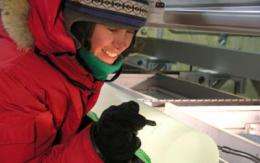
A researcher inspects a freshly-drilled ice core. Credit: Kendrick Taylor, Chief Scientist, WAIS Divide Ice Core Project Research Professor, Desert Research Institute, Nevada System of Higher Education
On Friday, Jan. 28 in Antarctica, a research team investigating the last 100,000 years of Earth's climate history reached an important milestone completing the main ice core to a depth of 3,331 meters (10,928 feet) at West Antarctic Ice Sheet Divide (WAIS). The project will be completed over the next two years with some additional coring and borehole logging to obtain additional information and samples of the ice for the study of the climate record contained in the core.
As part of the project, begun six years ago, the team, funded by the National Science Foundation (NSF), has been drilling deep into the ice at the WAIS Divide site and recovering and analyzing ice cores for clues about how changes in the concentration of greenhouse gases in the atmosphere have influenced the Earth's climate over time.
Friday's milestone was reached at a depth of 3,331 meters--about two miles deep--creating the deepest ice core ever drilled by the U.S. and the second deepest ice core ever drilled by any group, second only to the ice core drilled at Russia's Vostok Station as part of a joint French/U.S./Russian collaboration in the 1990s.
"By improving our understanding of how natural changes in greenhouse gas influenced climate in the past, the science community will be able to do a better job of predicting future climate changes caused by the emissions of greenhouse gases by human activity," said Kendrick Taylor, chief scientist for the WAIS Divide Ice Core Project.
The drilling site is about 966 kilometers (600 miles) from the South Pole, at an ice divide (which is analogous to a watershed divide) in West Antarctica, where the ice is flowing out to the sea in opposing directions.
"This location was selected because it is the best place on the planet to determine how greenhouse gases have changed during the last 100,000 years" said Taylor. Since it began, the WAIS Divide Ice Core Project has continuously collected ice from the surface down to a depth of 3,331 meters. The ice at this depth fell as snow about 100,000 years ago. The high annual snowfall at the site enables individual annual layers of snowfall to be identified and counted (much like counting tree rings) back to about 40,000 years. Below that, the layers become too compressed to allow annual layers to be resolved. Scientists hope for at least decadal resolution to this point, sufficient for the science goals to be achieved.
The ice cores are 13-centimeter (5-inch) diameter cylinders of ice collected from deep in the ice sheet. Over time, the ice has formed when snow was compacted at the surface by subsequent snowfall. The compacted snow contains dust, chemicals and atmospheric gases, which are trapped in the ice.
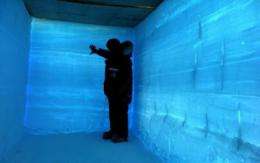
A researcher examines layers in a snow pit deposited by different storms. Credit: Kendrick Taylor, Chief Scientist, WAIS Divide Ice Core Project Research Professor, Desert Research Institute, Nevada System of Higher Education
The dust and other impurities in the ice are indicators of past climate, and the gas contained in air bubbles is a sample of the ancient atmosphere. The deeper the ice, the further back in time measurements can be made.In addition to measuring what the atmospheric concentrations of carbon dioxide, methane and other gases were in the past, the research team can also determine what the surface air temperature was in the past by studying changes in the isotopic composition of the water that makes up the ice. The past atmospheric concentrations of the gases krypton and xenon are used to determine what the average temperature of the ocean was in the past.
The 13-centimeter diameter 3,331-meter-long ice core is cut into 1 meter (3 feet)-long pieces of ice and sent by ship and refrigerated truck to the NSF National Ice Core Laboratory in Denver. The ice is cut into smaller samples and sent to 27 investigators around the U.S., who make the measurements.
"Previous ice cores have shown that the current level of greenhouse gases is greater now than at any time during the last 650,000 years, and that concentrations today are increasing at the fastest rate," said Taylor. "This increase is caused by human activity and is forcing the climate into a configuration that no human has ever experienced."

This is a section of an ice core coming out of the drill. Credit: Mark Twickler, University of New Hampshire
The WAIS Divide Ice Core Project is specifically investigating the small timing offsets between past changes in the atmospheric concentration of greenhouse gases and changes in temperature. By understanding these timing offsets, the research team can determine the role that changes in ocean circulation had in the release of carbon dioxide from the ocean and how an increase in carbon dioxide in the atmosphere warms the planet.The drilling ceased 100 meters (328 feet) above the contact between the ice and the underlying rock, to avoid contaminating a possible water layer at the ice-rock contact. The basal water system may consist of water-saturated, ground-up rock, and has not been exposed to the earth's surface for millions of years. It may harbor a unique and pristine biological environment that the U.S. Antarctic Program does not wish to contaminate.
The core taken by the WAIS Ice Core Drilling Project is crucial for fine-tuning the researchers' understanding of how the oceans, atmosphere and climate interact during climate changes. A Danish-led team recovered an ice core from Greenland this past summer with similar time resolution to the WAIS Divide record. The two cores provide an opportunity to compare the response of the northern and southern hemispheres to climate changes. The Greenland ice core cannot be used to study changes in the atmospheric concentration of carbon dioxide because there is too much dust in the Greenland ice, which decomposes and releases non-atmospheric carbon dioxide into the ice.
NSF's Office of Polar Programs funds this research, primarily through its Antarctic Glaciology Program.
"We still have two more field seasons of work to complete the project, and reaching this goal should allow us to complete the project on schedule," said Julie Palais, program director. "In addition, we are hoping to get as long a record as possible from this site, and getting all of the ice we planned on this year will allow the science community to do the work that they are funded to do. Drilling the ice core is just the first step in the process, albeit a very important one."
Provided by
National Science Foundation
-
From lemons to lemonade: Reaction uses carbon dioxide to make carbon-based semiconductor,
28 comments
-
Thioridazine kills cancer stem cells in human while avoiding toxic side-effects of conventional cancer treatments,
3 comments
-
SpaceX private rocket blasts off for space station (Update),
42 comments
-
Climate scientists say they have solved riddle of rising sea,
30 comments
-
Scotland passes turbine test to harness tidal power,
41 comments
-
More human population = greater mass?
May 25, 2012
-
Conversion from aircraft bearing to normal degrees
May 23, 2012
-
Interpretation/Analysis of the Lab results(HEPA filter)
May 22, 2012
-
Has anyone here attended the The Urbino Summer School in Paleoclimatology?
May 22, 2012
-
Earthquakes: Mag 6 N. Italy and Mag 5.6 W. Bulgaria
May 21, 2012
-
determining time frame for most recent geological layers
May 17, 2012
- More from Physics Forums - Earth
More news stories
Australia hails surprise super-telescope decision
Australia has hailed a surprise decision giving it a role in a radio telescope project aimed at revolutionising astronomy, vowing to draw on its decades of experience in space science.
9 hours ago |
5 / 5 (2) |
0
Astronomers seize last chance in lifetime for Venus Transit
Astronomers are gearing for one the rarest events in the Solar System: an alignment of Earth, Venus and the Sun that will not be seen for another 105 years.
9 hours ago |
5 / 5 (1) |
0
SpaceX capsule has 'new car' smell, astronauts say
SpaceX's Dragon cargo vessel smells like a new car, said astronauts at the International Space Station after opening the hatches Saturday following the spacecraft's landmark mission to the orbiting lab.
Space & Earth / Space Exploration
9 hours ago |
4.5 / 5 (11) |
0
Astronauts enter world's 1st private supply ship
(AP) -- Space station astronauts floated into the Dragon on Saturday, a day after its heralded arrival as the world's first commercial supply ship.
Space & Earth / Space Exploration
9 hours ago |
5 / 5 (4) |
0
Dragon arrives at space station in historic 1st (Update 2)
The privately bankrolled Dragon capsule made a historic arrival at the International Space Station on Friday, triumphantly captured by astronauts wielding a giant robot arm.
Space & Earth / Space Exploration
May 25, 2012 |
5 / 5 (10) |
16
SpotterRF debuts Radar Backpack Kit (w/ Video)
(Phys.org) -- SpotterRF has announced a special radar backpack kit designed to enhance situational awareness for soldiers on the ground. The company says its special radar is designed for warfighters as part ...
Thousands of shellfish found dead in Peru
Thousands of crustaceans were found dead off the coast of Lima following the mystery mass death of dolphins and pelicans, the Peruvian Navy said Friday.
Family history of Alzheimer's affects functional connectivity
(HealthDay) -- Cognitively normal individuals with a family history of late-onset Alzheimer's disease (AD) may display lower resting state functional connectivity in the default mode network (DMN) of the brain, ...
Transvaginal mesh op restores pelvic organ prolapse at price
(HealthDay) -- Transvaginal mesh (TVM) procedures are effective for anatomical restoration of pelvic organ prolapse (POP), but patients report a worsening of sexual function following surgery, according to ...
Travel to high altitudes tied to Crohn's, colitis flare-ups
(HealthDay) -- People with inflammatory bowel disease, which includes Crohn's disease and colitis, may be at increased risk for flare-ups when they fly or travel to high altitudes for skiing or mountain climbing, ...
Landmark calculation clears the way to answering how matter is formed
(Phys.org) -- An international collaboration of scientists, including Thomas Blum, associate professor of physics, is reporting in landmark detail the decay process of a subatomic particle called a kaon ...


Feb 02, 2011
Rank: 2.4 / 5 (25)
Feb 02, 2011
Rank: 3.2 / 5 (22)
And according to you specifically, what is the history of climate? That's right, change. You seem to have a problem with two words being strung together. I'd suggest you examine that irrational response.
Feb 02, 2011
Rank: 1 / 5 (1)
Feb 02, 2011
Rank: 5 / 5 (3)
My immediate thought was "What about ablation?" (description of ablation deleted as I went way over comment length limit)
What I am asking is effectively "would the contents of an air bubble inserted into a block of ice and then left frozen for 100,000 years be chemically altered by its surroundings?" And if so, do these studies account for this mathematically?
Any insight would be appreciated.
Feb 02, 2011
Rank: 2.9 / 5 (13)
The arbitrary assignment of abnormal to any current climate description is nonsensical and fails to capture the scope of climate change that has occurred on the planet, whatever their causes. The BEST climate for life on this planet is certainly much warmer, simply look back on the fossil record to see what the climate was like when there was the most life in the most regions of the world.
Feb 02, 2011
Rank: 3.7 / 5 (10)
Feb 02, 2011
Rank: 3.9 / 5 (7)
You're on the right track, but ablation isn't exactly the right word. I've read some studies about this and there is serious debate amongst the experts in regard to sample mixing and diffusion. The reasoning I've read is that under that kind of pressure the ice is plastic and flows in unpredictable ways. It's the same thing that happens in the Earth's crust due to earthquakes and normal tectonic deformation. Layers can get tilted, inverted, or folded till they overlap in an S curve. That's why they try to take samples over a high spot (divide). It's thought that plastic deformation may be smallest there.
It's also thought that there MAY be capilary action of liquid water molecules amongst the ice crystals under that extreme pressure, and gasses may be transported and diffused more than previously assumed. It's hard to tell though. That's kind of a hot button topic in ice core research right now.
Feb 02, 2011
Rank: 2.1 / 5 (18)
Clearly it is not.
CO2 rise has always followed heating, and this has been definitively proven, and simple physics dismisses AGW theory.
Too bad that the only way that a scientist can get funding is to continue to bow to this apostasy, and that the media continues to sell the lie.
Earth's climate is changing all the time, and CO2 concentrations, especially at the minute quantities that exist in our atmosphere, are negligible.
Feb 02, 2011
Rank: 1.7 / 5 (17)
I don't have time or space here to prove that but if you want to know more about it, read the book The Hockey Stick Illusion;Climategate and the Corruption of Science.
You can find it at Amazon.
Feb 02, 2011
Rank: 4 / 5 (18)
But the ultra-warm biosphere of the Jurassic was inhabited by species that were adapted to it. The same applies to the periods of great warmth during the early or middle Neogene.
Also, the marine life generally prefers colder conditions that allows more oxygen to be dissolved in the water. Arctic and antarctic seas have much more plankton, and thus more fish per volume unit.
Finally, the people living in Holland and Florida will find it hard to evolve into marine lifeforms in just a century...
Feb 02, 2011
Rank: 3.1 / 5 (8)
Feb 02, 2011
Rank: 5 / 5 (1)
Thank you for your thoughtful reply. You've given me a lot more to research ;)
Feb 02, 2011
Rank: 4 / 5 (1)
Feb 03, 2011
Rank: 1.5 / 5 (17)
I live in a mild coastal climate that fluctuates by 56C some years - -19C one day, +36C within 6 months.
I think we can adapt to +2C if it happens.
Of course as of the end of January the UAH temperature anomaly is -.01C below normal.
It isn't warming. Period.
Feb 03, 2011
Rank: 2.5 / 5 (6)
The vostok cores are ice cores. I have no idea what you are talking about. They have not drilled all the way through the ice into the lake yet. There is not plan to do so to my knowledge for fear of contamination. In addition to the microbial contamination mentioned above, they also fear drilling fluid contamination. In fact they even worry about getting close to the lake because the drilling fluid could seep through the ice in the capilary action I mentioned above.
Feb 03, 2011
Rank: 2.3 / 5 (4)
Most of the gloom and doom crowd these days is agreeing on a 1 meter rise in sea level in 90 years. That's not enough to drown Florida and Rotterdam, Netherlands is already 7 meters below sea level. Besides, if sea level does rise by 1 meter, that isn't going to be a uniform rise. Despite recent evidence that global sea level has risen, the sea level on the US East Coast and in the Gulf of Mexico seems to be falling, if you believe the NASA sea level measurements.
What may be a bigger long term problem for a few coastal areas around the world is land subsidence. As they use up the ground water (or oil in some cases), the land tends to sink rather quickly compared to the speed of other changes such as sea level or tectonics.
Feb 03, 2011
Rank: 5 / 5 (8)
Feb 03, 2011
Rank: 3.5 / 5 (2)
Feb 03, 2011
Rank: 4 / 5 (4)
GSwift- nicely put. Have you ever seen Monty Python and The Holy Grial? There is a great a part of the film wherea king of the marshes explains to his son how he built a castle on a swamp...won't ruin the sketch for you, just watch it on youtube!
Feb 03, 2011
Rank: 5 / 5 (2)
Unfortunately, building cities on deltas isn't only a modern mistake; It's a mistake that's been repeated many times, all the way back to pre-history. They found two old cities under the Nile delta not too long ago, for example. It seems that we never learn.
Feb 03, 2011
Rank: 4 / 5 (1)
There was an article here only days ago, saying that they are indeed going to drill into the Lake, and take samples. To do so, they stopped short, and plan to drill through the last few feet with a new, uncontaminated drill. I forget the specifics, but there it is.
Feb 03, 2011
Rank: 1.5 / 5 (6)
"Results of GPS data shows a peak rate of about 11 mm/year in the north part of the Gulf of Bothnia."
Feb 04, 2011
Rank: 3.7 / 5 (6)
Well very few of us today plan for terms longer than our appreciable lives. I can only assume that not being a forward thinker was more prevalent in the past when survival was more day to day than it is now for some of us.
Feb 04, 2011
Rank: 4 / 5 (1)
Oh, I stand corrected about the plans to penetrate the lake. I wasn't aware that had changed. It looks like they are planning to use the existing hole from the core sample though, so there won't be any chance to get another core, in answer to your question. It looks like not everyone agrees that penetrating the lake is a good idea though.
Feb 04, 2011
Rank: 5 / 5 (5)
Regarding scientific analysis of Lake Vostok ice cores, NOAA hosts a page with links to data and analysis of these cores:
h
ttp://www.ncdc.noaa.gov/paleo/icecore/antarctica/vostok/vostok_data.html
Feb 06, 2011
Rank: 2.3 / 5 (3)
You think you can adapt to it? No that's not right, YOU WILL have to adapt to it. Maybe more, and then more and then more. Also +2C is assuming a very optimist model. With the AGW (human caused warming) deniers, I would use a much less favorable model, and say 5.6C is probably close.
Feb 06, 2011
Rank: 4 / 5 (4)
You can also find "An Inconvenient Truth" there too. Unfortunately the book you site is full of crap. Try
h
ttp://www.climate.gov
The condensed view is right there.
Feb 06, 2011
Rank: 2.7 / 5 (3)
Climate is always changing. *shrug* This is what people don't seem to understand. Generally it has been warmer in the past. I would prefer that it were warmer rather than colder. Ice ages are a HUGE bummer. Warming will open up more of the Earth to life, both plants and animals, that is currently too cold for most species. There is a lot of land up here in the north country that is frozen much of the year. But city cousins don't understand that. Unfortunately they miss the real issue: pollution.
Feb 07, 2011
Rank: 3.9 / 5 (7)
I'm a believer, it global warming, no doubt about it. What gets folks upset somehow, is it correlates in lockstep with mans rise, industrialization and industrrial exhaust (pollution) CO2.
Feb 07, 2011
Rank: 1 / 5 (5)
Feb 07, 2011
Rank: 4.3 / 5 (6)
Your not helping the conversation or enlightening anyone when you make up silly shit like that.
Feb 07, 2011
Rank: 5 / 5 (2)
I assume you are joking. Keep in mind that sarcasm doesn't project very well in text. One of my local radio guys likes to say that computers should have a sarcasm font. lol.
Unfortunately, I've met many people who would believe every word of what you just said.
I think I just lost a million brain cells reading your post. Ouch.
Feb 07, 2011
Rank: not rated yet
We are a smart species and therefore will probably be able to whether the change as well.
It just won't be nice to see parts of the land get submerged, and some cute animals drown and go extinct. Morality tugging at our heart strings.
Not that we all shouldn't pollute less.
Feb 07, 2011
Rank: 5 / 5 (1)
Oh my gosh really? Global Drying? Wait a second, wasn't the Grand Canyon carved by the river over a very very long time?
HAhaHA, are you also a Scientologist?
Feb 07, 2011
Rank: 4.3 / 5 (6)
First of all 2 degrees is a global average. It is a spatial average, in that there will be less warming at the equator, and considerably more at the poles. It is a temporal average, in that both extreme highs and extreme lows will occur at higher temperature points. To put it in perspective, consider that the difference between normal body temperature and high fever, is just 3 degrees C.
Permafrost will melt across the arctic, transforming those lands into endless, impassable, methane-belching swamps (methane, BTW, will amplify the greenhouse effect further still.) If you think mosquito-plagued marshlands are going to be useful to anyone, I suggest you move to Siberia straight away: no point waiting.
Oceans will be less productive. Most of the equatorial lands will get drier. Extreme weather events (floods, in particular) will be more frequent.
Yeah, we will adapt. But it's going to cost a lot more than we're "saving" currently by using "cheap" fossil fuels.
Feb 16, 2011
Rank: 1 / 5 (2)
You guys need to get up in an airplane once in a while and discover the VASTNESS of this planet, and the utter impossibility that anything we could do could POSSIBLY affect such a huge expanse of air and water.
Much as we had NOTHING to do with the complete evaporation of the entire ocean that used to sit where Monument Valley now sits. Try to imagine what kinds of NATURAL climate changes were required to do that, and you can see that NATURAL changes will always trump whatever measly things mankind can do.
Just watch this next solar flare.
Feb 16, 2011
Rank: 3.7 / 5 (3)
Where were you during the Gulf Oil well spill? Utterly impossible to soak the huge expanse of the gulf in crude oil? It seems that we've proven the fact that it is easily do-able to create an environmental disaster the size of Texas with the last one.