Early humans won at running; Neandertals won at walking
February 7, 2011 by Lin Edwards
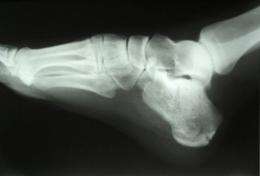
Calcaneus (heel bone) fracture X-ray. Image: Wikipedia.
(PhysOrg.com) -- New research has compared the performance of the heels of modern-day distance runners to the heels of Neandertals and ancient Homo sapiens. The results show the Neandertals' heels were taller than those of modern humans and Homo sapiens, and more adapted to walking than running over long distances, while those of Homo sapiens were more adapted to endurance running.
Assistant Professor of Anthropology, Dr David Raichlen of the University of Arizona in Tucson, and colleagues, found that unlike modern humans, the Neandertal heel was taller would have provided less spring during running, and speculated that the heel probably stabilized the ankle and helped in jumping and walking uphill. In modern humans the heel is lower and stretches the Achilles tendon and increases its ability to act like a spring and reduce the consumption of energy.
Dr Raichlen and colleagues had eight distance runners run on a treadmill at 10 mph (16 km/h) for periods of 10 minutes and calculated their rates of oxygen consumption. In different running periods, they also took magnetic resonance imaging (MRI) scans of their heels and Achilles tendons.
The results showed the heel bones were shorter and lower in the runners whose oxygen consumption while running was most efficient.
The heel measurements were compared with those of 13 fossil Homo sapiens dated from 30-100,000 years ago and with six Neandertals from around the same period. The researchers calculations suggest that during running the Homo sapiens would have expended 6.9% more energy than modern distance runners, but Neandertals would have needed an average of about 11.4% more energy.
The results suggest that while Neandertals may not have fared well in long-distance marathons, their bone structures would have given them an advantage in walking and in activities requiring great strength.
The results of the research support earlier findings that long-distance running in Homo sapiens evolved over two million years ago and probably helped early humans in hunting before spears began to be widely used about 400,000 years ago. The ability to run long distances in hot environments is thought to help in running prey to exhaustion. Neandertals lived in colder climates and probably needed different skills in hunting.
The paper was published in the Journal of Human Evolution.
More information: Calcaneus length determines running economy: Implications for endurance running performance in modern humans and Neandertals, by David A. Raichlen et al., Journal of Human Evolution, Article in Press, doi:10.1016/j.jhevol.2010.11.002
© 2010 PhysOrg.com
-
From lemons to lemonade: Reaction uses carbon dioxide to make carbon-based semiconductor,
28 comments
-
Thioridazine kills cancer stem cells in human while avoiding toxic side-effects of conventional cancer treatments,
3 comments
-
SpaceX private rocket blasts off for space station (Update),
42 comments
-
Climate scientists say they have solved riddle of rising sea,
30 comments
-
Scotland passes turbine test to harness tidal power,
41 comments
-
How do I identify different bacteria on culture plates?
11 hours ago
-
Why Do Dogs do Strange things...
May 25, 2012
-
What does exophillic and endophillic mean in terms of mosquito and their control?
May 24, 2012
-
Semen stains glows under black lights (uv light)?
May 23, 2012
-
Question on Human Chromosome 2
May 23, 2012
-
How important is composition of TBST in diluting antibodies and Western Blotting?
May 22, 2012
- More from Physics Forums - Biology
More news stories
Social welfare cuts ultimately come with heavy price, researchers say
(Phys.org) -- Slashing government funding for Medicaid, food stamps and other programs that serve the poor while politically popular with some lawmakers and many conservatives may do more harm ...
Other Sciences / Social Sciences
May 24, 2012 |
4.1 / 5 (13) |
101
Ancient Bethlehem seal unearthed in Jerusalem
Israeli archaeologists have discovered a 2,700-year-old seal that bears the inscription "Bethlehem," the Israel Antiquities Authority announced Wednesday, in what experts believe to be the oldest artifact ...
Other Sciences / Archaeology & Fossils
May 23, 2012 |
3.5 / 5 (14) |
23
Oldest Jewish archaeological evidence on the Iberian Peninsula
German archaeologists of the Friedrich Schiller University Jena found one of the oldest archaeological evidence so far of Jewish Culture on the Iberian Peninsula at an excavation site in the south of Portugal, ...
Other Sciences / Archaeology & Fossils
May 25, 2012 |
4.3 / 5 (4) |
12
Dollars and sense: Why are some people morally against tax?
As the U.S. presidential election campaigns heat up, the economic debate is dominated by bailouts, austerity and, inevitably, taxation. Now a new study published in Symbolic Interaction asks why tax is such an important issue ...
Other Sciences / Social Sciences
May 23, 2012 |
3 / 5 (2) |
12
Oldest art even older
New dates from Geißenklösterle Cave in Southwest Germany document the early arrival of modern humans and early appearance of art and music.
Other Sciences / Archaeology & Fossils
May 24, 2012 |
5 / 5 (2) |
6
Dell tablet leak: 10.1-inch display, two-battery choice
(Phys.org) -- Headline after headline talks about vendors tablets in the wings as likely number-one contenders for the iPad. Such claims have justifiably been taken with a grain of salt, considering ...
Scientist: Evolution debate will soon be history
(AP) -- Richard Leakey predicts skepticism over evolution will soon be history. Not that the avowed atheist has any doubts himself.
Keep food safety in mind this memorial day weekend
(HealthDay) -- Picnics, parades and cookouts are as much a part of Memorial Day weekend as tributes to the United States' war veterans.
SpaceX capsule has 'new car' smell, astronauts say (Update)
SpaceX's Dragon cargo vessel smells like a new car, said astronauts at the International Space Station after opening the hatches Saturday following the spacecraft's landmark mission to the orbiting lab.
SpotterRF debuts Radar Backpack Kit (w/ Video)
(Phys.org) -- SpotterRF has announced a special radar backpack kit designed to enhance situational awareness for soldiers on the ground. The company says its special radar is designed for warfighters as part ...
Australia hails surprise super-telescope decision
Australia has hailed a surprise decision giving it a role in a radio telescope project aimed at revolutionising astronomy, vowing to draw on its decades of experience in space science.
Feb 07, 2011
Rank: 4.6 / 5 (12)
There's one adaptation we have that (i think) no other animal has. The ability to sweat. We're not fast, we're not strong, but we can run forever compared to other animals, even in advanced age. To me, it is a reasonable assumption that the way we dealt with grassland was to spot our prey from far off and run it to exhaustion with the entire social group in tow.
Feb 07, 2011
Rank: 5 / 5 (6)
Feb 07, 2011
Rank: 3.8 / 5 (5)
I can't remember where but I saw a documentary where modern bushmen do this.
Feb 07, 2011
Rank: not rated yet
What was the advantage of longdistance walking for the Neanderthals? Did they use their brains more for catching pray with tactics? Or were they stealthy instead of quick? Did their diet consist of berries, leaves and other edible static resources, or did they mostly searched the land for already dead or sick animals?
They must have had a pretty good way to getting their food, but I'm really wondering which it was.
Feb 07, 2011
Rank: 4.4 / 5 (7)
I'm pretty sure horses sweat. And generally, most of the hoofed animals are much better long-distance runners than humans.
I'd even go farther and say that most four-legged animals are better runners than humans, period. I mean, try and go for a run alongside a wolf; see who passes out from exhaustion sooner...
If running was key to the hunting activities of the early Homo Sapiens, then it would imply they would have preferentially hunted slow-moving prey that's only good at sprinting. Things like boars. Or other great apes, perhaps...
On the other hand, early Homo Sapiens was at least as much a prey as predator, particularly on the steppes of Africa. Perhaps running was merely a way to elude roving packs of hyenas, big cats, and other similar threats -- particularly the sort of predators that can track your scent and thus give chase over long distances.
Then there's fight-or-flight. Sometimes it's easier to survive a conflict by running away...
Feb 07, 2011
Rank: 5 / 5 (4)
As for wolves, yes, they run faster, but all species of canis cannot run extended distances. When it comes to running, we are certainly in a league of our own. Our anatomy only indicates running as a primary activity. (cont).
Feb 07, 2011
Rank: 5 / 5 (4)
As for being able to run to escape predators, that's nonsense. They're all faster than us in burst, but none of them can run the distances we can.
Feb 07, 2011
Rank: 5 / 5 (3)
I have two greyhounds, and I take them jogging every morning. These dogs are retired racers, and a heckuvalot faster than I am. But I don't take them more than about a mile, as they begin to pant so hard they look like they're about to explode. Greyhounds aren't going to be finishing any marathons.
Feb 07, 2011
Rank: 5 / 5 (3)
Feb 07, 2011
Rank: 2 / 5 (1)
Umm... You missed an important detail. The Neanderthals lost. They died out. We won the race. So far.
Feb 07, 2011
Rank: 5 / 5 (2)
Interesting. We have dogs that are more timber / arctic wolf like. They run and run and run and run and just keep on going. Ours work on our farm as herding and guarding dogs. They can do very fast bursts but generally they do long distance running. They'll run our perimeter which can be miles up and down the mountains. Wolf vs Greyhound tactic. Us vs Neanderthal. Lots of room in evolution and the world for many wonderful variations.
Feb 07, 2011
Rank: not rated yet
Feb 07, 2011
Rank: 2.2 / 5 (10)
http
://discovermagazine.com/2006/may/tramps-like-us
Thats because we are tropical while they most likely had become a more temperate species. Our reproduction was not correlated with the seasons. If so, we could easily have out-reproduced them (and our resources.)
Inuits can stand motionless over a seal breathing hole in the ice for 6 hours or more. Running down prey is less useful in the snow.
Feb 07, 2011
Rank: 5 / 5 (1)
MacDougal is one of the few I've paid attention to in this aspect.
htp://www.youtube.com/watch?v=b-iGZPtWXzE
That's his latest TED talk. It's certainly interesting.
Feb 07, 2011
Rank: 2.8 / 5 (4)
Feb 07, 2011
Rank: 4 / 5 (2)
Feb 07, 2011
Rank: 5 / 5 (4)
A man can outrun a horse over any significant distance. It's been done over and over. As the distance increases, humans will get further and further ahead. Only 30 miles per day? My brother is an ultrarunner, and on *mountainous* terrain has covered 100 miles in a race in under 24 hours. He has run daily marathons for a week without a problem. The Tarahumara have been known to run 80 miles per day in 90-100 degree weather. A horse would be down after 10 miles.
Feb 08, 2011
Rank: 4 / 5 (2)
You guys are using hyperbole. Humans CANNOT outrun all animals even over distance. On HOT days some YOUNG Africans do try to run down SOME animals. Mostly it seems to be species that overheat. Some humans can and do run over a hundred miles a day for several days at altitude but it is more of a jog. Don't remember why but it was in the Andes. They have HUGE lungs and I think that heat is not much of an issue.
I suspect the big advantage the humans had on the Veld was the ability to go out in the Noon Day Sun. As for Neanderthal I don't think we outran them. Lots of things must have been involved but I recall that Neanderthal has a shoulder muscle that is arranged for power in such a way that it would make them lousy with thrown weapons. Chimps can't throw well either despite the long arms.
Ethelred
Feb 08, 2011
Rank: not rated yet
David Attenborough-African Kalahari desert Kudu persistant hunt.
I cant copy paste the link, the sistem thinks I am a spammer!
Feb 08, 2011
Rank: 5 / 5 (2)
We certainly didn't overpower them, use our teeth or claws, and we weren't faster by a long shot.
So how exactly did we do it then?
PE...
You answered your own question.
Feb 08, 2011
Rank: 5 / 5 (3)
Feb 08, 2011
Rank: not rated yet
Watch this thing I gave in youtube, this people read the landmarks as book, other thing is that they try to think as animal and to deduse where it will run to.
Feb 08, 2011
Rank: 1 / 5 (7)
"The Self-Transcendence 3100 mile race is the world's longest certified footrace.
This multiday race is hosted by the Sri Chinmoy Marathon Team and takes place in Queens, New York in the USA from June-August every year. The course is a little over one-half mile long and is run on the concrete sidewalk around a school, a playing field and a playground. The runners have 51 days in which to complete the distance - an average of 60.78 miles every day."
-My father described a hunting technique, I think he called it slow stalking. I tried it once, creeping real slow, and got within 30 ft of some deer I didnt even know were there.
Feb 08, 2011
Rank: 3.3 / 5 (3)
@SH,
Here's the thing about running prey to exhaustion: it's very doubtful that the running anatomy emerged in full glory ex nihilo. It must've been a gradual process of refinement, which means that for a long period of time our ancestors were very mediocre runners. Question is, what natural pressure(s) could've selected for those traits anyway, even while the traits weren't yet refined enough to be useful for hunting?
One possibility might be carrion (you see a couple of vultures circling on the horizon; the faster you get there, the better the odds of finding a corpse that hasn't been completely stripped yet...)
Feb 12, 2011
Rank: not rated yet
The dog is probably the best long distance runner. They can run all day to run down prey.
Feb 12, 2011
Rank: not rated yet
Feb 13, 2011
Rank: 1 / 5 (1)
best you wake up then
Feb 13, 2011
Rank: not rated yet
If you are implying that we were carrion eaters I think you are wrong for a couple reasons. First, carrion eaters are generally evolved to resist almost any kind of bacteria found in a dead body, we aren't. Carrion eaters have specialized mouth parts to eat meat, we lost our canines before we learned how to run. Most dead bodies have the predator around that probably killed it. If we had the means to take the prey from a predator, we had the means to kill prey ourselves in the first place. Monkeys don't eat carrion, they go out and kill something when they want meat, including other monkeys. Sounds like a family trait.
We were not carrion eaters to any extent that changed our physiology.
Feb 13, 2011
Rank: 1 / 5 (1)
You are wrong on both counts. Running all day is exactly what dogs were evolved to do, they are not ambush predators, they don't hide, they chase. That is why they evolved their incredible sense of smell, to stay on the trail and run down prey.
We aren't talking burst running which people are selectively mixing up with a trot or lope. Many other animals like antelopes or even Bison can run all day. We are by no means in a league of our own or the best.
Feb 13, 2011
Rank: not rated yet
htp://www.youtube.com/watch?v=fUpo_mA5RP8
Start at 2 minutes.