Cracking the children's fingerprint disappearing act
February 10, 2011 By Kendra Snyder

Solving the disappearing children's fingerprint act

Enlarge

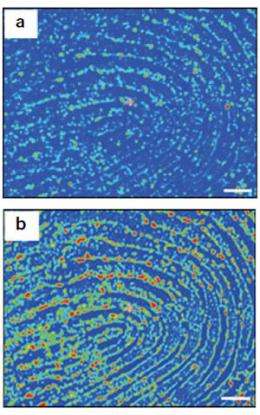
FTIRM images generated from a child's fingerprint, showing the protein in the fingerprint.

(PhysOrg.com) -- Children's fingerprints disappear faster than those of adults -- a little-known fact that can hamper investigations of kidnapping cases. To investigate this phenomenon, a team of researchers used beams of infrared light at Brookhaven's National Synchrotron Light Source (NSLS) as a powerful detective's microscope, finding that fingerprint staying power is based on the amount and types of oil in your skin.

Forensic scientists often use techniques like magnetic filings dusting, iodine, and cyanoacrylate fuming to see otherwise invisible, or latent, . Although efficient, inexpensive, and relatively fast, these methods make it difficult to preserve trace evidence found in a fingerprint. This is particularly difficult with aged fingerprints left by children, which have been shown to fade faster than those of adults, making them almost impossible to capture.

"Previous research has linked the difference in the longevity of fingerprints to the type of oil found in a person's skin," said NSLS biophysicist Lisa Miller, one of the authors of the study. "This oil, known as sebum, is just one of the components of a fingerprint, which also can contain small pieces of skin and sweat residue. We wanted to determine how these fingerprint components change over time in adults and children, and how these changes alter our ability to predict someone's age based on their fingerprint."

Using a collection of latent fingerprints given by six father (ages 35-45) and son (ages 7-10) pairs, the researchers watched for chemical changes over the course of four weeks. Twice a week, one fingerprint from each participant was dusted, lifted, and analyzed based on the number of features, or minutiae, visible. At the same time, a non-invasive synchrotron technique called Fourier transform infrared microspectroscopy (FTIRM) mapped the location and makeup of the skin and sebum in the prints.

"FTIRM is a very useful tool in this case because it allows us to examine individual fingerprint components — namely, skin and sebum — separately," Miller said.

At all points in time, the fathers' prints dusted darker than those from their sons. In fact, the fathers' prints remained virtually unchanged during the four-week study, while the fine minutiae of their children became increasingly more difficult to see.

The NSLS study, which was carried out at beamline U10B, helps researchers understand this disappearing act. As predicted by previous studies, FTIRM showed that adults produce more sebum than children, which leads to darker prints. "The more oily and moist your skin is, the better print you leave behind to be dusted and lifted," Miller said.

Researchers also found that the composition of the lipids, or fats, in sebum differ significantly between adults and children.

Adult sebum has higher concentrations of stable lipids such as squalene and wax esters, which are less likely to vaporize over time. Conversely, the sebum of children contains higher levels of cholesterol and branched chain free fatty acids — unstable lipids that break down more quickly.

The results, which appeared in the March 2010 edition of the Journal of Forensic Sciences, indicate that children's prints may disappear faster because they contain different oils. This could pave the path toward more advanced fingerprint detection techniques.

"Based on the differences in chemical composition, children's prints can still be distinguished from adults' prints with FTIRM even when the dusted copies are barely identifiable," Miller said. "To accurately determine the age of the print's individual, FTIRM should be used as a complementary tool to conventional forensic methods."

More information: K.M. Antoine, et al, "Chemical Differences are Observed in Children's Versus Adults' Latent Fingerprints as a Function of Time," J. Forensic Sci., 55(2), 513 (2010).

Provided by Brookhaven National Laboratory search and more info website

4.5 /5 (2 votes)  

Rank 4.5 /5 (2 votes)
Relevant PhysicsForums posts
  • why do trucks have bigger brakes?
    created4 hours ago
  • Solar Sail Physics - Do they work on a large scale?
    created5 hours ago
  • How should I switch an air conditioner off?
    created5 hours ago
  • Question about current decay in R-L circuit
    created6 hours ago
  • Elementary time - how does it work?
    created8 hours ago
  • How can squinting be used by both a myopic & hyperopic eye?
    created11 hours ago
  • More from Physics Forums - General Physics

More news stories

Landmark calculation clears the way to answering how matter is formed

(Phys.org) -- An international collaboration of scientists, including Thomas Blum, associate professor of physics, is reporting in landmark detail the decay process of a subatomic particle called a kaon – ...

Physics / General Physics

created May 25, 2012 | popularity 4.6 / 5 (18) | comments 46 | with audio podcast

Is a classical electrodynamics law incompatible with special relativity?

(Phys.org) -- The laws of classical electromagnetism that were developed in the 19th century are the same laws that scientists use today. They include Maxwell’s four equations along with the Lorentz la ...

Physics / General Physics

created May 24, 2012 | popularity 4.7 / 5 (15) | comments 35 | with audio podcast feature

Lying in wait for WIMPs: Researchers seek to dramatically increase sensitivity of Large Underground Xenon detector

Although it's invisible, dark matter accounts for at least 80 percent of the matter in the universe. No one knows what it is, but most scientists would bet on weakly interacting massive particles, or WIMPs.

Physics / General Physics

created May 23, 2012 | popularity 4 / 5 (7) | comments 15 | with audio podcast

Hall effect at the speed of light: How can you demonstrate relativistic effects with your mobile phone?

The relativistic Hall effect describing objects rotating at speeds comparable with the speed of light has been reported.

Physics / General Physics

created May 21, 2012 | popularity 4.3 / 5 (3) | comments 8

Cloak of invisibility: Engineers use plasmonics to create an invisible photodetector

A team of engineers at Stanford and the University of Pennsylvania has for the first time used "plasmonic cloaking" to create a device that can see without being seen - an invisible machine that detects light. It is the first ...

Physics / General Physics

created May 21, 2012 | popularity 4.8 / 5 (16) | comments 7 | with audio podcast


Dell tablet leak: 10.1-inch display, two-battery choice

(Phys.org) -- Headline after headline talks about vendors’ tablets in the wings as likely number-one contenders for the iPad. Such claims have justifiably been taken with a grain of salt, considering ...

Scientist: Evolution debate will soon be history

(AP) -- Richard Leakey predicts skepticism over evolution will soon be history. Not that the avowed atheist has any doubts himself.

Keep food safety in mind this memorial day weekend

(HealthDay) -- Picnics, parades and cookouts are as much a part of Memorial Day weekend as tributes to the United States' war veterans.

SpaceX capsule has 'new car' smell, astronauts say (Update)

SpaceX's Dragon cargo vessel smells like a new car, said astronauts at the International Space Station after opening the hatches Saturday following the spacecraft's landmark mission to the orbiting lab.

SpotterRF debuts Radar Backpack Kit (w/ Video)

(Phys.org) -- SpotterRF has announced a special radar backpack kit designed to enhance situational awareness for soldiers on the ground. The company says its special radar is designed for warfighters as part ...

Australia hails surprise super-telescope decision

Australia has hailed a surprise decision giving it a role in a radio telescope project aimed at revolutionising astronomy, vowing to draw on its decades of experience in space science.