Breakthrough for photons in the microwave frequency range
Photons in the microwave frequency range are important in quantum research - for quantum information processors, for example. Now, for the first time, researchers have achieved the controlled production of single photons in the microwave region and successfully detected them with highly sensitive measuring instruments - although they are 100,000 times weaker than the photons emitted by an electric light bulb.
When photons released by a conventional light or radiation source hit a detector, they trigger an electrical signal comparable to a single “click” of a Geiger counter, which rattles when radioactive particles strike it. However, unlike optical photons, until now there have been no detectors that can detect single photons at particularly low frequencies, such as the microwave frequency range. The intensity of these microwave photons is much too weak for this. The research group led by ETH Zurich Professor Andreas Wallraff from the Department of Physics has now been able to characterise such low-intensity photons even without any “clicking” detectors by using a special apparatus and method. Physicists need techniques of this kind, for example to research the fundamental principles of quantum mechanics or to enable efficient information transmission in optical data communication.
Detector and emitter in one
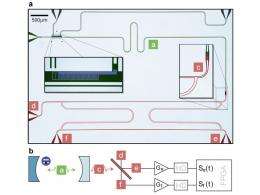
In the interdisciplinary collaboration between Wallraff’s group, the Master student Deniz Bozyigit from the Department of Information Technology and Electrical Engineering and Canadian scientists, the researchers integrated a light source that generates single microwave photons onto a microchip. The frequency range of these photons is a few gigahertz, similar to the electromagnetic radiation of mobile phones and microwave ovens. With this innovative arrangement, a single photon is generated with an accuracy controlled to within a few nanoseconds and at a total rate of two million times per second. The scientists also constructed a highly sensitive and efficient measuring device, similar to that used for optical photons, on the same microchip in order to show that this apparatus really does generate only single photons.
Only one way possible
In the case of optical photons, a half-mirrored beam splitter is used for this purpose. The photons can either be reflected or pass through the beam splitter, with equal probability. For each of these two alternatives there is a detector which identifies the reflected or transmitted photon. According to the laws of quantum mechanics, an individual photon generated by a photon source can never be half-reflected and half-transmitted. It must opt for one of the two alternatives. In this case the light is no longer described by its wave properties as in classical physics; the photons behave like particles. If only one of the detectors “clicks”, this proves that the source really does generate only single photons.
Wallraff explains how single photons have now been successfully recorded in this way even in the microwave frequency range: “Until now it was thought that these correlations – characterizing the properties of the photons and how they behave at a beam splitter – could be measured only if the detector detects the photons with a “click”, like a particle. Since the intensity of photons in the microwave frequency range is too weak for this, we amplify the signals of the incoming photons and then measure the amplitude of the field generated by the photons”. To cope with the immense volume of data from these measurements, amounting to more than 1,000 gigabytes per hour, the researchers also needed to develop an innovative system which can process this data in real time. From the statistics thus obtained, and by using the newly developed method, they were able to prove that only a single photon is emitted and, as expected, this took either one or the other of the possible routes.
Very promising for information processing
If it proves possible to manipulate and measure individual photons in the microwave frequency range, this measuring unit could become a component of a quantum computer: single photons strike a beam splitter and transmit information quantum mechanically across an integrated microchip, and are then detected. According to the physicist, this could allow information processing procedures to be carried out more efficiently in the future.
More information: Bozyigit D et al.: Antibunching of microwave-frequency photons observed in correlation measurements using linear detectors, Nature Physics 7, 154–158 (2011) doi:10.1038/nphys1845
Provided by ETH Zurich


