Shear brain power - sheep smarter than previously believed
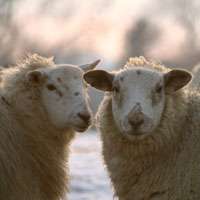
Credit: James Bowe
(PhysOrg.com) -- Scientists at the University of Cambridge have discovered that sheep are more intelligent than previously believed.
Despite having a comparable brain size to other highly evolved animals, sheep have been historically perceived as unintelligent and were therefore not considered to be good animal models for studying diseases that affect learning and memory.
However, new research recently published in the journal PLoS ONE shows that sheep are indeed smarter than previously believed. The researchers are hopeful the animals will prove useful for research into diseases that impair the cognitive abilities of patients, such as Huntington's disease (HD) and Alzheimer's disease.
"A new line of genetically modified sheep developed by researchers in New Zealand and Australia which carries the defective gene for HD has given us some unique opportunities to research treatments for this debilitating disease," said Professor Jenny Morton, a University of Cambridge researcher who specialises in HD. "However, if we are going to test the cognitive function in the HD sheep, first we need to understand how the brain works in a normal sheep."
The scientists posed a series of challenging tests similar to ones used to assess cognitive impairments of humans suffering from HD. The tests for the sheep involved making choices that were cued by different coloured or shaped objects, with feed as an incentive. These were each mastered in turn by the sheep. For example, in the first and easiest trial the sheep was presented with a blue bucket containing food and an empty yellow bucket. After a few trials they went automatically to the blue bucket.
Previous research has shown that sheep not only have good memories for faces. This study shows that they also can discriminate colour and shape as separate dimensions.
"The sheep were very amenable to the testing," said Professor Jenny Morton, who conducted the study while she was a Royal Society Leverhulme Senior Research Fellow. "They have an agreeable disposition which lends itself well to being used for such experiments."
The next stage of the research will be to test the Huntington's disease sheep, to see if, like human patients, they also have cognitive deficits.
Provided by
University of Cambridge
-
From lemons to lemonade: Reaction uses carbon dioxide to make carbon-based semiconductor,
30 comments
-
Thioridazine kills cancer stem cells in human while avoiding toxic side-effects of conventional cancer treatments,
3 comments
-
SpaceX private rocket blasts off for space station (Update),
42 comments
-
Climate scientists say they have solved riddle of rising sea,
30 comments
-
Delphi gasoline-injection engine technique rivals hybrid's edge,
37 comments
-
What would stain as translucent on light-coloured fabric?
2 hours ago
-
How do I identify different bacteria on culture plates?
12 hours ago
-
Why Do Dogs do Strange things...
May 25, 2012
-
What does exophillic and endophillic mean in terms of mosquito and their control?
May 24, 2012
-
Semen stains glows under black lights (uv light)?
May 23, 2012
-
Question on Human Chromosome 2
May 23, 2012
- More from Physics Forums - Biology
More news stories
Scientist: Evolution debate will soon be history
(AP) -- Richard Leakey predicts skepticism over evolution will soon be history. Not that the avowed atheist has any doubts himself.
1 hour ago |
3.5 / 5 (4) |
2
Thousands of shellfish found dead in Peru
Thousands of crustaceans were found dead off the coast of Lima following the mystery mass death of dolphins and pelicans, the Peruvian Navy said Friday.
11 hours ago |
4.8 / 5 (4) |
5
More plant species responding to global warming than previously thought
(Phys.org) -- Far more wild plant species may be responding to global warming than previous large-scale estimates have suggested.
May 22, 2012 |
4.6 / 5 (14) |
18
|
Totally rad: Scientists create rewritable digital data storage in DNA
(Phys.org) -- Scientists from Stanford's Department of Bioengineering have devised a method for repeatedly encoding, storing and erasing digital data within the DNA of living cells.
May 21, 2012 |
4.9 / 5 (17) |
11
|
For monogamous sparrows, it doesn't pay to stray (but they do it anyway)
It's quite common for a female song sparrow to stray from her breeding partner and mate with the male next door, but a new study shows that sleeping around can be costly.
May 22, 2012 |
5 / 5 (1) |
7
|
Dell tablet leak: 10.1-inch display, two-battery choice
(Phys.org) -- Headline after headline talks about vendors tablets in the wings as likely number-one contenders for the iPad. Such claims have justifiably been taken with a grain of salt, considering ...
Keep food safety in mind this memorial day weekend
(HealthDay) -- Picnics, parades and cookouts are as much a part of Memorial Day weekend as tributes to the United States' war veterans.
SpaceX capsule has 'new car' smell, astronauts say (Update)
SpaceX's Dragon cargo vessel smells like a new car, said astronauts at the International Space Station after opening the hatches Saturday following the spacecraft's landmark mission to the orbiting lab.
SpotterRF debuts Radar Backpack Kit (w/ Video)
(Phys.org) -- SpotterRF has announced a special radar backpack kit designed to enhance situational awareness for soldiers on the ground. The company says its special radar is designed for warfighters as part ...
Australia hails surprise super-telescope decision
Australia has hailed a surprise decision giving it a role in a radio telescope project aimed at revolutionising astronomy, vowing to draw on its decades of experience in space science.
Astronomers seize last chance in lifetime for Venus Transit
Astronomers are gearing for one the rarest events in the Solar System: an alignment of Earth, Venus and the Sun that will not be seen for another 105 years.
Feb 21, 2011
Rank: 5 / 5 (2)
I can remember a pet sheep of mine once figured out how to unhinge an old gate by lifting it off with its head. Another sheep panicked when the dogs barked and tried to jump across a stream that was obviously too wide and almost drowned haha.
Feb 21, 2011
Rank: not rated yet
Feb 22, 2011
Rank: 5 / 5 (2)
An animal with less than that much learning capability can hardly exist. To survive without at least that much of "smartness", an animal would have to "know" everything it needs from birth. Including all the kinds of grass that are edible, precise lists of predators to avoid and non-predators to ignore, and where you can find food in each season.
If this were true and a new kind of predator emerged, then all the sheep would become food and die.
If this study shows that sheep are more "smart" than in previous studies, then the stupidity is with the previous scientists, not the animals.
Feb 22, 2011
Rank: 5 / 5 (1)
I believe the point of the bucket test is to see how or even if the sheep distinguish color. The article doesn't give detail, but I'm assuming the buckets would be positioned differently each time.