Taking brain-computer interfaces to the next phase (w/ Video)
February 17, 2011

Taking brain-computer interfaces to the next phase

Enlarge

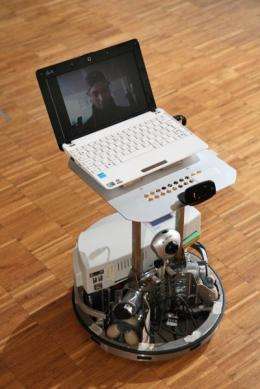
Robotino is a BCI distance-controlled robot to help disabled people interact with their surroundings developed at EPFL. Credit: Alain Herzog / EPFL

You may have heard of virtual keyboards controlled by thought, brain-powered wheelchairs, and neuro-prosthetic limbs. But powering these machines can be downright tiring, a fact that prevents the technology from being of much use to people with disabilities, among others. Professor Jose del R. Millan and his team at the Ecole Polytechnique Federale de Lausanne (EPFL) in Switzerland have a solution: engineer the system so that it learns about its user, allows for periods of rest, and even multitasking.

In a typical (BCI) set-up, users can send one of three commands – left, right, or no-command. No-command is the static state between left and right and is necessary for a brain-powered wheelchair to continue going straight, for example, or to stay put in front of a specific target. But it turns out that no-command is very taxing to maintain and requires extreme concentration. After about an hour, most users are spent. Not much help if you need to maneuver that wheelchair through an airport.

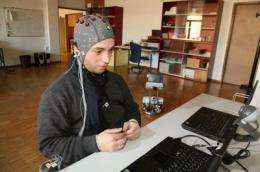
In an ongoing study demonstrated by Millan and doctoral student Michele Tavella at the AAAS 2011 Annual Meeting in Washington, D.C., the scientists hook volunteers up to BCI and ask them to read, speak, or read aloud while delivering as many left and right commands as possible or delivering a no-command. By using statistical analysis programmed by the scientists, Millán's BCI can distinguish between left and right commands and learn when each subject is sending one of these versus a no-command. In other words, the machine learns to read the subject's mental intention. The result is that users can mentally relax and also execute secondary tasks while controlling the BCI.

This video is not supported by your browser at this time.

José del R. Millán explains how "shared control" and probability theory are used to reduce fatigue, allowing BCI users to control the devices over longer periods of time.

The so-called Shared Control approach to facilitating human-robot interactions employs image sensors and image-processing to avoid obstacles. According to Millan, however, Shared Control isn't enough to let an operator to rest or concentrate on more than one command at once, limiting long-term use.

Millán's new work complements research on Shared Control and makes multitasking a reality while at the same time allows users to catch a break. His trick is in decoding the signals coming from EEG readings on the scalp—readings that represent the activity of millions of neurons and have notoriously low resolution. By incorporating statistical analysis, or probability theory, his BCI allows for both targeted control—maneuvering around an obstacle—and more precise tasks, such as staying on a target. It also makes it easier to give simple commands like "go straight" that need to be executed over longer periods of time (think back to that airport) without having to focus on giving the same command over and over again.
Taking brain-computer interfaces to the next phase
Enlarge

Robotino uses both "shared control" sensors and a recently developed system that uses probability theory to help users use the BCI for longer periods of time Credit: Alain Herzog / EPFL

It will be a while before this cutting-edge technology makes the move from lab to production line, but Millán's prototypes are the first working models of their kind to use probability theory to make BCIs easier to use over time. His next step is to combine this new level of sophistication with Shared Control in an ongoing effort to take BCI to the next level, necessary for widespread use. Further advancements, such as finer grained interpretation of cognitive information, are being developed in collaboration with the European project for Tools for Brain Computer. The multinational project is headed by Professor Millán and has moved into the clinical testing phase for several BCIs.

Provided by Ecole Polytechnique Federale de Lausanne

4.7 /5 (6 votes)  

Filter


Move the slider to adjust rank threshold, so that you can hide some of the comments.


Display comments: newest first

Eikka
Feb 17, 2011

Rank: 5 / 5 (1)
The problem is similiar to bashing random keys on a keyboard, but occasionally the user means something when they press a particular key.

Why not encode the commands into action sequences that are more easily distinguished from the noise because of their lower probability to occur?

If you see "alskdjaohdaforwardsödaklpdo", it's pretty easy to see what the intention is.
pauljpease
Feb 17, 2011

Rank: 5 / 5 (2)
I'm glad these BCI researchers have finally figured this out. After reading about the first generation of BCIs, I realized that they would be much more efficient if the computer uses it's computational ability to read intentions, thus simplifying the commands that the user needs to give. In other words, an AI makes decisions and the person controlling it just needs to do nothing if the AI is doing the right thing and indicate "NO!" if the AI guesses wrong. I think this is much more how our own brains operate. Some sub-region of my brain (below conscious level) is making decisions and guiding me, so doing normal tasks doesn't take any focus. As computers get smarter, they can figure out the right thing to do with less oversight from the user...
Rank 4.7 /5 (6 votes)
Relevant PhysicsForums posts

More news stories

SpotterRF debuts Radar Backpack Kit (w/ Video)

(Phys.org) -- SpotterRF has announced a special radar backpack kit designed to enhance situational awareness for soldiers on the ground. The company says its special radar is designed for warfighters as part ...

Technology / Hi Tech & Innovation

created 11 hours ago | popularity 5 / 5 (3) | comments 10 | with audio podcast report

Probability of contamination from severe nuclear reactor accidents is higher than expected: study

Catastrophic nuclear accidents such as the core meltdowns in Chernobyl and Fukushima are more likely to happen than previously assumed. Based on the operating hours of all civil nuclear reactors and the number ...

Technology / Energy & Green Tech

created May 22, 2012 | popularity 3.6 / 5 (19) | comments 50 | with audio podcast

Delphi gasoline-injection engine technique rivals hybrid's edge

(Phys.org) -- Running a diesel like engine on gasoline is something Delphi is doing in notable fashion. They claim they are on to a promising way to enjoy an engine that gives the vehicle owner high efficiency ...

Technology / Energy & Green Tech

created May 21, 2012 | popularity 4.7 / 5 (18) | comments 37 | with audio podcast report

HyperSolar shows dirty water no barrier to power world

(Phys.org) -- The Santa Barbara, California, company, HyperSolar, is set to transparently share the ups and downs of its research experiences toward the company’s ultimate vision, successfully producing ...

Technology / Energy & Green Tech

created May 24, 2012 | popularity 4.8 / 5 (14) | comments 17 | with audio podcast report

Tesla to launch electric sedan in US on June 22

Tesla Motors said Tuesday it would begin deliveries of "the world's first premium electric sedan" on June 22, slightly ahead of schedule.

Technology / Energy & Green Tech

created May 22, 2012 | popularity 4.5 / 5 (11) | comments 18


Dell tablet leak: 10.1-inch display, two-battery choice

(Phys.org) -- Headline after headline talks about vendors’ tablets in the wings as likely number-one contenders for the iPad. Such claims have justifiably been taken with a grain of salt, considering ...

Scientist: Evolution debate will soon be history

(AP) -- Richard Leakey predicts skepticism over evolution will soon be history. Not that the avowed atheist has any doubts himself.

Keep food safety in mind this memorial day weekend

(HealthDay) -- Picnics, parades and cookouts are as much a part of Memorial Day weekend as tributes to the United States' war veterans.

SpaceX capsule has 'new car' smell, astronauts say (Update)

SpaceX's Dragon cargo vessel smells like a new car, said astronauts at the International Space Station after opening the hatches Saturday following the spacecraft's landmark mission to the orbiting lab.

Australia hails surprise super-telescope decision

Australia has hailed a surprise decision giving it a role in a radio telescope project aimed at revolutionising astronomy, vowing to draw on its decades of experience in space science.

Thousands of shellfish found dead in Peru

Thousands of crustaceans were found dead off the coast of Lima following the mystery mass death of dolphins and pelicans, the Peruvian Navy said Friday.