Anthropologists discover earliest cemetery in Middle East
February 2, 2011

Anthropologists discover earliest cemetery in Middle East

Enlarge

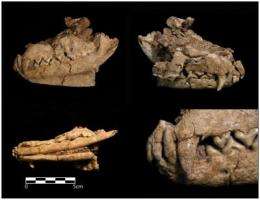
This is the red fox skull from Grave I at 'Uyun al-Hammam in Jordan after conservation and reconstruction. Credit: Lisa Maher et al.

Anthropologists at the University of Toronto and the University of Cambridge have discovered the oldest cemetery in the Middle East at a site in northern Jordan. The cemetery includes graves containing human remains buried alongside those of a red fox, suggesting that the animal was possibly kept as a pet by humans long before dogs ever were.

The 16,500-year-old site at 'Uyun al-Hammam was discovered in 2000 by an expedition led by University of Toronto professor Edward (Ted) Banning and Lisa Maher, an assistant professor of anthropology at U of T and research associate at the University of Cambridge. "Recent have uncovered the remains of at least 11 individuals – more than known from all other sites of this kind combined," says Banning, of U of T's Department of .

Previous research had identified the earliest cemeteries in the region in a somewhat later period (the Natufian, ca. 15,000-12,000 years ago). These were notable for instances of burials of humans with dogs. One such case involved a woman buried with her hand on a puppy, while another included three humans buried with two dogs along with tortoise shells. However, this new research shows that some of these practices occurred earlier.

Most of the individuals buried at the Jordan site were found with what are known as "grave goods," such as stone tools, a bone spoon, animal parts, and red ochre (an iron mineral). One grave contained the skull and right upper arm bone of a red fox, with red ochre adhered to the skull, along with bones of deer, gazelle and wild cattle. Another nearby grave contained the nearly complete skeleton of a , missing its skull and right upper arm bone, suggesting that portions of a single fox had been moved from one grave to another in prehistoric times.

"What we appear to have found is a case where a fox was killed and buried with its owner," says Maher, who directs excavations at the site. "Later, the grave was reopened for some reason and the human's body was moved. But because the link between the fox and the human had been significant, the fox was moved as well."

The researchers say that it could suggest that foxes were at one time treated in much the same way as dogs, in that there could have been early attempts to tame foxes, but no successful domestication. Studies have shown that foxes can be brought under human control but is not easily done given their skittish and timid nature, which may explain why dogs ultimately achieved "man's best friend" status instead.

"However, it is also noteworthy that the graves contain other animal remains, so we can only take the fox-dog analogy so far," says Banning. "We should remember that some more recent hunter-gatherers consider themselves to have social relationships with a wide range of wild animals, including ones they hunt, and that this sometimes led to prescribed ways to treat the remains of animals, as well as to represent relationships between particular humans and particular animals." Banning says that the "pet" hypothesis is only one among several, which happens to fit with modern preconceptions about human-dog relationships.

Either way, because the same grave that held the fox remains also contained other bones, Banning says that the find holds important clues about burial methods of civilizations past.

"These were unusually dense and diverse concentrations of bones, and indicate very early mortuary practices that involved interring selected animal remains with humans," says Banning. "The site has implications both for our understanding of the development of ideas about death and mortuary practice, and for our understanding of the beginnings of domestication of dog-like animals."

Provided by University of Toronto search and more info website

4.4 /5 (12 votes)  

Filter


Move the slider to adjust rank threshold, so that you can hide some of the comments.


Display comments: newest first

kevinrtrs
Feb 02, 2011

Rank: 1 / 5 (10)
What are the indicators that show that the discoveries are graves? That is an important question to have an answer to.

There is another explanation that warrants attention, namely that it is possibly a find of graves[if it was that] of people who lived before the great global flood. In this case it is possible that what we now consider to be wild animals could be buried with their owners. The reason is that animals only became fearful of human beings AFTER the flood.

The reason for asking whether these are really graves is that there is a possibility that it might have been a catastrophic flood swept together-burial of animals and humans in the same place after being killed elsewhere separately.

Richarydoo
Feb 02, 2011

Rank: 5 / 5 (4)
The reason is that animals only became fearful of human beings AFTER the flood.


And snakes could talk too. "And after the flood god saideth unto his Creatures - 'Taketh thine selves frometh these naughty Children O'mine. For they haveth offendedeth me and they shall henceforth be the smelly child in the class no-one wants to play with.' To which the animals of the world responded 'Baaaeth, Moooeth, Roareth, and Squeeketh' and played with the humans no more."
Terrible_Bohr
Feb 02, 2011

Rank: 5 / 5 (7)
The reason for asking whether these are really graves is that there is a possibility that it might have been a catastrophic flood swept together-burial of animals and humans in the same place after being killed elsewhere separately.

You should probably find some physical evidence for the biblical flood before you start to wonder if these graves were the result of it.

These are pretty common practices among early human burials: symbolic animal remains, tools, and good old red ochre. You argue for a random scattering with a torrent of water, but these type of items tend to clump together in the fossil record. Then you have the woman resting her hand on her puppy. The bones in these graves tend to be found posed, not with limbs flailing wildly. They were purposely buried.
Telekinetic
Feb 02, 2011

Rank: 5 / 5 (2)
I'd like kevinrtrs to defend me in my murder trial:

"Your honor, ladies and gentlemen of the jury, my client was target shooting when a giant tidal wave knocked his arm..."
Ethelred
Feb 03, 2011

Rank: 5 / 5 (4)
What are the indicators that show that the discoveries are graves?
Someone dug a hole and put a body in it. What the heck do you want. A sign?

< KEVIN THIS IS A GRAVE >

Is that what you need?
of people who lived before the great global flood.
No. If you want to use the Bible you just have to pretend that those things don't exist as they were not only buried before the Flood they were buried before the Earth was created according to any Bible based timeline.

So just when was the Flood you are so certain off yet have no evidence for?

Ethelred
barakn
Feb 03, 2011

Rank: 5 / 5 (1)
I like how Kevin thinks that after the fox and the human died in a flood, someone thoughtfully skinned the fox and painted its skull with ochre, then placed it with the human. Come to think of it, it had to be Noah or one of his sons or their wives. Now why they would have come hundreds of kilometers to perform that act for those specific individuals when there were millions of other dead bodies lying around is beyond me.
Bog_Mire
Feb 03, 2011

Rank: 5 / 5 (1)
kev, it seems you read and take an interest in quite a lot of articles on this site. Aren't you starting to wonder about your brainwa..err beliefs a little? The evidence is kind of overwhelming. And I also wonder: are you trying to convert people to your way of thinking, or are you merely trolling?
dollymop
Feb 03, 2011

Rank: 5 / 5 (1)
I was just reading a book on geography and human development (Europe Between the Oceans 9000BC-AD 1000), that describes the geology of the Black Sea - a huge freshwater lake, fed by glacier melt. For a time it may have spilled fresh water into the Mediterranean over a spillway - then it stopped rising. Over the same 5000 years since the end of the last big glaciation, the Med kept rising, until about 5500 BCE, when the Med broke through the dry spillway of the Bosphorus in the other direction. At that time the Med was about 500' above the surface of the Black Sea. It appears to have happened suddenly. Water flooded in and drowned a great deal of the low northern shore of the Black Sea area - well within agricultural times. I don't believe the legends literally, but it does seem that the tales of a great flood, which were finally written down in early Mesopotamia and other cultures of that area very early on, might well have had their beginnings in a disaster like this.
Terrible_Bohr
Feb 03, 2011

Rank: 5 / 5 (3)
@ dollymop:
I've heard of this flood you speak of, and I agree it could very well be the inspiration for numerous culture's myths. What I dispute is the idea that there was a flood, like the biblical one, that inundated the entire Earth.
dollymop
Feb 03, 2011

Rank: 5 / 5 (3)
@TB:
Agreed. I have a problem with myths that break the known laws of physics, or go counter to provable science and history. But as a study of legend, human behavior, literature and imagination - they are fun and very interesting.
googleplex
Feb 06, 2011

Rank: 5 / 5 (2)
The fact that it says graves indicates that the sites were cut into natural ground/rock. Floods do not generally dig holes to place bodies in.
Also bodies in graves such as this tend to be ritually positioned in a consistent manner. Also grave goods are very common in ancient graves. I find the conjecture that the foxes were domesticated a stretch, unless there is more evidence than the article gives.
Rank 4.4 /5 (12 votes)
Relevant PhysicsForums posts

More news stories

Social welfare cuts ultimately come with heavy price, researchers say

(Phys.org) -- Slashing government funding for Medicaid, food stamps and other programs that serve the poor – while politically popular with some lawmakers and many conservatives – may do more harm ...

Other Sciences / Social Sciences

created May 24, 2012 | popularity 4.1 / 5 (13) | comments 101

Ancient Bethlehem seal unearthed in Jerusalem

Israeli archaeologists have discovered a 2,700-year-old seal that bears the inscription "Bethlehem," the Israel Antiquities Authority announced Wednesday, in what experts believe to be the oldest artifact ...

Other Sciences / Archaeology & Fossils

created May 23, 2012 | popularity 3.5 / 5 (14) | comments 23

Oldest Jewish archaeological evidence on the Iberian Peninsula

German archaeologists of the Friedrich Schiller University Jena found one of the oldest archaeological evidence so far of Jewish Culture on the Iberian Peninsula at an excavation site in the south of Portugal, ...

Other Sciences / Archaeology & Fossils

created May 25, 2012 | popularity 4.3 / 5 (4) | comments 12

Dollars and sense: Why are some people morally against tax?

As the U.S. presidential election campaigns heat up, the economic debate is dominated by bailouts, austerity and, inevitably, taxation. Now a new study published in Symbolic Interaction asks why tax is such an important issue ...

Other Sciences / Social Sciences

created May 23, 2012 | popularity 3 / 5 (2) | comments 12

Oldest art even older

New dates from Geißenklösterle Cave in Southwest Germany document the early arrival of modern humans and early appearance of art and music.

Other Sciences / Archaeology & Fossils

created May 24, 2012 | popularity 5 / 5 (2) | comments 6


Dell tablet leak: 10.1-inch display, two-battery choice

(Phys.org) -- Headline after headline talks about vendors’ tablets in the wings as likely number-one contenders for the iPad. Such claims have justifiably been taken with a grain of salt, considering ...

Scientist: Evolution debate will soon be history

(AP) -- Richard Leakey predicts skepticism over evolution will soon be history. Not that the avowed atheist has any doubts himself.

Keep food safety in mind this memorial day weekend

(HealthDay) -- Picnics, parades and cookouts are as much a part of Memorial Day weekend as tributes to the United States' war veterans.

SpaceX capsule has 'new car' smell, astronauts say (Update)

SpaceX's Dragon cargo vessel smells like a new car, said astronauts at the International Space Station after opening the hatches Saturday following the spacecraft's landmark mission to the orbiting lab.

SpotterRF debuts Radar Backpack Kit (w/ Video)

(Phys.org) -- SpotterRF has announced a special radar backpack kit designed to enhance situational awareness for soldiers on the ground. The company says its special radar is designed for warfighters as part ...

Australia hails surprise super-telescope decision

Australia has hailed a surprise decision giving it a role in a radio telescope project aimed at revolutionising astronomy, vowing to draw on its decades of experience in space science.