Virginia Tech engineers work with InterDigital to increase wireless speed, accessibility
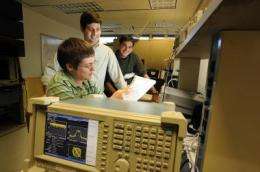
In the first phase of a more than two-year study funded by InterDigital, Virginia Tech researchers have made great strides in the development of more reliable and efficient spectrum sensing techniques that will be needed to meet the ever-expanding demand for wireless technologies.
"The U.S. government has noted that broadband wireless access technologies are a key foundation for economic growth, job creation, global competitiveness, and a better way of life," explained Claudio da Silva, an assistant professor in Virginia Tech's Bradley Department of Electrical and Computer Engineering. He was referring to a recent report by the Federal Communications Commission on the need to ensure all Americans have access to broadband capability http://www.broadband.gov/download-plan/.
These spectrum-sensing technologies are envisioned to support high speed internet in rural areas, enable the creation of super Wi-Fi networks, and support the implementation of smart grid technologies. However, implementation of these technologies is seen as the "the greatest infrastructure challenge of the 21st century," according to the commission's report.
A major key to solving this challenge is in the design of wireless systems that more efficiently use the limited radio spectrum resources, said da Silva. "As a means to achieve this goal, the U.S. government, through the Federal Communications Commission, has recently finalized rules to make the unused spectrum in the television band available to unlicensed broadband wireless systems. In these systems, devices first identify underutilized spectrum with the use of spectrum databases and/or spectrum sensing and then, following pre-defined rules, dynamically access the "best" frequency bands on an opportunistic and non-interfering basis."
"The U.S. government has plans to release even more spectrum for unlicensed broadband wireless access," added da Silva. "While sensing is not a requirement for television band access, the Federal Communications Commission is encouraging the continued development of spectrum sensing techniques for potential use in these new bands."
"InterDigital's advanced wireless technology development efforts compliment this work at Virginia Tech," added James J. Nolan, InterDigital's executive vice-president of research and development. "We see the evolution of wireless systems to dynamic spectrum management technologies as being key to solving the looming bandwidth supply-demand gap by more efficiently leveraging lightly used spectrum. These cognitive radio technologies are an integral part of our holistic bandwidth management strategy, and we have invested significantly in this area of research."
During the first phase of the study, "by exploiting location-dependent signal propagation characteristics, we have developed efficient sensing algorithms that enable a set of devices to work together to determine spectrum opportunities", said William Headley, of Ringgold, Va., one of the Ph.D. students working on this project.
For the second year of the study, the focus is changing to the design of spectrum sensing algorithms that are robust to both man-made noise and severe multipath fading. "The vast majority of sensing algorithms were developed for channels in which the noise is a Gaussian process," said Gautham Chavali, of Blacksburg, Va., the second Ph.D. student working on this project. "However, experimental studies have shown that the noise that appears in most radio channels is highly non-Gaussian," Chavali added.
" Man-made noise, which arises from incidental radiation of a wide range of electrical devices, for example, is partially responsible for this occurrence," Chavali said. In addition, the algorithms to be designed will not rely on the common, but impractical, assumption of perfect synchronization and equalization by the radio front-end, which is an important concern when dealing with realistic multipath fading channels, such as indoor environments.
Provided by Virginia Tech


