Verizon reveals first 4G wireless tablets, phones (Update)
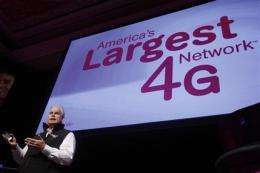
(AP) -- This year, the big national wireless carriers will be racing to stake their claims in the new frontier of service: ultra-fast data access - for smart phones and laptops as well as for gadgets like tablets.
The companies are boosting their wireless data speeds and revving up the marketing hype. They're moving away from talking about call quality and coverage, and focusing on data speeds: megabits in place of minutes. For consumers, there are benefits in the form of faster service and cooler gadgets. Yet some of the marketing campaigns seem designed to confuse consumers about the gadgets' speed.
At the International Consumer Electronics Show in Las Vegas this week, Verizon Wireless revealed the 10 gadgets with built-in access to its new high-speed wireless data network, including smart phones, tablet and laptops. Some are to launch as early as March.
Along with Sprint Nextel Corp.'s subsidiary Clearwire Corp., Verizon is at the forefront of the move to a new network technology, designed to relay data rather than calls. Verizon's fourth-generation, or "4G" network, went live for laptop modems in last month.
The new wireless network is the nation's fastest. Verizon is hoping to cash in on that advantage by selling tablets and smart phones that devour data.
One of the devices, Motorola Mobility Inc.'s Xoom tablet, will come with a 10.1-inch screen and two cameras: one for video chatting, the other for high-definition videos. The Xoom will begin selling by March. Initially, it will work with Verizon's 3G network but will be upgradeable to work on the speedier 4G network.
Motorola's Droid Bionic smart phone will also have two cameras, to help with videoconferencing, a data-hungry task. It will be one of the first phones with a so-called "dual-core processor" that will roughly double its computing capacity. That should help with video processing.
LG Electronics Inc., Samsung Electronics Co. and HTC Corp. are bringing out similar phones for the network. Hewlett-Packard Co. is adding 4G capability to a laptop and a netbook.
There will also be two "mobile hotspot" devices for the network: small battery-powered bricks that act as Wi-Fi access points, connecting Wi-Fi-equipped computers to the 4G network.
Verizon didn't reveal what the new devices or wireless plans will cost.
Verizon's size - by number of subscribers, it's the largest U.S. wireless carrier - and the quality of its network are helping it gain traction with manufacturers.
"By deciding to go early and go first to (4G), we sent a signal to the entire consumer electronics market that this technology would develop very quickly," said Lowell McAdam, Verizon's president and chief operating officer, in a keynote address at the trade show Thursday.
There's speculation that Verizon will get to sell a version of Apple Inc.'s iPhone this year. That would break AT&T Inc.'s exclusive hold on the most popular smart phone. But there was no talk of an iPhone from Verizon at Thursday's events.
With or without the iPhone, Verizon's new network is pressuring its competitors to step up their offerings. AT&T Inc. on Wednesday said it's on track to launch its own 4G network this summer. Also, it said it will start calling its current 3G network "4G," since it's been upgraded to be capable of nearly 4G speeds.
T-Mobile USA said Thursday that it will upgrade its 3G network to double the possible download speeds in two-thirds of its coverage area. It started calling the network "4G" in ads last fall. It, too, revealed two tablets for its network, to launch later this year.
Sprint and Clearwire have chosen a slightly different route to 4G. They've picked a 4G technology called WiMax that was ready before Long Term Evolution, or LTE, which Verizon is using.
Now, however, WiMax looks set to be a niche technology, while the rest of the industry adopts LTE. That will hamper Sprint's efforts to get competitive devices for the network. Still, it was able to launch its first 4G phone last summer, ahead of the competition. On Wednesday, it announced it would be the first to carry a 4G tablet computer from Research In Motion Ltd., the maker of the BlackBerry, some time this summer.
The most distinctive feature of 4G technologies like LTE and WiMax is that they're designed to carry data rather than phone calls. That makes them more efficient at serving today's smart phones, tablets and other gadgets that need data access on the go. It also makes the networks cheaper to build out and manage.
They're faster than today's 3G networks, though not by much, which makes T-Mobile and AT&T feel justified in calling their upgraded 3G networks "4G." After all, they say, speed is what really matters to users.
Aside from the bump in speed, the main reason the LTE buildouts of Verizon Wireless and AT&T significant is that they add fresh spectrum to the nation's wireless networks. That means more capacity for the growing number of mobile gadgets.
Also, both companies are using spectrum that was previously used for UHF TV channels, a prime piece of the airwaves. It can cover wide areas easily and penetrate deep into buildings. (Clearwire's WiMax network uses a frequency that has shorter range and more difficulty penetrating buildings.)
Future upgrades can further boost the speed of wireless networks. But at some point, they will run out of room for improvement. There's a theoretical limit for how much information a certain slice of the airwaves can carry. When that happens, there will still be two ways to add capacity to wireless broadband.
The government can assign more spectrum, perhaps by taking it from TV stations. But spectrum, too, will run out. The carriers can add more cell towers, but that's expensive and difficult. They can't put cell towers everywhere they'd like.
Given these limiting factors, wireless broadband isn't likely to ever replace wireline connections for home broadband, except possibly in rural areas where it's expensive to draw cables for high-speed connections to homes.
The U.S. is at the forefront in the international race to LTE. Verizon's buildout is the world's largest. The U.S. was faster than most other countries in taking back airwaves from TV stations and selling it off for wireless broadband.
Another reason Verizon has been aggressive about LTE is that its 3G network uses a technology that isn't upgradable to higher speeds as AT&T's and T-Mobile's are. That's left it with a burning need for the next network technology.
Verizon Wireless is a joint venture of Verizon Communications Inc. and Vodafone Group PLC of Britain. Motorola Mobility Inc. was formed this week as Motorola Inc. split into two parts. The Mobility consists of the cell phone business.
©2010 The Associated Press. All rights reserved. This material may not be published, broadcast, rewritten or redistributed.


