Universal solvent no match for new self-healing sticky gel
January 27, 2011

Universal solvent no match for new self-healing sticky gel

Enlarge

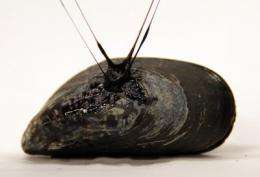
Mussels can generate their own self-healing sticky material, which allows them to attach to rocks and to repair microtears caused by breaking waves and sand abrasion, but the elastic gel attached to this one was created in the laboratory. A patent is pending on the gel, which is described online in this week’s Proceedings of the National Academy of Sciences Early Edition. Credit: Tara Fadenrecht, Niels Holten-Andersen

Scientists can now manufacture a synthetic version of the self-healing sticky substance that mussels use to anchor themselves to rocks in pounding ocean surf and surging tidal basins. A patent is pending on the substance, whose potential applications include use as an adhesive or coating for underwater machinery or in biomedical settings as a surgical adhesive or bonding agent for implants.

Inspiring the invention were the hair-thin holdfast fibers that mussels secrete to stick against rocks in lakes, rivers and oceans. "Everything amazingly just self-assembles underwater in a matter of minutes, which is a process that's still not understood that well," said Niels Holten-Andersen, a postdoctoral scholar with chemistry professor Ka Yee Lee at the University of Chicago.

Holten-Andersen, Lee and an international team of colleagues are publishing the details of their invention this week in the Early Edition. Holten-Andersen views the evolution of life on Earth as "this beautiful, amazingly huge experiment" in which natural selection has enabled organisms to evolve an optimal use of materials over many millions of years.

"The mussels that live right on the coast where the waves really come crashing in have had to adapt to that environment and build their materials accordingly," he said.

Many existing synthetic coatings involve a compromise between strength and brittleness. Those coatings rely on permanent covalent bonds, a common type of that is held together by two atoms that share two or more electrons. The bonds of the mussel-inspired material, however, are linked via metals and exhibit both strength and reversibility.

"These metal bonds are stable, yet if they break, they automatically self-heal without adding any extra energy to the system," Holten-Andersen said.

A key ingredient of the material is a polymer, which consists of long chains of molecules, synthesized by co-author Phillip Messersmith of Northwestern University. When mixed with metal salts at low pH, the appears as a green solution. But the solution immediately transforms into a gel when mixed with sodium hydroxide to change the pH from high acidity to high alkalinity.

"Instead of it being this green solution, it turned into this red, self-healing sticky gel that you can play with, kind of like Silly Putty," he said. Holten-Andersen and his colleagues found that the gel could repair tears within minutes.

"You can change the property of the system by dialing in a pH," said Ka Yee Lee, a professor in chemistry at UChicago and co-author of the PNAS paper. The type of metal ion (an electrically charged atom of, for example. iron, titanium or aluminum) added to the mix provides yet another knob for tuning the material's properties, even at the same pH.
Universal solvent no match for new self-healing sticky gel
Enlarge

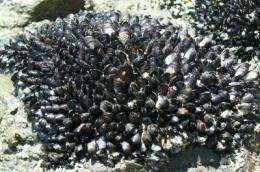
The sticky material that mussels have evolved has inspired an international team of scientists to design a new artificial, self-healing gel that lends itself to underwater applications. The mussels pictured here are attached to a rock on Onetangi Beach of Waiheke Island, New Zealand. Credit: Steve Koppes

"You can tune the stiffness, the strength of the material, by now having two knobs. The question is, what other knobs are out there?" Lee said.

This week's PNAS study reports the most recent in a series of advances related to sticky mussel fibers that various research collaborations have posted in recent years. A 2006 PNAS paper by Haeshin Lee, now of the Korea Advanced Institute of Technology, Northwestern's Phillip Messersmith and UChicago's Norbert Scherer demonstrated an elusive but previously suspected fact. Using atomic-force microscopy, they established that an unusual amino acid called "dopa" was indeed the key ingredient in the adhesive protein mussels use to adhere to rocky surfaces.

Last year in the journal Science, scientists at Germany's Max Planck Institute documented still more details about mussel-fiber chemical bonds. The Max Planck collaboration included Holten-Andersen and Herbert Waite of the University of California, Santa Barbara. Holten-
Andersen began researching the hardness and composition of mussel coatings as a graduate student in Waite's laboratory.

"Our aspiration is to learn some new design principles from nature that we haven't yet actually been using in man-made materials that we can then apply to make man-made materials even better," he said.

Being able to manufacture green materials is another advantage of drawing inspiration from nature. "A lot of our traditional materials are hard to get rid of once we're done with them, whereas nature's materials are obviously made in a way that's environmentally friendly," Holten-Andersen said.

More information: "pH-induced metal-ligand cross-links inspired by mussel yield self-healing polymer networks with near-covalent elastic moduli," by Niels Holten-Andersen, Matthew J. Harrington, Henrik Birkedal, Bruce P. Lee, Phillip B. Messersmith, Ka Yee C. Lee, and J. Herbert Waite, Proceedings of the National Academy of Sciences Early Edition, Jan. 24, 2011.

Provided by University of Chicago search and more info website

4.8 /5 (10 votes)  

Filter


Move the slider to adjust rank threshold, so that you can hide some of the comments.


Display comments: newest first

shavera
Jan 27, 2011

Rank: 5 / 5 (1)
If the system properties change so much over these "knobs" could it also be possible to change the pH of the water near a boat (say in a dock) to cause the mussels bound to it to drop off? Just a question, I imagine there are a lot of secondary effects I'm not considering.
Ricochet
Jan 28, 2011

Rank: not rated yet
"Everything amazingly just self-assembles underwater in a matter of minutes, which is a process that's still not understood that well," said Niels Holten-Andersen, a postdoctoral scholar with chemistry professor Ka Yee Lee at the University of Chicago.

So, they created this substance, but they don't know how it works? So, I guess on the patent application they just put a "?" on that section?
pauljpease
Jan 28, 2011

Rank: not rated yet

So, they created this substance, but they don't know how it works? So, I guess on the patent application they just put a "?" on that section?


I don't think perfect understanding is necessary for a patent. For example, someone probably patented the design for a lead-acid battery at some point, and it was only recently discovered that the high voltage of such cells is actually generated through relativistic effects.
Rank 4.8 /5 (10 votes)
Relevant PhysicsForums posts
  • magnetic field from stream of protons
    created1 hour ago
  • Force on a particle constrained to move on the surface of a sphere
    created1 hour ago
  • Force in a magnetic coupling
    created11 hours ago
  • Sign of scalar product in electric potential integral?
    created18 hours ago
  • Heat engines: how can we yield work?
    created19 hours ago
  • Work done by us on the spring
    createdMay 25, 2012
  • More from Physics Forums - Classical Physics

More news stories

From lemons to lemonade: Reaction uses carbon dioxide to make carbon-based semiconductor

(Phys.org) -- A materials scientist at Michigan Technological University has discovered a chemical reaction that not only eats up the greenhouse gas carbon dioxide, it also creates something useful. And, by ...

Chemistry / Materials Science

created May 21, 2012 | popularity 4.7 / 5 (88) | comments 30 | with audio podcast

High-speed method to aid search for solar energy storage catalysts

Eons ago, nature solved the problem of converting solar energy to fuels by inventing the process of photosynthesis.

Chemistry / Materials Science

created May 25, 2012 | popularity 5 / 5 (3) | comments 4 | with audio podcast

New CO2-removing catalyst can take the heat

(Phys.org) -- The current method of removing the greenhouse gas carbon dioxide (CO2) from the flues of coal-fired power plants uses so much energy that no one bothers to use it. So says Roger Aines, principal ...

Chemistry / Materials Science

created May 24, 2012 | popularity 5 / 5 (7) | comments 7 | with audio podcast

Researchers demonstrate possible primitive mechanism of chemical info self-replication

(Phys.org) -- When scientists think about the replication of information in chemistry, they usually have in mind something akin to what happens in living organisms when DNA gets copied: a double-stranded molecule ...

Chemistry / Materials Science

created May 25, 2012 | popularity 5 / 5 (4) | comments 2 | with audio podcast

Castor oil: Action mechanism of one of the oldest drugs known to man elucidated

Castor oil is known primarily as an effective laxative; however, it was also used in ancient times with pregnant women to induce labour. Only now have scientists at the Max Planck Institute for Heart and Lung ...

Chemistry / Biochemistry

created May 21, 2012 | popularity 3 / 5 (2) | comments 3 | with audio podcast


Dell tablet leak: 10.1-inch display, two-battery choice

(Phys.org) -- Headline after headline talks about vendors’ tablets in the wings as likely number-one contenders for the iPad. Such claims have justifiably been taken with a grain of salt, considering ...

Scientist: Evolution debate will soon be history

(AP) -- Richard Leakey predicts skepticism over evolution will soon be history. Not that the avowed atheist has any doubts himself.

Keep food safety in mind this memorial day weekend

(HealthDay) -- Picnics, parades and cookouts are as much a part of Memorial Day weekend as tributes to the United States' war veterans.

SpaceX capsule has 'new car' smell, astronauts say (Update)

SpaceX's Dragon cargo vessel smells like a new car, said astronauts at the International Space Station after opening the hatches Saturday following the spacecraft's landmark mission to the orbiting lab.

SpotterRF debuts Radar Backpack Kit (w/ Video)

(Phys.org) -- SpotterRF has announced a special radar backpack kit designed to enhance situational awareness for soldiers on the ground. The company says its special radar is designed for warfighters as part ...

Australia hails surprise super-telescope decision

Australia has hailed a surprise decision giving it a role in a radio telescope project aimed at revolutionising astronomy, vowing to draw on its decades of experience in space science.