Polymer membranes with molecular-sized channels that assemble themselves
(PhysOrg.com) -- Many futurists envision a world in which polymer membranes with molecular-sized channels are used to capture carbon, produce solar-based fuels, or desalinating sea water, among many other functions. This will require methods by which such membranes can be readily fabricated in bulk quantities. A technique representing a significant first step down that road has now been successfully demonstrated.
Researchers with the U.S. Department of Energy's Lawrence Berkeley National Laboratory (Berkeley Lab) and the University of California (UC) Berkeley have developed a solution-based method for inducing the self-assembly of flexible polymer membranes with highly aligned subnanometer channels. Fully compatible with commercial membrane-fabrication processes, this new technique is believed to be the first example of organic nanotubes fabricated into a functional membrane over macroscopic distances.
"We've used nanotube-forming cyclic peptides and block co-polymers to demonstrate a directed co-assembly technique for fabricating subnanometer porous membranes over macroscopic distances," says Ting Xu, a polymer scientist who led this project. "This technique should enable us to generate porous thin films in the future where the size and shape of the channels can be tailored by the molecular structure of the organic nanotubes."
Xu, who holds joint appointments with Berkeley Lab's Materials Sciences Division and the University of California Berkeley's Departments of Materials Sciences and Engineering, and Chemistry, is the lead author of a paper describing this work, which has been published in the journal ACS Nano. The paper is titled "Subnanometer Porous Thin Films by the Co-assembly of Nanotube Subunits and Block Copolymers." Co-authoring the paper with Xu were Nana Zhao, Feng Ren, Rami Hourani, Ming Tsang Lee, Jessica Shu, Samuel Mao, and Brett Helms, who is with the Molecular Foundry, a DOE nanoscience center hosted at Berkeley Lab.
Channeled membranes are one of nature's most clever and important inventions. Membranes perforated with subnanometer channels line the exterior and interior of a biological cell, controlling – by virtue of size – the transport of essential molecules and ions into, through, and out of the cell. This same approach holds enormous potential for a wide range of human technologies, but the challenge has been finding a cost-effective means of orienting vertically-aligned subnanometer channels over macroscopic distances on flexible substrates.
"Obtaining molecular level control over the pore size, shape, and surface chemistry of channels in polymer membranes has been investigated across many disciplines but has remained a critical bottleneck," Xu says. "Composite films have been fabricated using pre-formed carbon nanotubes and the field is making rapid progess, however, it still presents a challenge to orient pre-formed nanotubes normal to the film surface over macroscopic distances."
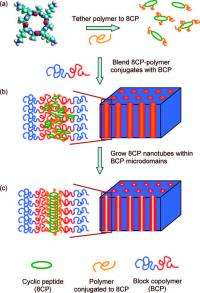
For their subnanometer channels, Xu and her research group used the organic nanotubes naturally formed by cyclic peptides - polypeptide protein chains that connect at either end to make a circle. Unlike pre-formed carbon nanotubes, these organic nanotubes are "reversible," which means their size and orientation can be easily modified during the fabrication process. For the membrane, Xu and her collaborators used block copolymers - long sequences or "blocks" of one type of monomer molecule bound to blocks of another type of monomer molecule. Just as cyclic peptides self-assemble into nanotubes, block copolymers self-assemble into well-defined arrays of nanostructures over macroscopic distances. A polymer covalently linked to the cyclic peptide was used as a "mediator" to bind together these two self-assembling systems
"The polymer conjugate is the key," Xu says. "It controls the interface between the cyclic peptides and the block copolymers and synchronizes their self-assembly. The result is that nanotube channels only grow within the framework of the polymer membrane. When you can make everything work together this way, the process really becomes very simple."
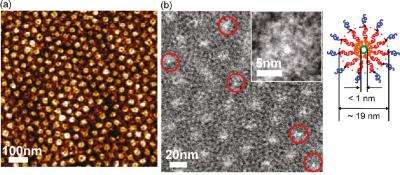
Xu and her colleagues were able to fabricate subnanometer porous membranes measuring several centimeters across and featuring high-density arrays of channels. The channels were tested via gas transport measurements of carbon dioxide and neopentane. These tests confirmed that permeance was higher for the smaller carbon dioxide molecules than for the larger molecules of neopentane. The next step will be to use this technique to make thicker membranes.
"Theoretically, there are no size limitations for our technique so there should be no problem in making membranes over large area," Xu says. "We're excited because we believe this demonstrates the feasibility of synchronizing multiple self-assembly processes by tailoring secondary interactions between individual components. Our work opens a new avenue to achieving hierarchical structures in a multicomponent system simultaneously, which in turn should help overcome the bottleneck to achieving functional materials using a bottom-up approach."
More information: A copy of the paper in ACS Nano paper “Subnanometer Porous Thin Films by the Co-assembly of Nanotube Subunits and Block Copolymers” is available at pubs.acs.org/doi/abs/10.1021/nn103083t
Provided by Lawrence Berkeley National Laboratory


