Communication pathways within proteins may yield new drug targets to stop superbugs
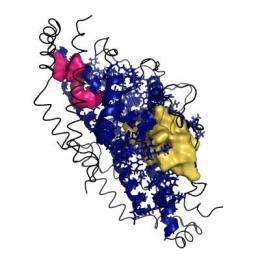
The enzyme chorismate mutase catalyzes an essential reaction in bacteria such as Myobacterium tuberculosis. Rigidity analysis of chorismate mustase from this tuberculosis causing bacteria reveals a rigid path (shown in blue) for communication between effector (shown in yellow) and catalytic (shown in pink) sites. A greater understanding of the coupling between these different sites suggests a means by which to control, inhibit or prevent the function of this enzyme. Credit: Andrew Rader, Ph.D., Department of Physics, School of Science, Indiana University-Purdue University Indianapolis
A School of Science at Indiana University-Purdue University Indianapolis biophysicist has developed a new method to identify communication pathways connecting distant regions within proteins.
With this tool, Andrew J. Rader, Ph.D., assistant professor of physics, has identified a mechanism for cooperative behavior within an entire molecule, a finding that suggests that in the future it may be possible to design drugs that target anywhere along the length of a molecule's communication pathway rather than only in a single location as they do today. The discovery holds promise for increasing the likelihood of therapeutic success.
The study, "Correlating Allostery with Rigidity" is published in the current issue of Molecular BioSystems, a journal of the Royal Society of Chemistry.
Microorganisms frequently contain enzymes, protein molecules that carry out most of the important functions of cells, not present in human cells. Blocking these enzymes can stop or kill a harmful invader.
Drugs are often developed to block or restrict the function of such enzymes, thereby treating the underlying infectious disease they convey. These drugs often target specific chemical sites on bacterial or viral enzymes, and alter the enzymes so they no longer function. Unfortunately, microorganisms can evolve enzymes that are impervious to these drugs, resulting in drug resistant organisms.
"With the growth of drug resistant organisms, it is increasingly important that we gain a better understanding of what makes enzymes within cellular proteins do what they do, so that we can develop alternative approaches to targeting these proteins, shutting down enzymes and killing these superbugs," said Rader, first author of the study.
He has found that the "poking" of one spot on the rigid pathway connecting regions within proteins produces communication along the entire pathway, indicating that drugs could be targeted to multiple locations on the pathways that had not developed drug resistance and could travel to where needed. His new method identified more than twice as many communication pathways as previous studies.
To use the analogy of a railroad track, dislocating a single rail, anywhere on the track, effects the entire track as trains cannot travel from one end to the other due to the rail that is out of alignment. Returning the rail to its proper location makes the entire track function normally. In the case of the rigid pathways within proteins, affecting a single chemical locus on the pathway affects the entire pathway.
"We now see in these rigid pathways that we can effect something at a distance. This holds great potential for drug targeting. We can do something at one site on the pathway, where drug resistance is not an issue, and it will affect another, perhaps turning an enzyme off and eliminating drug resistance. It's too early to say whether we can successfully counter tuberculosis, Methicillin-resistant Staphylococcus aureus [MRSA] and others of the growing number of multidrug resistant organisms this way, but it's a promising approach well worth further exploration," said Rader.
More information: Mol. BioSyst., 2011, 7, 464-471
Provided by
Indiana University
-
From lemons to lemonade: Reaction uses carbon dioxide to make carbon-based semiconductor,
28 comments
-
Thioridazine kills cancer stem cells in human while avoiding toxic side-effects of conventional cancer treatments,
3 comments
-
SpaceX private rocket blasts off for space station (Update),
41 comments
-
Climate scientists say they have solved riddle of rising sea,
30 comments
-
Scotland passes turbine test to harness tidal power,
40 comments
-
Schwartz reagent-- NMR/MS/IR
4 hours ago
-
Inversion temp
9 hours ago
-
High school chemistry EEI
16 hours ago
-
oxidation of I- by KMnO4
May 25, 2012
-
Invesion temp
May 25, 2012
-
Hybridization of SnCl3 -
May 25, 2012
- More from Physics Forums - Chemistry
More news stories
High-speed method to aid search for solar energy storage catalysts
Eons ago, nature solved the problem of converting solar energy to fuels by inventing the process of photosynthesis.
22 hours ago |
5 / 5 (3) |
3
|
From lemons to lemonade: Reaction uses carbon dioxide to make carbon-based semiconductor
(Phys.org) -- A materials scientist at Michigan Technological University has discovered a chemical reaction that not only eats up the greenhouse gas carbon dioxide, it also creates something useful. And, by ...
May 21, 2012 |
4.7 / 5 (88) |
28
|
New CO2-removing catalyst can take the heat
(Phys.org) -- The current method of removing the greenhouse gas carbon dioxide (CO2) from the flues of coal-fired power plants uses so much energy that no one bothers to use it. So says Roger Aines, principal ...
May 24, 2012 |
5 / 5 (7) |
7
|
Researchers demonstrate possible primitive mechanism of chemical info self-replication
(Phys.org) -- When scientists think about the replication of information in chemistry, they usually have in mind something akin to what happens in living organisms when DNA gets copied: a double-stranded molecule ...
May 25, 2012 |
5 / 5 (4) |
2
|
Castor oil: Action mechanism of one of the oldest drugs known to man elucidated
Castor oil is known primarily as an effective laxative; however, it was also used in ancient times with pregnant women to induce labour. Only now have scientists at the Max Planck Institute for Heart and Lung ...
May 21, 2012 |
3 / 5 (2) |
3
|
SpotterRF debuts Radar Backpack Kit (w/ Video)
(Phys.org) -- SpotterRF has announced a special radar backpack kit designed to enhance situational awareness for soldiers on the ground. The company says its special radar is designed for warfighters as part ...
Australia hails surprise super-telescope decision
Australia has hailed a surprise decision giving it a role in a radio telescope project aimed at revolutionising astronomy, vowing to draw on its decades of experience in space science.
Astronomers seize last chance in lifetime for Venus Transit
Astronomers are gearing for one the rarest events in the Solar System: an alignment of Earth, Venus and the Sun that will not be seen for another 105 years.
Thousands of shellfish found dead in Peru
Thousands of crustaceans were found dead off the coast of Lima following the mystery mass death of dolphins and pelicans, the Peruvian Navy said Friday.
SpaceX capsule has 'new car' smell, astronauts say
SpaceX's Dragon cargo vessel smells like a new car, said astronauts at the International Space Station after opening the hatches Saturday following the spacecraft's landmark mission to the orbiting lab.
Family history of Alzheimer's affects functional connectivity
(HealthDay) -- Cognitively normal individuals with a family history of late-onset Alzheimer's disease (AD) may display lower resting state functional connectivity in the default mode network (DMN) of the brain, ...