NIST telescope calibration may help explain mystery of universe's expansion
Jan 06, 2011
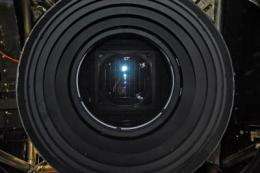
NIST expertise helped calibrate the 1.4 billion pixels in the camera of the Pan-STARRS telescope in Hawaii, whose observations may reveal details about the expansion of the universe. Credit: Rob Ratkowski, Copyright PS1SC

Is the expansion of the universe accelerating for some unknown reason? This is one of the mysteries plaguing astrophysics, and somewhere in distant galaxies are yet-unseen supernovae that may hold the key. Now, thanks to a telescope calibrated by scientists from the National Institute of Standards and Technology, Harvard University and the University of Hawaii, astrophysicists can be more certain of one day obtaining an accurate answer.

The NIST scientists traveled to the summit of Haleakala volcano in Hawaii to fine-tune the operation of billions of light-collecting pixels in the Pan-STARRS , which scans the heavens for . These dying stars always shine with the same luminosity as other Type IA supernovae, making them useful to observers as "standard candles" for judging distance in the universe. Any apparent shift in the supernova's spectrum gives a measure of how the universe has expanded (or contracted) as the light traveled from the to Earth.

Because Type IA's are valuable as signposts, astrophysicists want to be sure that when they observe one of these faraway stellar cataclysms, they are getting a clear and accurate picture—particularly important given the current mystery over why the rate of expansion of the universe appears to be increasing. For that, they need a telescope that will return consistent information about supernovae regardless of which of the roughly 1,400,000,000 pixels of its collector spots it.

"That's where we came in," says NIST's John Woodward. "We specialize in measurement, and they needed to calibrate the telescope in a way that has never been done before."

Ordinary calibrations involve a telescope's performance at many light wavelengths simultaneously, but Pan-STARRS needed to be calibrated at many individual wavelengths between 400 and 1,000 nanometers. For the job, Woodward and his colleagues used a special laser whose wavelength can be tuned to any value in that range, and spent three days testing the telescope's huge 1.4 gigapixel camera–the largest in the world, Woodward says.

"Pan-STARRS will scan the same areas of the sky repeatedly over many months," Woodward says. "It was designed to look for near-Earth objects like asteroids, and it also pulls double duty as a supernova hunter. But for both jobs, observers need to be sure they can usefully compare what they see from one image to the next."

Woodward says that because this is one of the first-ever such calibrations of a telescope, it is unclear just how much effect the team's work will have, and part of their future work will be determining how much they have reduced the uncertainties in Pan-STARRS's performance. They will use this information to calibrate a much larger telescope–the Large Synoptic Survey Telescope, planned for construction in Chile.

Explore further: Galaxy's Ring of Fire

More information: * C.W. Stubbs, P. Doherty, C. Cramer, G. Narayan, Y.J. Brown, K.R. Lykke, J.T. Woodward and J.L. Tonry. Precise throughput determination of the Pan-STARRS telescope and the gigapixel imager using a calibrated silicon photodiode and a tunable laser: Initial results. Astrophysical Journal Supplement, Dec. 2010, Pages 376-388.

add to favorites email to friend print save as pdf

Related Stories

Early warning of dangerous asteroids and comets

Nov 18, 2008

(PhysOrg.com) -- Silicon chips developed at MIT Lincoln Laboratory are at the heart of a new survey telescope that will soon provide a more than fivefold improvement in scientists’ ability to detect asteroids ...

Hubble Snaps Images of a Pinwheel-Shaped Galaxy

Feb 07, 2006

Looking like a child's pinwheel ready to be set a spinning by a gentle breeze, this dramatic spiral galaxy is one of the latest viewed by NASA's Hubble Space Telescope. Stunning details of the face-on spiral ...

Recommended for you

Galaxy's Ring of Fire

May 18, 2013

Johnny Cash may have preferred this galaxy's burning ring of fire to the one he sang about falling into in his popular song. The "starburst ring" seen at center in red and yellow hues is not the product of ...

4C+29.30: Black hole powered jets plow into galaxy

May 15, 2013

(Phys.org) —This composite image of a galaxy illustrates how the intense gravity of a supermassive black hole can be tapped to generate immense power. The image contains X-ray data from NASA's Chandra X-ray ...

A space-time magnifying glass

May 15, 2013

(Phys.org) —Bright arcs are smeared around the heart of galaxy cluster Abell S1077 in this image taken by the NASA/ESA Hubble space telescope. The arcs are stretched images of distant galaxies distorted ...

User comments : 3

Adjust slider to filter visible comments by rank

Display comments: newest first

frajo
2 / 5 (1) Jan 08, 2011
I'm very pleased with NIST's cautious wording. Unlike many other articles this one does not hurry to present the hypothesis of an accelerating expansion as undisputed fact.
phlipper
1 / 5 (2) Jan 08, 2011
I'm very pleased with NIST's cautious wording. Unlike many other articles this one does not hurry to present the hypothesis of an accelerating expansion as undisputed fact.

Well, if they can't make a connection between the calibration and global warming, they could be in very big trouble.
frajo
not rated yet Jan 09, 2011
I'm very pleased with NIST's cautious wording. Unlike many other articles this one does not hurry to present the hypothesis of an accelerating expansion as undisputed fact.

Well, if they can't make a connection between the calibration and global warming, they could be in very big trouble.

Thanks for making me laugh :)

More news stories

Heat-related deaths in Manhattan projected to rise

Residents of Manhattan will not just sweat harder from rising temperatures in the future, says a new study; many may die. Researchers say deaths linked to warming climate may rise some 20 percent by the 2020s, ...

Mice, gerbils perish in Russia space flight

A number of mice and eight gerbils sent into space in a Russian capsule destined to find out how well organisms can withstand extended flights perished during their journey, scientists said Sunday as the ...

Kinks and curves at the nanoscale

One of the basic principles of nanotechnology is that when you make things extremely small—one nanometer is about five atoms wide, 100,000 times smaller than the diameter of a human hair—they are going ...

Honeybees trained in Croatia to find land mines

(AP)—Mirjana Filipovic is still haunted by the land mine blast that killed her boyfriend and blew off her left leg while on a fishing trip nearly a decade ago. It happened in a field that was supposedly ...