Astronomers find most distant galaxy candidate yet seen (w/ Video)
January 26, 2011

Distant galaxy born in the dawn of time

Enlarge

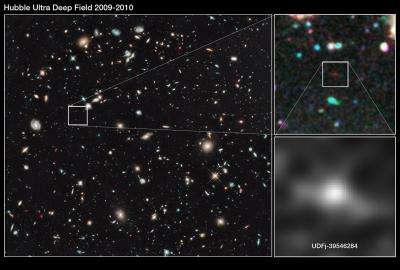
Astronomers have used Hubble to spot what they think is the furthest and one of the very earliest galaxies ever seen in the Universe. Candidate galaxy UDFj-39546284 appears as a faint red blob in this ultra deep field exposure taken with the NASA/ESA Hubble Space Telescope. This is the deepest infrared image taken of the Universe. Based on the object’s colour, astronomers believe that its light has taken 13.2 billion years to reach us. Spectroscopic confirmation that this is indeed the most distant galaxy ever seen is expected to come from the NASA/ESA/CSA James Webb Space Telescope, which is planned for launch later this decade. Credit: NASA, ESA, G. Illingworth (University of California, Santa Cruz), R. Bouwens (University of California, Santa Cruz, and Leiden University) and the HUDF09 Team

(PhysOrg.com) -- Pushing the Hubble Space Telescope to the limit of its technical ability, an international collaboration of astronomers have found what is likely to be the most distant and ancient galaxy ever seen, whose light has taken 13.2 billion years to reach us (a redshift of around 10).

Astronomers have pushed the NASA/ESA to its limits by finding what is plausibly the most distant and ancient object in the Universe ever seen. Its light has travelled for 13.2 billion years to reach Hubble, which corresponds to a redshift around 10. The age of the Universe is 13.7 billion years.

The dim object, called UDFj-39546284, is likely to be a compact galaxy of blue stars that existed 480 million years after the , only four percent of the Universe’s current age. It is tiny. Over one hundred such mini-galaxies would be needed to make up our own galaxy, the Milky Way.

This galaxy would be more distant than the population of redshift 8 recently discovered in the Hubble Ultra Deep Field, including the current most distant spectroscopically confirmed record holder at a redshift of 8.6 (eso1041), and the redshift 8.2 gamma-ray burst from 2009 (eso0917). A redshift of z = 8.6 means that the object is seen as it was around 600 million years after the Big Bang.

This video is not supported by your browser at this time.

Credit: NASA, ESA, G. Illingworth and R. Bouwens (University of California, Santa Cruz) and the HUDF09 Team

“We’re seeing huge changes in the rate of star birth that tell us that if we go a little further back in time we’re going to see even more dramatic changes,” says Garth Illingworth of the University of California at Santa Cruz.

The were surprised, as this new result suggests that the rate at which galaxies were forming stars grew precipitously, increasing by a factor of ten over the 170 million years that elapsed between the era of this newly discovered candidate galaxy and that of the population of previously identified galaxies at a around 8 (650 million years after the Big Bang).

“These observations provide us with our best insights yet into the likely nature of the earlier generation of primeval objects that we are yet to find,” adds Rychard Bouwens of Leiden University in the Netherlands.

Astronomers don’t know exactly when the first stars appeared in the Universe, but every step further from Earth takes them deeper into the early Universe’s formative years when stars and galaxies were just beginning to emerge in the aftermath of the Big Bang.
Hubble finds a new contender for galaxy distance record
Enlarge

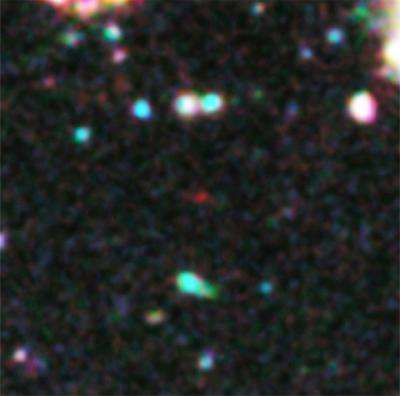
Astronomers have used Hubble to spot what they think is the furthest and one of the very earliest galaxies ever seen in the Universe. Candidate galaxy UDFj-39546284 appears as a faint red blob in this part of an ultra deep field exposure taken with the NASA/ESA Hubble Space Telescope. This is the deepest infrared image taken of the Universe. Based on the object’s colour, astronomers believe that its light has taken 13.2 billion years to reach us. Spectroscopic confirmation that this is indeed the most distant galaxy ever seen is expected to come from the NASA/ESA/CSA James Webb Space Telescope, which is planned for launch later this decade. Credit: NASA, ESA, G. Illingworth (University of California, Santa Cruz), R. Bouwens (University of California, Santa Cruz, and Leiden University) and the HUDF09 Team

“We’re moving into a regime where there are big changes afoot. Another couple of hundred million years back towards the Big Bang, and that will be the time when the first galaxies really are starting to build up,” says Illingworth.

Bouwens and Illingworth are reporting the discovery in the 27 January issue of the British science journal Nature.

The even more distant proto-galaxies that the team expects are out there will require the infrared vision of the /ESA/CSA James Webb Space Telescope (JWST), which is the successor to Hubble. Planned for launch later this decade, JWST will provide the spectroscopic measurements that will confirm today’s report of the object’s tremendous distance.

A year of detailed analysis was required before the object was identified in the Hubble Ultra Deep Field — Infrared (HUDF-IR) data taken in the late summers of 2009 and 2010. The object appears as a faint dot of starlight in the Hubble exposures, and although its individual stars can’t be resolved by Hubble, the evidence suggests that this is a compact galaxy of hot stars that first started to form over 100-200 million years earlier, from gas trapped in a pocket of dark matter.

The proto-galaxy is only visible at the longest infrared wavelengths observable by Hubble. This means that the expansion of the Universe has stretched and thereby reddened its light more than that of any other galaxy previously identified in the HUDF-IR, taking it to the very limit that Hubble can detect. JWST will go deeper into infrared wavelengths and will be at least an order of magnitude more sensitive than Hubble, allowing it to hunt more efficiently for primeval at even greater distances, at earlier times, closer to the Big Bang.

Provided by ESA/Hubble Information Centre search and more info website

4.9 /5 (26 votes)  

Filter


Move the slider to adjust rank threshold, so that you can hide some of the comments.


Display comments: newest first

savroD
Jan 26, 2011

Rank: 1.4 / 5 (20)
What I'm hearing is just stupid. It's like this thing is falling off the edge of the universe, the way people use to think ships fell off of flat Earth!
kevinrtrs
Jan 26, 2011

Rank: 1.4 / 5 (16)
the evidence suggests that this is a compact galaxy of hot stars that first started to form over 100-200 million years earlier, from gas trapped in a pocket of dark matter.
This can only be suggested because one has certain expectations of that evidence. How on earth does anyone know that it arose from a pocket of dark matter? Only if one makes certain assumptions and then lines up the evidence in support of those assumptions. It might well turn out that the evidence points to something entirely different. I hope that if it does the researchers will be just as quick to retract their statements.
kevinrtrs
Jan 26, 2011

Rank: 1.5 / 5 (18)
The proto-galaxy is only visible at the longest infrared wavelengths observable by Hubble.
See what I mean by assumptions? Here the evidence is not even up to the point where stars can be seen and already it's being classified as a proto-galaxy - mainly because that is the expectation of how it should be. Why not wait until a clearer picture emerges before making such a definitive statement?
Quantum_Conundrum
Jan 26, 2011

Rank: 1.7 / 5 (13)
What I'm hearing is just stupid. It's like this thing is falling off the edge of the universe, the way people use to think ships fell off of flat Earth!


Not exactly, but for all practical purposes it wouldn't matter.

Based on the consequences of relativity, one wouldn't be able to tell whether an object beyond a certain distance actually existed any longer, or whether it simply disappeared, because "information" from that object could never reach the observer, no matter how long it traveled.

Local space-time is "open" in spite of everyone's screwy interpretations. Within the framework of the standard model, it is interpreted that the galaxies at this distance must have been moving away from us at like 95% of the speed of light from the very beginning of the universe's history.

By now, they have accelerated even more, and would be 2 or 3 times farther away than they appear to be, making them completely de-coupled from our region of spacetime in relativity.
Quantum_Conundrum
Jan 26, 2011

Rank: 1.7 / 5 (16)
The objection I have about astronomy at these distances is the fact we know about issues like interference of light, gravity lenses and things of this nature.

When dealing with point light sources that are this faint and this heavily red shift, how can you REALLY distinguish whether this is due to hubble red shift, gravitational red shift, or some form of quantum "double slit" interference effect over ridiculously long distances?

How do you prove object at these distances aren't illusions like optical ghosts and sun dogs caused by gravity, dust, or quantum effects?
Paljor
Jan 26, 2011

Rank: 3.9 / 5 (12)
well why don't you all non experts line up and start an internet shouting fest over what it really is OR you can WAIT TILL THEY LOOK AT IT CLOSER!
savroD
Jan 26, 2011

Rank: 1.5 / 5 (16)
Space-time is a mathmatical construct. There is no such dimension as time, and space-time is a stretch, even though the math works out. Modern pyhsics continues to miss-identify the fourth dimension completely.
Quantum_Conundrum
Jan 26, 2011

Rank: 1 / 5 (14)
Space-time is a mathmatical construct. There is no such dimension as time, and space-time is a stretch, even though the math works out. Modern pyhsics continues to miss-identify the fourth dimension completely.


The more fundamental question is:

"If space-time is curved, then into what does it curve?"

Curvature is necessarily a measure of how a line in one dimension changes with respect to a second dimension.

More particularly, the lines:

Y = 0

and

Y = X

Are not curved, but:

Y = X^2

and

Y = 1/X

are curved
Tuxford
Jan 26, 2011

Rank: 1.9 / 5 (14)
I predict they will one day conclude, that we are just looking at a bright old galactic core at this distance. The big bang is a fantasy to satisfy one assumption that the red-shift is valid at intergalactic distances. Make the model, then interpret the data to fit the model. Isn't that what is happening over and over? Last spring it was shown that there is no time dilation at galactic distances. Say it ain't so! Must ignore that data point.
muha
Jan 26, 2011

Rank: 1 / 5 (7)

The more fundamental question is:
"If space-time is curved, then into what does it curve?"


Loop quantum gravity solves this problem.
There is no space. There is only graph.
crimsonclear
Jan 26, 2011

Rank: 4.5 / 5 (25)
"A year of detailed analysis was required before the object was identified in the Hubble Ultra Deep Field"

It is strangely curious that so many of the posters on this article (and many PhysOrg articles) are such experts when their names are masked by the internet. Your credentials must be SOOOOOOO great that NASA won't even hire you out of fear of your intelligence. I mean, here is a team of scientists putting their reputation on the line, after spending A YEAR (opposed to the 2 minutes your response took to put together) doing analysis.

Note to NASA: Fire everyone and close your doors, because the posters at PhyOrg.com know way more than you and are eager to actually put their real names on the line and step out from the anonymity provided by the world wide web.

edit: Ive been reading articles on this site for awhile, but thank you for pissing me off with your crude remarks on the intelligence of actual astronomers so much as to make me actually create an account.
savroD
Jan 26, 2011

Rank: 1.6 / 5 (14)
Quantum Conundrum.....

Space-time looks curved because of the fourth dimension! Actually, there is no dimension of Space-time. Einstein was wrong, as well as the whole of physics. One day, I may publish; but for now, I don't have the time. And besides, my theory is so plainly obvious and staring everyone right in the face that it cannot be seen. I would like to thank Einstein though for doing the originl math. Too bad the results have been so badly mis-interpreted!
Quantum_Conundrum
Jan 26, 2011

Rank: 1.4 / 5 (9)
crimsonclear:

We regularly find situations in astronomy where results published by two teams within a matter of a short while of one another totally contradict each other's results.

Case in point, the recent article about the galaxy makes statements about findings which totally contradict findings on AGN formation which were published just a few weeks ago.

The results are "massaged" to fit the standard model, instead of discarding the standard model and doing something that makes sense.
El_Nose
Jan 26, 2011

Rank: not rated yet
@kevin

why its a protogalaxy -- because if you are looking at something that is really far away even the smallest specks of dust will block the light --- now since hubble can actually see the light then there are a tremendous amount of photons actually making it this far. Now why isn't this just a star we are seeing striaght on -- well its would blocked -- the distance is to great -- and then there is the fact of redshift in the light.

-- and now to feed the trolls, there funny when they poke out from under the bridge....

@savoy

but you perceive time and it is truly a vector that is perpendicular to all of three space... most ascept time as a deminsion -- the issue is why does it seem to flow in one direction. we currently have no good explanation for this.

DamienS
Jan 27, 2011

Rank: 5 / 5 (6)
Only if one makes certain assumptions and then lines up the evidence in support of those assumptions. It might well turn out that the evidence points to something entirely different.

You've really got to love this statement, coming as it does, from a creationist! Oh, the irony.
frajo
Jan 27, 2011

Rank: 5 / 5 (1)
Ive been reading articles on this site for awhile, but thank you for pissing me off with your crude remarks on the intelligence of actual astronomers so much as to make me actually create an account.
It's your choice - you can stay in the ivory towers or (aut) you can show commitment here, in the www.
But it's vain to condemn the www because of it being the www.
Btw, crude remarks on the intelligence of actual astronomers are qualifying only the commenter.
savroD
Jan 27, 2011

Rank: 5 / 5 (1)
Quant..
You say, "but you perceive time and it is truly a vector that is perpendicular to all of three space... most ascept time as a deminsion -- the issue is why does it seem to flow in one direction. we currently have no good explanation for this."

You can't argue that time is perpendicular to the 3 dimensions of space. That is ridiculous. You can say the time has length, width, and depth; however, you would be hard-pressed to prove that! In short, you are spouting nonsense as science!
Noumenon
Jan 27, 2011

Rank: 4.7 / 5 (27)
To make rational sense of phenomenal reality, SR takes one frame of reference as a mixture of another frame of reference, which means that one observers x dimension is a linear combination of t, x, y, z dimension of another observer. Motion through space reduces the temporal component while increasing the spacial components (time dilation).
RobertKarlStonjek
Jan 27, 2011

Rank: 5 / 5 (1)
Hubble is sighting targets for James Webb...
sleepaholic
Jan 27, 2011

Rank: 4 / 5 (5)
To all you guys who are convinced that it is wrong to doubt these NASA experts, let me quote you the great Richard Feynman:

"Science is the belief in the ignorance of experts."

I hope experts will soon be able to perceive objects older than the "big bang", so that alternative models get more consideration.
Quantum_Conundrum
Jan 27, 2011

Rank: 1 / 5 (1)
You can't argue that time is perpendicular to the 3 dimensions of space. That is ridiculous. You can say the time has length, width, and depth; however, you would be hard-pressed to prove that! In short, you are spouting nonsense as science!


Actually, that's EXACTLY what Relativity says.

The Lorentz Transformation doesn't even work unless time is perpendicular to other dimensions, because it is derived from the 4th dimensonal application of Pythagorean theorem, which, as you know deals with distance of a line in N dimensions, through the interpretation of the length of the hypotenuese of a triangle, pyramid, etc, given the length(s) of the legs and assuming a right angle between the legs...

Again, by it's own mathematical formulas and definitions, "space-time" requires that time is a dimension perpendicular, or more correctly, Orthogonal, to each of the space dimensions.
Noumenon
Jan 27, 2011

Rank: 4.8 / 5 (26)
In GR coordinates are curvilinear, not orthogonal, so requires contravarient and covariant coordinates,... two ways (say vector & 1-form) to address a point, ...only the combination of which is invariant under a transformation.
Noumenon
Jan 27, 2011

Rank: 4.8 / 5 (26)
Space-time is a mathmatical construct. There is no such dimension as time, and space-time is a stretch, even though the math works out. Modern pyhsics continues to miss-identify the fourth dimension completely.


The more fundamental question is:

"If space-time is curved, then into what does it curve?"

Curvature is necessarily a measure of how a line in one dimension changes with respect to a second dimension.

More particularly, the lines:

Y = 0

and

Y = X

Are not curved, but:

Y = X^2

and

Y = 1/X

are curved

By using a metric GR is a coordinate free theory, and geodesics are straight lines.
Quantum_Conundrum
Jan 27, 2011

Rank: 1 / 5 (1)
By using a metric GR is a coordinate free theory, and geodesics are straight lines.


Oh really...Let's see what an encyclopedia or a relativity text book says...

At its core are Einstein's equations, which describe the relation between the geometry of a four-dimensional, pseudo-Riemannian manifold representing spacetime, and the energy-momentum contained in that spacetime.

As it is constructed using tensors, general relativity exhibits general covariance its laws...take on the same form in all coordinate systems.


It doesn't say its coordinate free. It says it takes on the same form in all coordinate systems.

"All coordinate systems" implies that it is a coordinate based.

For that matter, you can't even measure anything at all in science without respect to some coordinate, except scalar constants, such as "G," which are calculated from measure of 2 or more coordinates.
Quantum_Conundrum
Jan 27, 2011

Rank: 1 / 5 (1)
Einstein's theory is not sufficient by itself to determine the time evolution of the metric tensor. It must be combined with a coordinate condition, which is analogous to gauge fixing in other field theories.[148]

To understand Einstein's equations as partial differential equations, it is helpful to formulate them in a way that describes the evolution of the universe over time. This is done in so-called "3+1" formulations, where spacetime is split into three space dimensions and one time dimension


Yeah...

Learn something every day do you?
frajo
Jan 27, 2011

Rank: 5 / 5 (3)
By using a metric GR is a coordinate free theory, and geodesics are straight lines.


Oh really...Let's see what an encyclopedia or a relativity text book says...

At its core are Einstein's equations, which describe the relation between the geometry of a four-dimensional, pseudo-Riemannian manifold representing spacetime, and the energy-momentum contained in that spacetime.

As it is constructed using tensors, general relativity exhibits general covariance its laws...take on the same form in all coordinate systems.


It doesn't say its coordinate free. It says it takes on the same form in all coordinate systems.

"All coordinate systems" implies that it is a coordinate based.
I'm sorry, but you exemplify that guy of whom Socrates said "I know that I don't know anything. But that guy doesn't even know this much."
Noumenon
Jan 27, 2011

Rank: 4.8 / 5 (26)
It doesn't say its coordinate free. It says it takes on the same form in all coordinate systems.


Sorry QC, I should have said coordinate independent, or maybe basis free. In any case it is possible to represent a coordinate free Covariant derivative (Levi-Civita connection).
71STARS
Jan 27, 2011

Rank: 1 / 5 (4)
@savroD: re "Actually, there is no dimension of Space-Time." Thank you for not being afraid to make that statement. Write it out for all to see.

@sleepaholic: If you "want experts to perceive objects older than the big bang," all you have to do is reject the big bang theory, which is full of Time and Temperature unexplainables, and start looking for the First Mother Sun as the beginning of the Universe. No, I am not afraid to say it. R.L.Dwyer Unfortunately, our technology will never be able to capture the "beginning" due to its place in the Universe. Nonetheless, searching must continue which will put the big bang theory to rest.
wiyosaya
Jan 27, 2011

Rank: not rated yet
Personally, I can't wait to see what ESO's E-ELT brings to the table in terms of distant galaxies.
PinkElephant
Jan 27, 2011

Rank: 5 / 5 (5)
@QC,
If space-time is curved, then into what does it curve?
Without bogging in fancy math and esoteric terminology, imagine a straight line in a Cartesian coordinate system. It's one-dimensional. Now mark points along that line. Let's call them coordinates.

Now imagine the line is made of rubber. Grab it at two points, and pull in opposite directions (always along the line). The line "stretches" between the points you've pulled, and "compresses" outside them. It does that without ever becoming curved (i.e. it remains one-dimensional.) But the points you marked on it (the coordinates) have been distorted: the distance between some of them increased, while the distance between some others decreased.

The tension you've created within the line, can be described by a "tensor". Your mechanism of computing distance within the tensor is the "metric". In GR, what actually curves is not the coordinate system per se, but rather the components of a tensor embedded within it.
Quantum_Conundrum
Jan 29, 2011

Rank: not rated yet
The mathematical definition of "curvature", as far as I can tell, requires a coordinate system, and always implies a change in one dimension with respect to another. It is expressed as the form:

k(t) = |r'(t) x r"(t)| / (|r'(t)|^3)...

Which the cross product is undefined for a one dimensional vector...

I guess that is going to stay formatted.
Noumenon
Jan 29, 2011

Rank: 4.8 / 5 (26)
PE answered your question. In GR everyone with an a-hole carries their own coordinates, so the essential point of using *differential-geometry and tensors is to express *general-covariance in a non-Euclidean geometry where the pythagorean theorem fails to work as a distance measure. (See my previous post wrt vectors/1-forms (not that I'm an expect in any of this!))

*look up
Au-Pu
Jan 30, 2011

Rank: 5 / 5 (1)
I concur with sleepaholic, especially about other theories to the big bang.
13.7 billion years is allegedly the age of this universe.
13.7 billion light years is our visual event horizon.
I do not believe in coincidences, i.e. that we are remarkably at a time in the universes evolution when the out edges of the universe are about to reach our visual event horizon.
I strongly suspect that if we were to travel 6 billion light years from earth we would find that we still had a 13.7 billion light year visual event horizon.
When 80% of the matter you need to support the theory is missing and if dark matter turns out to be real the estimate is that this will add 25% of matter to the universe, that is less than half of what the big bang theory needs. methinks it is time for a rethink.
Ethelred
Jan 31, 2011

Rank: 5 / 5 (3)
13.7 billion years is allegedly the age of this universe.
13.7 billion light years is our visual event horizon.
I do not believe in coincidences, i.e. that we are remarkably at a time in the universes evolution when the out edges of the universe are about to reach our visual event horizon.
It isn't a coincidence. It is one of the definitions of the Universe. That which we can see. We can only see as far as light has traveled since the beginning of the Universe.

So it isn't remarkable. Its expected if the Universe started with a Big Bang 13.7 billion years ago. So you are reading something into it that isn't there.

There may be more to Universe than we can see. There may not be. IF the idea of inflation is real then there is more. If the idea of inflation is unnecessary than the Universe may be exactly 13.7 billion light years in radius. Either way we can't see farther than light has traveled since the beginning of the Universe.

Ethelred
Rank 4.9 /5 (26 votes)
Relevant PhysicsForums posts
  • revamping general concept and cosmological principle
    createdMay 25, 2012
  • Transiting Exoplanet Light Curve
    createdMay 25, 2012
  • Math behind Theoretical Physics
    createdMay 24, 2012
  • Do we know whats at the center of galaxies yet?
    createdMay 23, 2012
  • Structure of the Milky Way?
    createdMay 20, 2012
  • What would it take to terraform Pluto and Charon?
    createdMay 19, 2012
  • More from Physics Forums - General Astronomy

More news stories

Australia hails surprise super-telescope decision

Australia has hailed a surprise decision giving it a role in a radio telescope project aimed at revolutionising astronomy, vowing to draw on its decades of experience in space science.

Space & Earth / Astronomy

created 6 hours ago | popularity 5 / 5 (2) | comments 0

Astronomers seize last chance in lifetime for Venus Transit

Astronomers are gearing for one the rarest events in the Solar System: an alignment of Earth, Venus and the Sun that will not be seen for another 105 years.

Space & Earth / Astronomy

created 6 hours ago | popularity 5 / 5 (1) | comments 0

SpaceX capsule has 'new car' smell, astronauts say

SpaceX's Dragon cargo vessel smells like a new car, said astronauts at the International Space Station after opening the hatches Saturday following the spacecraft's landmark mission to the orbiting lab.

Space & Earth / Space Exploration

created 6 hours ago | popularity 4.7 / 5 (7) | comments 0

Astronauts enter world's 1st private supply ship

(AP) -- Space station astronauts floated into the Dragon on Saturday, a day after its heralded arrival as the world's first commercial supply ship.

Space & Earth / Space Exploration

created 6 hours ago | popularity 5 / 5 (3) | comments 0

Dragon makes history with space station docking

The private company SpaceX made history Friday with the docking of its Dragon capsule to the International Space Station, the most impressive feat yet in turning routine spaceflight over to the commercial ...

Space & Earth / Space Exploration

created 21 hours ago | popularity 4.9 / 5 (8) | comments 0


SpotterRF debuts Radar Backpack Kit (w/ Video)

(Phys.org) -- SpotterRF has announced a special radar backpack kit designed to enhance situational awareness for soldiers on the ground. The company says its special radar is designed for warfighters as part ...

Family history of Alzheimer's affects functional connectivity

(HealthDay) -- Cognitively normal individuals with a family history of late-onset Alzheimer's disease (AD) may display lower resting state functional connectivity in the default mode network (DMN) of the brain, ...

Thousands of shellfish found dead in Peru

Thousands of crustaceans were found dead off the coast of Lima following the mystery mass death of dolphins and pelicans, the Peruvian Navy said Friday.

Transvaginal mesh op restores pelvic organ prolapse at price

(HealthDay) -- Transvaginal mesh (TVM) procedures are effective for anatomical restoration of pelvic organ prolapse (POP), but patients report a worsening of sexual function following surgery, according to ...

Travel to high altitudes tied to Crohn's, colitis flare-ups

(HealthDay) -- People with inflammatory bowel disease, which includes Crohn's disease and colitis, may be at increased risk for flare-ups when they fly or travel to high altitudes for skiing or mountain climbing, ...

High-speed method to aid search for solar energy storage catalysts

Eons ago, nature solved the problem of converting solar energy to fuels by inventing the process of photosynthesis.