Gardening in Space with HydroTropi
January 19, 2011 By Jessica Nimon
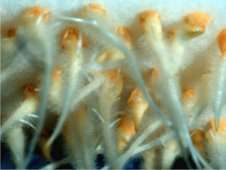
Cucumber roots grew laterally in space following 70 hours in microgravity on STS 95. Credit: JAXA
(PhysOrg.com) -- Plants are fundamental to life on Earth, converting light and carbon dioxide into food and oxygen. Plant growth may be an important part of human survival in exploring space, as well. Gardening in space has been part of the International Space Station from the beginning -- whether peas grown in the Lada greenhouse or experiments in the Biomass Production System. The space station offers unique opportunities to study plant growth and gravity, something that cannot be done on Earth.
The latest experiment that has astronauts putting their green thumbs to the test is Hydrotropism and Auxin-Inducible Gene expression in Roots Grown Under Microgravity Conditions, known as HydroTropi. Operations were conducted October 18-21, 2010, HydroTropi is a Japan Aerospace Exploration Agency (JAXA)-run study that looks at directional root growth. In microgravity, roots grow latterly or sideways, instead of up and down like they do under Earths gravitational forces.
Using cucumber plants (scientific name Cucumis sativus), investigators look to determine whether hydrotropic -- plant root orientation due to waterresponse can control the direction of root growth in microgravity. To perform the HydroTropi experiment, astronauts transport the cucumber seeds from Earth to the space station and then coax them into growth. The seeds, which reside in Hydrotropism chambers, undergo 18 hours of incubation in a Cell Biology Experiment Facility or CBEF. Then the crewmembers activate the seeds with water or a saturated salt solution, followed by a second application of water 4 to 5 hours later. The crew harvests the cucumber seedlings and preserves them using fixation tubes called Kenney Space Center Fixation Tubes or KFTs, which then store in one of the station MELFI freezers to await return to Earth.
The results from HydroTropi, which returns to Earth on STS-133, will help investigators to better understand how plants grow and develop at a molecular level. The experiment will demonstrate a plants ability to change growth direction in response to gravity (gravitropism) vs. directional growth in response to water (hydrotropism). By looking at the reaction of the plants to the stimuli and the resulting response of differential auxin -- the compound regulating the growth of plants -- investigators will learn about plants inducible gene expression. In space, investigators hope HydroTropi will show them how to control directional root growth by using the hydrotropism stimulus; this knowledge may also lead to significant advancements in agriculture production on Earth.
More information: http://www.nasa.go … roTropi.html
Provided by
JPL/NASA
-
From lemons to lemonade: Reaction uses carbon dioxide to make carbon-based semiconductor,
28 comments
-
Thioridazine kills cancer stem cells in human while avoiding toxic side-effects of conventional cancer treatments,
3 comments
-
SpaceX private rocket blasts off for space station (Update),
41 comments
-
Climate scientists say they have solved riddle of rising sea,
30 comments
-
Scotland passes turbine test to harness tidal power,
40 comments
-
revamping general concept and cosmological principle
May 25, 2012
-
Transiting Exoplanet Light Curve
May 25, 2012
-
Math behind Theoretical Physics
May 24, 2012
-
Do we know whats at the center of galaxies yet?
May 23, 2012
-
Structure of the Milky Way?
May 20, 2012
-
What would it take to terraform Pluto and Charon?
May 19, 2012
- More from Physics Forums - General Astronomy
More news stories
Australia hails surprise super-telescope decision
Australia has hailed a surprise decision giving it a role in a radio telescope project aimed at revolutionising astronomy, vowing to draw on its decades of experience in space science.
5 hours ago |
5 / 5 (1) |
0
Astronomers seize last chance in lifetime for Venus Transit
Astronomers are gearing for one the rarest events in the Solar System: an alignment of Earth, Venus and the Sun that will not be seen for another 105 years.
5 hours ago |
5 / 5 (1) |
0
SpaceX capsule has 'new car' smell, astronauts say
SpaceX's Dragon cargo vessel smells like a new car, said astronauts at the International Space Station after opening the hatches Saturday following the spacecraft's landmark mission to the orbiting lab.
Space & Earth / Space Exploration
5 hours ago |
4.7 / 5 (6) |
0
Astronauts enter world's 1st private supply ship
(AP) -- Space station astronauts floated into the Dragon on Saturday, a day after its heralded arrival as the world's first commercial supply ship.
Space & Earth / Space Exploration
5 hours ago |
5 / 5 (3) |
0
Dragon makes history with space station docking
The private company SpaceX made history Friday with the docking of its Dragon capsule to the International Space Station, the most impressive feat yet in turning routine spaceflight over to the commercial ...
Space & Earth / Space Exploration
20 hours ago |
4.9 / 5 (8) |
0
SpotterRF debuts Radar Backpack Kit (w/ Video)
(Phys.org) -- SpotterRF has announced a special radar backpack kit designed to enhance situational awareness for soldiers on the ground. The company says its special radar is designed for warfighters as part ...
Family history of Alzheimer's affects functional connectivity
(HealthDay) -- Cognitively normal individuals with a family history of late-onset Alzheimer's disease (AD) may display lower resting state functional connectivity in the default mode network (DMN) of the brain, ...
Thousands of shellfish found dead in Peru
Thousands of crustaceans were found dead off the coast of Lima following the mystery mass death of dolphins and pelicans, the Peruvian Navy said Friday.
Transvaginal mesh op restores pelvic organ prolapse at price
(HealthDay) -- Transvaginal mesh (TVM) procedures are effective for anatomical restoration of pelvic organ prolapse (POP), but patients report a worsening of sexual function following surgery, according to ...
Travel to high altitudes tied to Crohn's, colitis flare-ups
(HealthDay) -- People with inflammatory bowel disease, which includes Crohn's disease and colitis, may be at increased risk for flare-ups when they fly or travel to high altitudes for skiing or mountain climbing, ...
High-speed method to aid search for solar energy storage catalysts
Eons ago, nature solved the problem of converting solar energy to fuels by inventing the process of photosynthesis.