Galileo satellite undergoes launch check-up at ESTEC
January 20, 2011

Galileo satellite undergoes launch check-up at ESTEC

Enlarge

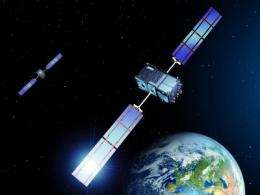
The first two of four Galileo In-Orbit Validation satellites are due to launch in August 2011. Credit: ESA

Galileo's first satellite is undergoing testing at ESA's technical centre in the Netherlands, checking its readiness to be launched into orbit. This marks a significant step for Europe's Galileo satnav constellation.

The first part of Europe's global is due to be launched over the next two years – a total of four Galileo In-Orbit Validation (IOV) satellites.

The following four years to 2015 will see Galileo brought up to its first operational configuration of 18 satellites in medium Earth orbit.

Before they are launched, the IOV satellites must be formally qualified for space operations by passing a rigorous series of tests that reproduce the heavy vibration, acoustic noise and shock they will experience during the violent rocket ride into orbit – plus a little extra for safety.
Galileo satellite undergoes launch check-up at ESTEC
Enlarge

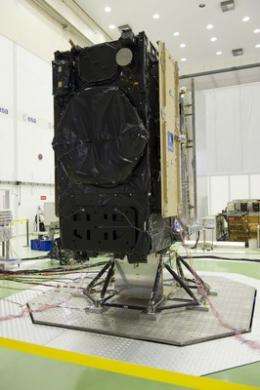
Galileo dispenser testing using the QUAD electrodynamic shaker during December 2010. The tests are using a qualification model of the dispenser, along with the with a pair of engineering models of Galileo IOV satellites, respectively the Structural Model (SM) and Structural and Thermal Model (STM). Credit: ESA

The venue for these tests is the ESTEC Test Centre in Noordwijk, the Netherlands. This unique European facility combines a complete portfolio of space simulation facilities under a single roof.

“From the point of view of mechanical qualification, the Galileo IOV satellites are identical,” said Pedro Cosma, Assembly Integration and Testing engineer for Galileo.

“So we are employing one of the satellites for this qualification testing, the first to be built, known as the Protoflight Model (PFM). It will respond in practically the same way as the other Flight Models – FM2, FM3 and FM4.”

The satellites have been built by a consortium of European companies. Their payloads were designed, developed and assembled by EADS Astrium in Portsmouth, UK, with the overall satellite designed and developed by Astrium in Ottobrunn, Germany and assembled by Thales Alenia Space in Rome, Italy.

The first satellite will endure simulated launch vibrations on ESTEC’s Electrodynamic Shaker, followed by the sudden pyrotechnic shocks during separation from the launch vehicle.

Finally, it will take an acoustic battering matching the launcher’s sound pressure and frequency – imagine a squadron of fighter jets taking off 30 m away – in the Large European Acoustic Facility.

“We’re not anticipating any surprises,” added Pedro. “This is because we’ve previously carried out these tests on two Galileo structural/thermal models, but testing on an actual satellite remains an essential part of the official flight qualification process.”

Those models have also recently been reused for other tests at ESTEC. The Galileo IOV satellites are launched two at a time, so a dispenser is needed to hold them together within the launcher fairing and then, when the time is right, to release them in orbit.

Pyrotechnic devices will shoot them safely away from the dispenser and each other. Last December these models took part in a pyrotechnic shock test alongside a qualification model of the dispenser.

“The test’s success prepares us to perform a release test with the real dispenser and PFM satellite in our facilities later this month,” Pedro added.

Once ESTEC testing is complete in February, the PFM will be reunited with the rest of the IOV quartet in Italy for a follow-up round of thermal vacuum testing, to prove that they can withstand the temperature extremes of space.

Finally, the satellites will be transported to Europe’s Spaceport in Kourou, French Guiana to be launched on Soyuz rockets. The PFM and Flight Model 2 will be on the first flight of Soyuz from Kourou, marking a double first for ESA.

Provided by European Space Agency search and more info website


Rank 5 /5 (2 votes)
Relevant PhysicsForums posts
  • revamping general concept and cosmological principle
    createdMay 25, 2012
  • Transiting Exoplanet Light Curve
    createdMay 25, 2012
  • Math behind Theoretical Physics
    createdMay 24, 2012
  • Do we know whats at the center of galaxies yet?
    createdMay 23, 2012
  • Structure of the Milky Way?
    createdMay 20, 2012
  • What would it take to terraform Pluto and Charon?
    createdMay 19, 2012
  • More from Physics Forums - General Astronomy

More news stories

Australia hails surprise super-telescope decision

Australia has hailed a surprise decision giving it a role in a radio telescope project aimed at revolutionising astronomy, vowing to draw on its decades of experience in space science.

Space & Earth / Astronomy

created 5 hours ago | popularity 5 / 5 (1) | comments 0

Astronomers seize last chance in lifetime for Venus Transit

Astronomers are gearing for one the rarest events in the Solar System: an alignment of Earth, Venus and the Sun that will not be seen for another 105 years.

Space & Earth / Astronomy

created 5 hours ago | popularity 5 / 5 (1) | comments 0

SpaceX capsule has 'new car' smell, astronauts say

SpaceX's Dragon cargo vessel smells like a new car, said astronauts at the International Space Station after opening the hatches Saturday following the spacecraft's landmark mission to the orbiting lab.

Space & Earth / Space Exploration

created 5 hours ago | popularity 4.7 / 5 (6) | comments 0

Astronauts enter world's 1st private supply ship

(AP) -- Space station astronauts floated into the Dragon on Saturday, a day after its heralded arrival as the world's first commercial supply ship.

Space & Earth / Space Exploration

created 5 hours ago | popularity 5 / 5 (3) | comments 0

Dragon makes history with space station docking

The private company SpaceX made history Friday with the docking of its Dragon capsule to the International Space Station, the most impressive feat yet in turning routine spaceflight over to the commercial ...

Space & Earth / Space Exploration

created 20 hours ago | popularity 4.9 / 5 (8) | comments 0


SpotterRF debuts Radar Backpack Kit (w/ Video)

(Phys.org) -- SpotterRF has announced a special radar backpack kit designed to enhance situational awareness for soldiers on the ground. The company says its special radar is designed for warfighters as part ...

Family history of Alzheimer's affects functional connectivity

(HealthDay) -- Cognitively normal individuals with a family history of late-onset Alzheimer's disease (AD) may display lower resting state functional connectivity in the default mode network (DMN) of the brain, ...

Thousands of shellfish found dead in Peru

Thousands of crustaceans were found dead off the coast of Lima following the mystery mass death of dolphins and pelicans, the Peruvian Navy said Friday.

Transvaginal mesh op restores pelvic organ prolapse at price

(HealthDay) -- Transvaginal mesh (TVM) procedures are effective for anatomical restoration of pelvic organ prolapse (POP), but patients report a worsening of sexual function following surgery, according to ...

Travel to high altitudes tied to Crohn's, colitis flare-ups

(HealthDay) -- People with inflammatory bowel disease, which includes Crohn's disease and colitis, may be at increased risk for flare-ups when they fly or travel to high altitudes for skiing or mountain climbing, ...

High-speed method to aid search for solar energy storage catalysts

Eons ago, nature solved the problem of converting solar energy to fuels by inventing the process of photosynthesis.