Cyclone Wilma's eye catches attention of NASA satellites
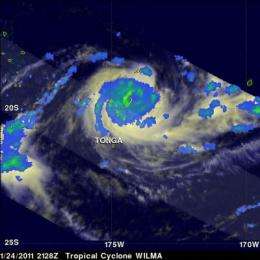
Tropical cyclone Wilma was seen by the TRMM satellite shortly after attaining hurricane intensity on Jan. 24, 2011, at 2128 UTC. The yellow and green areas indicate moderate rainfall between .78 to 1.57 inches (20 and 40 mm) per hour. Credit: NASA/SSAI, Hal Pierce
Wilma caught the eye of NASA. NASA's Aqua satellite captured visible and infrared images of Cyclone Wilma in the Southwestern Pacific Ocean and her eye was clearly visible from space.
On January 25 at 00:59 UTC (8:59 p.m. EST on Jan. 24), the Atmospheric Infrared Sounder (AIRS) instrument captured data that was used to create infrared and visible images at NASA's Jet Propulsion Laboratory in Pasadena, Calif. The images showed Cyclone Wilma had strengthened overnight and now has a visible eye.
AIRS Infrared imagery showed strong, very cold thunderstorm cloud tops around Wilma's center of circulation. The cloud tops were as cold as or colder than -63 Fahrenheit (-52 Celsius) indicating strong convection (rapidly rising air that creates the thunderstorms that power a tropical cyclone). Animated infrared satellite imagery showed a 25 nautical mile (29 mile/46 km) diameter ragged eye with tightly-curved banding of thunderstorms wrapping into the center.
AIRS instrument data also showed what appears to be a large "tail" from Wilma's center, stretching several hundred miles (kilometers) to the northeast of the storm's center.
Tropical cyclone Wilma was also seen by the Tropical Rainfall Measuring Mission (TRMM) satellite shortly after attaining hurricane intensity on January 24, 2011 at 2128 UTC 2:28 p.m. EST). The system had mostly moderate rainfall, falling at rates between .78 to 1.57 inches (20 and 40 mm) per hour. The TRMM satellite is managed by both NASA and JAXA, and TRMM data and imagery was created at NASA's Goddard Space Flight Center in Greenbelt, Md.
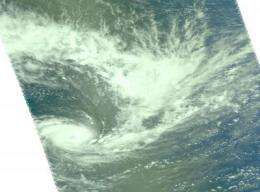
NASA's Aqua satellite captured visible and infrared images of Cyclone Wilma on Jan. 25 at 00:59 UTC. This visible image shows a well-organized storm with a visible eye. Credit: NASA/JPL, Ed Olsen
On January 25 at 0900 UTC (4 a.m. EST), Tropical Cyclone Wilma had maximum sustained winds near 85 knots (97 mph/157 km/hr). It was located about 360 nautical miles southeast of Nadi, Fiji near 22.0 South and 178.2 West. It was moving southwestward near 24 knots (27 mph/ 44 km/hr).
A Tropical Cyclone Warning is in force for areas of Tonga and for areas of Fiji. On its projected path, Tropical Cyclone Wilma is expected to pass about 124 miles (200 km) south-southeast of Ono-i-lau by midnight local time tonight.
Republic of the Fiji Islands is an island nation in Melanesia in the South Pacific Ocean about 1,243 miles (2,000 km) northeast of New Zealand's North Island. Vanuatu is located to the west, and New Caledonia is located to the southwest. Tonga is located east of Fiji. Tonga is an archipelago comprised of 176 islands scattered over 270,000 square miles (700,000 square kilometers).
Wilma is forecast to continue moving southwest parallel to Fiji and New Caledonia as it makes its way toward New Zealand. On January 28 it is forecast to change course and head southeast bringing rains and gusty winds to northern New Zealand.
Provided by
NASA's Goddard Space Flight Center
-
From lemons to lemonade: Reaction uses carbon dioxide to make carbon-based semiconductor,
28 comments
-
Thioridazine kills cancer stem cells in human while avoiding toxic side-effects of conventional cancer treatments,
3 comments
-
SpaceX private rocket blasts off for space station (Update),
41 comments
-
Climate scientists say they have solved riddle of rising sea,
30 comments
-
Scotland passes turbine test to harness tidal power,
40 comments
-
More human population = greater mass?
May 25, 2012
-
Conversion from aircraft bearing to normal degrees
May 23, 2012
-
Interpretation/Analysis of the Lab results(HEPA filter)
May 22, 2012
-
Has anyone here attended the The Urbino Summer School in Paleoclimatology?
May 22, 2012
-
Earthquakes: Mag 6 N. Italy and Mag 5.6 W. Bulgaria
May 21, 2012
-
determining time frame for most recent geological layers
May 17, 2012
- More from Physics Forums - Earth
More news stories
Astronomers seize last chance in lifetime for Venus Transit
Astronomers are gearing for one the rarest events in the Solar System: an alignment of Earth, Venus and the Sun that will not be seen for another 105 years.
3 hours ago |
5 / 5 (1) |
0
Australia hails surprise super-telescope decision
Australia has hailed a surprise decision giving it a role in a radio telescope project aimed at revolutionising astronomy, vowing to draw on its decades of experience in space science.
3 hours ago |
5 / 5 (1) |
0
SpaceX capsule has 'new car' smell, astronauts say
SpaceX's Dragon cargo vessel smells like a new car, said astronauts at the International Space Station after opening the hatches Saturday following the spacecraft's landmark mission to the orbiting lab.
Space & Earth / Space Exploration
3 hours ago |
not rated yet |
0
Astronauts enter world's 1st private supply ship
(AP) -- Space station astronauts floated into the Dragon on Saturday, a day after its heralded arrival as the world's first commercial supply ship.
Space & Earth / Space Exploration
3 hours ago |
5 / 5 (2) |
0
Dragon makes history with space station docking
The private company SpaceX made history Friday with the docking of its Dragon capsule to the International Space Station, the most impressive feat yet in turning routine spaceflight over to the commercial ...
Space & Earth / Space Exploration
18 hours ago |
4.9 / 5 (7) |
0
SpotterRF debuts Radar Backpack Kit (w/ Video)
(Phys.org) -- SpotterRF has announced a special radar backpack kit designed to enhance situational awareness for soldiers on the ground. The company says its special radar is designed for warfighters as part ...
Family history of Alzheimer's affects functional connectivity
(HealthDay) -- Cognitively normal individuals with a family history of late-onset Alzheimer's disease (AD) may display lower resting state functional connectivity in the default mode network (DMN) of the brain, ...
Transvaginal mesh op restores pelvic organ prolapse at price
(HealthDay) -- Transvaginal mesh (TVM) procedures are effective for anatomical restoration of pelvic organ prolapse (POP), but patients report a worsening of sexual function following surgery, according to ...
Travel to high altitudes tied to Crohn's, colitis flare-ups
(HealthDay) -- People with inflammatory bowel disease, which includes Crohn's disease and colitis, may be at increased risk for flare-ups when they fly or travel to high altitudes for skiing or mountain climbing, ...
Thousands of shellfish found dead in Peru
Thousands of crustaceans were found dead off the coast of Lima following the mystery mass death of dolphins and pelicans, the Peruvian Navy said Friday.
High-speed method to aid search for solar energy storage catalysts
Eons ago, nature solved the problem of converting solar energy to fuels by inventing the process of photosynthesis.

Jan 25, 2011
Rank: not rated yet
The best news is that it missed it's peak intensity "sweet spot" for this region, which was several degrees to the north of it's current position.
The bad news is it's still inside a peak intensity predictor of 900mb to 910mb, so it is unlikely, but if atmospheric conditions remain favorable, there is still a slim chance, probably less than 5%, of some further intensification to as much as high end of cat 4.
The models currently project it holding cat 2 until about 48 hours and then peters out...
Models are very ridiculously, even spooky good on position/path this year, but not always timing and intensity.
They have been off by several categories either way on maximum peak intensity for most storms.
Jan 26, 2011
Rank: not rated yet
I beat the models on intensity forecast AGAIN.
Yesterday, not even one major statistical or dynamic model was actually calling for a cat 3/cat 4 class storm. Only the max potential intensity map showed above cat 2.
Today it's a borderline 3/4, and now forecast to become a 4 through 5pm tomorrow.