Cosmology standard candle not so standard after all
January 12, 2011

Cosmology standard candle not so standard after all

Enlarge

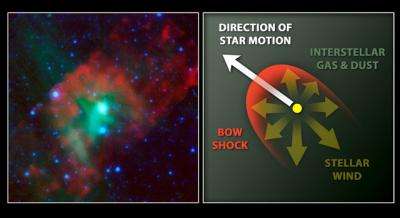
This image layout illustrates how NASA's Spitzer Space Telescope was able to show that a "standard candle" used to measure cosmological distances is shrinking -- a finding that affects precise measurements of the age, size and expansion rate of our universe. Image credit: NASA/JPL-Caltech/Iowa State

(PhysOrg.com) -- Astronomers have turned up the first direct proof that "standard candles" used to illuminate the size of the universe, termed Cepheids, shrink in mass, making them not quite as standard as once thought. The findings, made with NASA's Spitzer Space Telescope, will help astronomers make even more precise measurements of the size, age and expansion rate of our universe.

Standard candles are astronomical objects that make up the rungs of the so-called cosmic distance ladder, a tool for measuring the distances to farther and farther galaxies. The ladder's first rung consists of pulsating stars called variables, or Cepheids for short. Measurements of the distances to these stars from Earth are critical in making precise measurements of even more distant objects. Each rung on the ladder depends on the previous one, so without accurate Cepheid measurements, the whole cosmic distance ladder would come unhinged.

Now, new observations from Spitzer show that keeping this ladder secure requires even more careful attention to Cepheids. The telescope's infrared observations of one particular Cepheid provide the first direct evidence that these stars can lose mass-or essentially shrink. This could affect measurements of their distances.

"We have shown that these particular standard candles are slowly consumed by their wind," said Massimo Marengo of Iowa State University, Ames, Iowa, lead author of a recent study on the discovery appearing in the Astronomical Journal. "When using Cepheids as standard candles, we must be extra careful because, much like actual candles, they are consumed as they burn."

The star in the study is Delta Cephei, which is the namesake for the entire class of Cepheids. It was discovered in 1784 in the constellation Cepheus, or the King. Intermediate-mass stars can become Cepheids when they are middle-aged, pulsing with a regular beat that is related to how bright they are. This unique trait allows astronomers to take the pulse of a Cepheid and figure out how bright it is intrinsically-or how bright it would be if you were right next to it. By measuring how bright the star appears in the sky, and comparing this to its intrinsic brightness, it can then be determined how far away it must be.

This calculation was famously performed by astronomer Edwin Hubble in 1924, leading to the revelation that our galaxy is just one of many in a vast cosmic sea. Cepheids also helped in the discovery that our universe is expanding and galaxies are drifting apart.

Cepheids have since become reliable rungs on the cosmic distance ladder, but mysteries about these standard candles remain. One question has been whether or not they lose mass. Winds from a Cepheid star could blow off significant amounts of gas and dust, forming a dusty cocoon around the star that would affect how bright it appears. This, in turn, would affect calculations of its distance. Previous research had hinted at such mass loss, but more direct evidence was needed.

Marengo and his colleague used Spitzer's infrared vision to study the dust around Delta Cephei. This particular star is racing along through space at high speeds, pushing interstellar gas and dust into a bow shock up ahead. Luckily for the scientists, a nearby companion star happens to be lighting the area, making the bow shock easier to see. By studying the size and structure of the shock, the team was able to show that a strong, massive wind from the star is pushing against the interstellar gas and dust. In addition, the team calculated that this wind is up to one million times stronger than the wind blown by our sun. This proves that Delta Cephei is shrinking slightly.

Follow-up observations of other Cepheids conducted by the same team using Spitzer have shown that other Cepheids, up to 25 percent observed, are also losing mass.

"Everything crumbles in cosmology studies if you don't start up with the most precise measurements of Cepheids possible," said Pauline Barmby of the University of Western Ontario, Canada, lead author of the follow-up Cepheid study published online Jan. 6 in the . "This discovery will allow us to better understand these stars, and use them as ever more precise distance indicators."

The Spitzer observations were made before it ran out of its liquid coolant in May 2009 and began its warm mission.

Provided by JPL/NASA search and more info website

Filter


Move the slider to adjust rank threshold, so that you can hide some of the comments.


Display comments: newest first

Skultch
Jan 12, 2011

Rank: 4.4 / 5 (7)
A min / max % of variation would be nice. So is this verse 13.7 B yrs old, 15, 30, 5? How far off could we be?
lengould100
Jan 12, 2011

Rank: 3.3 / 5 (3)
Doesn't sound like they've done enough analysis yet to say that for sure. Looks like the variation due to mass loss shouldn't be huge though, perhaps "in the range of" one percent over the time period we've been using them.
Modernmystic
Jan 12, 2011

Rank: 4.2 / 5 (5)
I couldn't imagine it being off by too much, there are other factors that lend credence to the age of the universe.

Skultch...do I detect a fellow Firefly fan in your speech patterns?
Skultch
Jan 12, 2011

Rank: 4.2 / 5 (5)


Skultch...do I detect a fellow Firefly fan in your speech patterns?


HUGE fan. What gave you the idea?

Ohhh. Verse. Yep, got that from Firefly. Makes sense to use if there's a possible multi out there.
Modernmystic
Jan 12, 2011

Rank: 3.7 / 5 (3)
HUGE fan.


Shiny! :-)
MorituriMax
Jan 12, 2011

Rank: 3.7 / 5 (3)
Just don't let this article damage your calm TOO much. Hmmm, Cepheids shrinking, universe expansion accelerating, any correlation?
QuantaUniverseCom
Jan 12, 2011

Rank: 2.2 / 5 (13)
the cepheids mass loss could be substantial enough to discredit an expanding universe! STOP believing in predetermined and imaginary dark energy acceleration that was determined by proven incoorrect imprecise measurements. type la supernova used to measure dark energy are worthless and result from two white dwarfs colliding of varying mass and angular momentum. Its time for an open minded scientific analysis from new data to show us if the universe could instead be contracting for all we know cause the big-bang was not the beginning of everything
QuantaUniverse.com
Skeptic_Heretic
Jan 12, 2011

Rank: 3 / 5 (4)
They would have to be losing mass at such an extreme rate that the friction of the molecules would shine brilliantly in order to be counteracting inflation entirely.
shavera
Jan 12, 2011

Rank: 5 / 5 (7)
@QuantaUniverseCom, this IS open minded scientific analysis. This is the essence of science. We have an idea that works generally well, and we refine it through further observation.
(to others, yes I know they may be trolling/self-promoting)
rah
Jan 13, 2011

Rank: 5 / 5 (1)
Seriously, why write this article without some ciphers to bounce around? Are the Cephids now 5% less reliable or .0005%?
frajo
Jan 13, 2011

Rank: 5 / 5 (1)
in the constellation Cepheus, or the King
To be more precise:
Cepheus, the Latinized form of Kephevs, does not mean king. Neither does the ancient Greek word "kephevs" mean gardener - contrary to the wikipedia article on "Cepheus". Instead, gardener is kepevs in ancient Greek.

In this context, Cepheus is the name of the king of Aethiopia, husband of Cassiopeia, and father of Andromeda - personalities of Greek mythology.
Bob_Kob
Jan 13, 2011

Rank: 1 / 5 (5)
This is why I'm skeptical about cosmology. While they've done some fantastic things with the technology currently available, there is just no way of knowing precisely if their calculations are correct. There are many many assumptions being used and until we get out into the universe and test these phenomena out first hand we won't know whats truly beating in the hearts of galaxies.
antialias
Jan 13, 2011

Rank: 5 / 5 (3)
Are the Cephids now 5% less reliable or .0005%

With one star having been studied closely there isn't enough power for a statistical analysis (yet). Of the other 25% mentioned we first need to figure out how much mass they lose to come to a new estimate.

This is why I'm skeptical about cosmology.

People should stop being so black/white about things. That a measurement has produced a (slightly) different result does not automatically invalidate an entire theory. Theories are not like mathematical proofs - they are approximations (always). This means they can take some beating before one can consider them 'failed'. The better the theory the less the margin for such errors.

The new knowledge being incorporated over the past years is still so close to the expected values that the 'standard model of cosmology' is not really in any danger. Even so the best course is to adapt it, rather than to replace it (because it _does_ give such good results for the most part)

omatumr
Jan 13, 2011

Rank: 1 / 5 (6)
ILLUSIONS vs REALITY:

All stars, including the Sun, discard waste products (mostly H & He) from the stellar engine (a neutron star): The solar wind.

Waste products become incandescent and glow brightly in the part that astronomers study: e.g., The photosphere.

That is NOT the star: We live in the Sun's outer layer, the heliosphere.

That veneer of waste products is like the veil on a bride. It hides information on the material below.

Astronomers are like grooms: Fascinated by the bride's veil.

1. "The Sun's origin, composition and source of energy",
Abstract 1041 , 32nd Lunar and Planetary Science Conf.,
Houston, TX, March 12-16, 2001, LPI Contribution 1080,
ISSN No. 0161-5297 (2001): arxiv.org/pdf/astro-ph/0411255v1

2. "Gamma-Ray Flares from the Crab Nebula,"
ScienceXpress, 6 Jan 2011, 10.1126/science.1199705
(Copy supplied on request)

Oliver K. Manuel
Former NASA Principal
Investigator for Apollo
Parsec
Jan 13, 2011

Rank: 5 / 5 (3)
the cepheids mass loss could be substantial enough to discredit an expanding universe! STOP believing in predetermined and imaginary dark energy acceleration that was determined by proven incoorrect imprecise measurements. type la supernova used to measure dark energy are worthless and result from two white dwarfs colliding of varying mass and angular momentum. Its time for an open minded scientific analysis from new data to show us if the universe could instead be contracting for all we know cause the big-bang was not the beginning of everything
QuantaUniverse.com

No. Type 1a supernovas are white dwarfs of about 1.3 solar masses blowing up. They may or may not be as accurate as we are assuming, but they are pretty constant in intrinsic brightness.
eachus
Jan 13, 2011

Rank: 5 / 5 (2)
There is a very good reason why the article says that there MAY be a problem with Cephids as standard candles. If the period of the pulses changes as the star loses mass, there would be no problem. The fact that Cephids have a large amount of surrounding gas could also make them less accurate, but that is likely to be a random effect--if all Cephids are blowing off large amounts of gas, the location of the star may mean that more or less gas is in the line of sight from Earth. In other words which way the (interstellar) wind is blowing in the area of the Cephid would mean we are looking through more or less gas.

But the important thing to know is that in a statistical sense all of these effects would introduce unbiased errors in distance measurements. Not closer, not further away, for any particular measurement, just less certain.

Note that combined with the just reported improvement in 1a Supernovas as standard candles, the distance scale should become more accurate.
rwinners
Jan 13, 2011

Rank: not rated yet
This is why I'm skeptical about cosmology. While they've done some fantastic things with the technology currently available, there is just no way of knowing precisely if their calculations are correct. There are many many assumptions being used and until we get out into the universe and test these phenomena out first hand we won't know whats truly beating in the hearts of galaxies.


Yes... and no. In order to 'get out' into the universe, we will need a form of propulsion that is now non-existent. Or.. the 'we' you speak of will be made up of those a huge number of generations removed from 'us'.
We are stuck in our own space/time and can't 'get out there'. Sad to say, because I'd like to know too!
rwinners
Jan 13, 2011

Rank: not rated yet
"But the important thing to know is that in a statistical sense all of these effects would introduce unbiased errors in distance measurements. Not closer, not further away, for any particular measurement, just less certain."

Well, yes... and no.. again. Just how many Cephids are we talking about? I'd guess, just guess, that we'd need a good statistical sampling to better understand the phenomenon.

But you are correct. This just makes the theory slightly less certain. Other things may come along to do the same.

RocketRangerRick
Jan 14, 2011

Rank: 3.7 / 5 (3)
Now I have to admit up front that all I know of Cosmology is what I've heard from my cousin Stella, who gradgiated from Cosmology Skool and tells me she works with a bunch of big stars...

That said, I've been skeptical of Dark Matter and Dark Energy from day one.
One variation in a single constant we use to model the cosmos might not explain the discrepancies that we explain away with the magical properties of Dark Matter and Dark Energy, but what if a series of constants were not so constant?

In recent years, I've read that the speed of light may not even be universally constant. There may well be other slight variations in our standards which collectively would account for the convenient inclusion of ethereal forces from the great beyond.

So from my layman's perspective, it seems that minor variations in a series of presumed constants could conceivably add up to a very different picture.

What say you all?
rwinners
Jan 14, 2011

Rank: not rated yet
Hey Rocket! Where's that Cosmology skool? I wanna go!
Decimatus
Jan 16, 2011

Rank: not rated yet
What we need is a big rocket that can put dozens of giant space telescopes into orbit.
soulman
Jan 16, 2011

Rank: 1 / 5 (3)
I've been skeptical of Dark Matter and Dark Energy from day one.

Who cares? You've just admitted that you haven't the faintest clue about cosmology, so your so-called skepticism is of little importance.

What say you all?

I'd say enroll in that Skool of Cosmology and get some facts under your belt first.
Decimatus
Jan 16, 2011

Rank: not rated yet
I've been skeptical of Dark Matter and Dark Energy from day one.

Who cares? You've just admitted that you haven't the faintest clue about cosmology, so your so-called skepticism is of little importance.

What say you all?

I'd say enroll in that Skool of Cosmology and get some facts under your belt first.


Facts? I have seen many theories, and lots of circumstantial evidence, but facts?

The day a Unified Field Theory that explains every possible detail in the universe is they day these assumptions become fact.
soulman
Jan 16, 2011

Rank: 2 / 5 (4)
Facts? I have seen many theories, and lots of circumstantial evidence, but facts?

Yes, there are theories and facts, it's all a part of science.
The day a Unified Field Theory that explains every possible detail in the universe is they day these assumptions become fact.

A GUT theory, even if it can ever be discovered, will not be able to 'explain every possible detail in the universe'.
Decimatus
Jan 16, 2011

Rank: not rated yet
Yes, there are theories and facts, it's all a part of science. A GUT theory, even if it can ever be discovered, will not be able to 'explain every possible detail in the universe'.


Facts are part of science, but that doesn't mean they are (all) part of cosmological physics. There are no facts proving a big bang, what happens inside stars and black holes, what happens in the space between galaxies, etc etc.

There are hints here and there that we infer and assume to represent possible facts that MIGHT exist, but not actual facts.

And plenty of well thought out theories to explain inferences and assumptions to fit the data, but those aren't facts either.

And I think a single theory or combination of theories, that finally figures out how our primary forces work,s hould be able to explain all observable phenomenon. Not included ever smaller sub-sub-sub-atomic phenomenon, but at least the mechanics the general universe.

soulman
Jan 17, 2011

Rank: 2.4 / 5 (5)
There are no facts proving a big bang

There are many, many facts which corroborate a big bang event.
what happens inside stars and black holes

Here we don't know all the facts, but we have sufficient facts to construct plausible theories, aspects of which can be tested in the lab. I don't see your point.
what happens in the space between galaxies

Nothing much, I expect. Some cosmic rays buzzing around, CMB radiation, various quantum fields, photons, gases, the odd ejected planet or star, creation of space, etc. Again, what was the point?
There are hints here and there that we infer and assume to represent possible facts that MIGHT exist, but not actual facts.

There are no ACTUAL facts - in science, everything is provisional.
(more...)
soulman
Jan 17, 2011

Rank: 2.6 / 5 (5)
)cont...)

Compare this:
And I think a single theory or combination of theories, that finally figures out how our primary forces work,s hould be able to explain all observable phenomenon.

with this:
Not included ever smaller sub-sub-sub-atomic phenomenon, but at least the mechanics the general universe.

Describing the 'mechanics of the general universe' is what a GUT would do, but not 'every possible detail in the universe', which is way too broad.

And to the contrary, a GUT should be able to describe 'ever smaller sub-sub-sub-atomic phenomena'. That's it's raison d'etre.

Decimatus
Jan 17, 2011

Rank: not rated yet
There are many, many facts which corroborate a big bang event.


I don't dispute that there are good hints and clues and theories. What I dispute is talking about these theories that are layer upon layer of assumptions as if they were fact.

Fact - Gravity and velocity redshift/blueshift light.
Not Fact - Multi-Billion year old light is an accurate predictor of velocity.

Fact - We can use spectrums to determine elemental composition.
Not Fact - Determining elemental composition of a solar surface, or even of the ejected remnants of a nova, tells us what the inner core of the star consists of.

Nothing much, I expect. Some cosmic rays buzzing around, CMB radiation, various quantum fields, photons, gases, the odd ejected planet or star, creation of space, etc. Again, what was the point?


Mythical Dark Energy was the point here, in addition to the possibly vast amount of "Dark" matter such as gas, blackholes, and otherwise dead rocks.
Decimatus
Jan 17, 2011

Rank: not rated yet
There are no ACTUAL facts - in science, everything is provisional.
(more...)


You could go this route all day really. But there are common facts that are easy to prove and demonstrate. And then there are facts which are inferred and projected from other facts. Those don't count as facts.

Describing the 'mechanics of the general universe' is what a GUT would do, but not 'every possible detail in the universe', which is way too broad.

And to the contrary, a GUT should be able to describe 'ever smaller sub-sub-sub-atomic phenomena'. That's it's raison d'etre.


At some point, defining the exact laws of the quark level, or the level below that, should give us everything we need to know about the observable universe. I don't expect the next big theory to cover all levels to infinity.

When we don't really have solid understanding of gravity and light, it is hard to define the universe in terms of facts.

frajo
Jan 17, 2011

Rank: 4.7 / 5 (3)
Facts? I have seen many theories, and lots of circumstantial evidence, but facts?

Yes, there are theories and facts, it's all a part of science.
No. Theories and observations are part of science. Facts are part of philosophy. Whether you take models for reality is your philosophical (metaphysical) decision.
douglas2
Jan 17, 2011

Rank: not rated yet
Another correction that can help to explain this idea of accelerating expansion, or dark energy. Maybe they are just not as far away as the intrinsic brightness implies. Older Cepheids are partially obscured.
Skeptic_Heretic
Jan 17, 2011

Rank: 5 / 5 (4)
I don't dispute that there are good hints and clues and theories. What I dispute is talking about these theories that are layer upon layer of assumptions as if they were fact.
This is wrong. A scientific theory is the highest form of statement within science. Theory constitutes the totality of knowledge on the subject in which it is a component.

To dismiss theory as such is a reflection of your not understanding science.
rwinners
Jan 17, 2011

Rank: not rated yet
"This is wrong. A scientific theory is the highest form of statement within science. Theory constitutes the totality of knowledge on the subject in which it is a component."

In most fields of science, this is correct. However, in cosmology, there are far more unknowns, things that fall outside the accepted laws of physics. In other words, cosmological theory relies far more on conjecture and supposition than on tested results, and will always do so because human beings simply cannot go "there" to 'see' what is happening.
Skeptic_Heretic
Jan 17, 2011

Rank: not rated yet
In most fields of science, this is correct. However, in cosmology, there are far more unknowns, things that fall outside the accepted laws of physics. In other words, cosmological theory relies far more on conjecture and supposition than on tested results, and will always do so because human beings simply cannot go "there" to 'see' what is happening.
You're talking about the mathematical theories of the universe, ie: String Theory and Black Hole Theory, which are jsut applications of other founded and proved natural theories.

They're under debate, but there are no contrary observations.
soulman
Jan 17, 2011

Rank: 2 / 5 (4)
Facts? I have seen many theories, and lots of circumstantial evidence, but facts?

Yes, there are theories and facts, it's all a part of science.
No. Theories and observations are part of science. Facts are part of philosophy. Whether you take models for reality is your philosophical (metaphysical) decision.

You quote that part, but not this:
There are no ACTUAL facts - in science, everything is provisional.

The first response was simply a generalization - facts as in things which aren't disputable or that have been verified countless times in various tests, but not in a philosophical sense.
rwinners
Jan 17, 2011

Rank: not rated yet
You're talking about the mathematical theories of the universe, ie: String Theory and Black Hole Theory, which are jsut applications of other founded and proved natural theories.

They're under debate, but there are no contrary observations. "

Actually, strings have never been observed. They are mathematical constructs. Possibilities, nothing more. Smallest thing that is commonly accepted is the electron, as far as I know.
Many other of the 'tiny things' have never been observed, either. Quarks of all sorts are acknowledged by their energy signatures, left as a particle is annihilated.
I'll even postulate that there are (in)finitely smaller particles, but we will never find them because the energy needed to do so is unobtainable. Just of guess, of course.
rwinners
Jan 17, 2011

Rank: not rated yet
Tonight, on the "Science" channel is a program called "Into the Universe" . Sub-title is: "The Story of Everything Series/Special (2010) The universe from it's beginning to how it will likely end."

At least they said 'likely' end. As for beginning, it sounds pretty absolute.

Pure quackery.
Skeptic_Heretic
Jan 18, 2011

Rank: not rated yet
Actually, strings have never been observed. They are mathematical constructs. Possibilities, nothing more. Smallest thing that is commonly accepted is the electron, as far as I know.
Quite wrong.
Many other of the 'tiny things' have never been observed, either. Quarks of all sorts are acknowledged by their energy signatures, left as a particle is annihilated.
Also quite wrong.

If you're going to guess, then you're not in a position to argue facts and evidence.
frajo
Jan 18, 2011

Rank: 5 / 5 (2)
Facts? I have seen many theories, and lots of circumstantial evidence, but facts?
Yes, there are theories and facts, it's all a part of science.
No. Theories and observations are part of science. Facts are part of philosophy. Whether you take models for reality is your philosophical (metaphysical) decision.
You quote that part, but not this:
There are no ACTUAL facts - in science, everything is provisional.
The first response was simply a generalization - facts as in things which aren't disputable or that have been verified countless times in various tests, but not in a philosophical sense.
You are right. There were several contextual levels involved of which I addressed only one.
Facts, as in "you see it, I see it, and even the evil fat capitalist over there doesn't deny it", are indeed parts of science.
RocketRangerRick
Jan 18, 2011

Rank: not rated yet
Facts? I have seen many theories, and lots of circumstantial evidence, but facts?

Yes, there are theories and facts, it's all a part of science.
The day a Unified Field Theory that explains every possible detail in the universe is they day these assumptions become fact.

A GUT theory, even if it can ever be discovered, will not be able to 'explain every possible detail in the universe'.

RocketRangerRick
Jan 18, 2011

Rank: not rated yet
(oops, ignore previous post, I clicked on the wrong quote)

I've been skeptical of Dark Matter and Dark Energy from day one.

Who cares? You've just admitted that you haven't the faintest clue about cosmology, so your so-called skepticism is of little importance.

What say you all?

I'd say enroll in that Skool of Cosmology and get some facts under your belt first.


Hey uh Soulman... just joking around a bit here.
The truth is that I've been a science nerd for about forty years. I read Scientific American, watch the Discovery Channel shows and try to glean as much as I can from the popular scientific media.
Which is why I felt I should confess up front that I'm not an expert.

I suppose I should also admit that I don't really have a cousin named Stella.

(Stella is Latin for Star.)
rwinners
Jan 19, 2011

Rank: not rated yet
Actually, strings have never been observed. They are mathematical constructs. Possibilities, nothing more. Smallest thing that is commonly accepted is the electron, as far as I know.
Quite wrong.
Many other of the 'tiny things' have never been observed, either. Quarks of all sorts are acknowledged by their energy signatures, left as a particle is annihilated.
Also quite wrong.

If you're going to guess, then you're not in a position to argue facts and evidence.


Provide links to show I'm wrong.
Skultch
Jan 20, 2011

Rank: not rated yet
Many other of the 'tiny things' have never been observed, either. Quarks of all sorts are acknowledged by their energy signatures, left as a particle is annihilated.
Also quite wrong.


Which part? Just the other day, I heard a former Cambridge physicist on NPR say that quarks are indeed inferred. Then again, he also said quantum theory means there is randomness in the universe allowing for god and free will.
Rank 5 /5 (15 votes)
Relevant PhysicsForums posts
  • revamping general concept and cosmological principle
    created22 hours ago
  • Transiting Exoplanet Light Curve
    createdMay 25, 2012
  • Math behind Theoretical Physics
    createdMay 24, 2012
  • Do we know whats at the center of galaxies yet?
    createdMay 23, 2012
  • Structure of the Milky Way?
    createdMay 20, 2012
  • What would it take to terraform Pluto and Charon?
    createdMay 19, 2012
  • More from Physics Forums - General Astronomy

More news stories

Astronomers seize last chance in lifetime for Venus Transit

Astronomers are gearing for one the rarest events in the Solar System: an alignment of Earth, Venus and the Sun that will not be seen for another 105 years.

Space & Earth / Astronomy

created 3 hours ago | popularity 5 / 5 (1) | comments 0

Australia hails surprise super-telescope decision

Australia has hailed a surprise decision giving it a role in a radio telescope project aimed at revolutionising astronomy, vowing to draw on its decades of experience in space science.

Space & Earth / Astronomy

created 3 hours ago | popularity 5 / 5 (1) | comments 0

SpaceX capsule has 'new car' smell, astronauts say

SpaceX's Dragon cargo vessel smells like a new car, said astronauts at the International Space Station after opening the hatches Saturday following the spacecraft's landmark mission to the orbiting lab.

Space & Earth / Space Exploration

created 3 hours ago | popularity not rated yet | comments 0

Astronauts enter world's 1st private supply ship

(AP) -- Space station astronauts floated into the Dragon on Saturday, a day after its heralded arrival as the world's first commercial supply ship.

Space & Earth / Space Exploration

created 3 hours ago | popularity 5 / 5 (2) | comments 0

Dragon makes history with space station docking

The private company SpaceX made history Friday with the docking of its Dragon capsule to the International Space Station, the most impressive feat yet in turning routine spaceflight over to the commercial ...

Space & Earth / Space Exploration

created 18 hours ago | popularity 4.9 / 5 (7) | comments 0


SpotterRF debuts Radar Backpack Kit (w/ Video)

(Phys.org) -- SpotterRF has announced a special radar backpack kit designed to enhance situational awareness for soldiers on the ground. The company says its special radar is designed for warfighters as part ...

Family history of Alzheimer's affects functional connectivity

(HealthDay) -- Cognitively normal individuals with a family history of late-onset Alzheimer's disease (AD) may display lower resting state functional connectivity in the default mode network (DMN) of the brain, ...

Transvaginal mesh op restores pelvic organ prolapse at price

(HealthDay) -- Transvaginal mesh (TVM) procedures are effective for anatomical restoration of pelvic organ prolapse (POP), but patients report a worsening of sexual function following surgery, according to ...

Travel to high altitudes tied to Crohn's, colitis flare-ups

(HealthDay) -- People with inflammatory bowel disease, which includes Crohn's disease and colitis, may be at increased risk for flare-ups when they fly or travel to high altitudes for skiing or mountain climbing, ...

Thousands of shellfish found dead in Peru

Thousands of crustaceans were found dead off the coast of Lima following the mystery mass death of dolphins and pelicans, the Peruvian Navy said Friday.

High-speed method to aid search for solar energy storage catalysts

Eons ago, nature solved the problem of converting solar energy to fuels by inventing the process of photosynthesis.